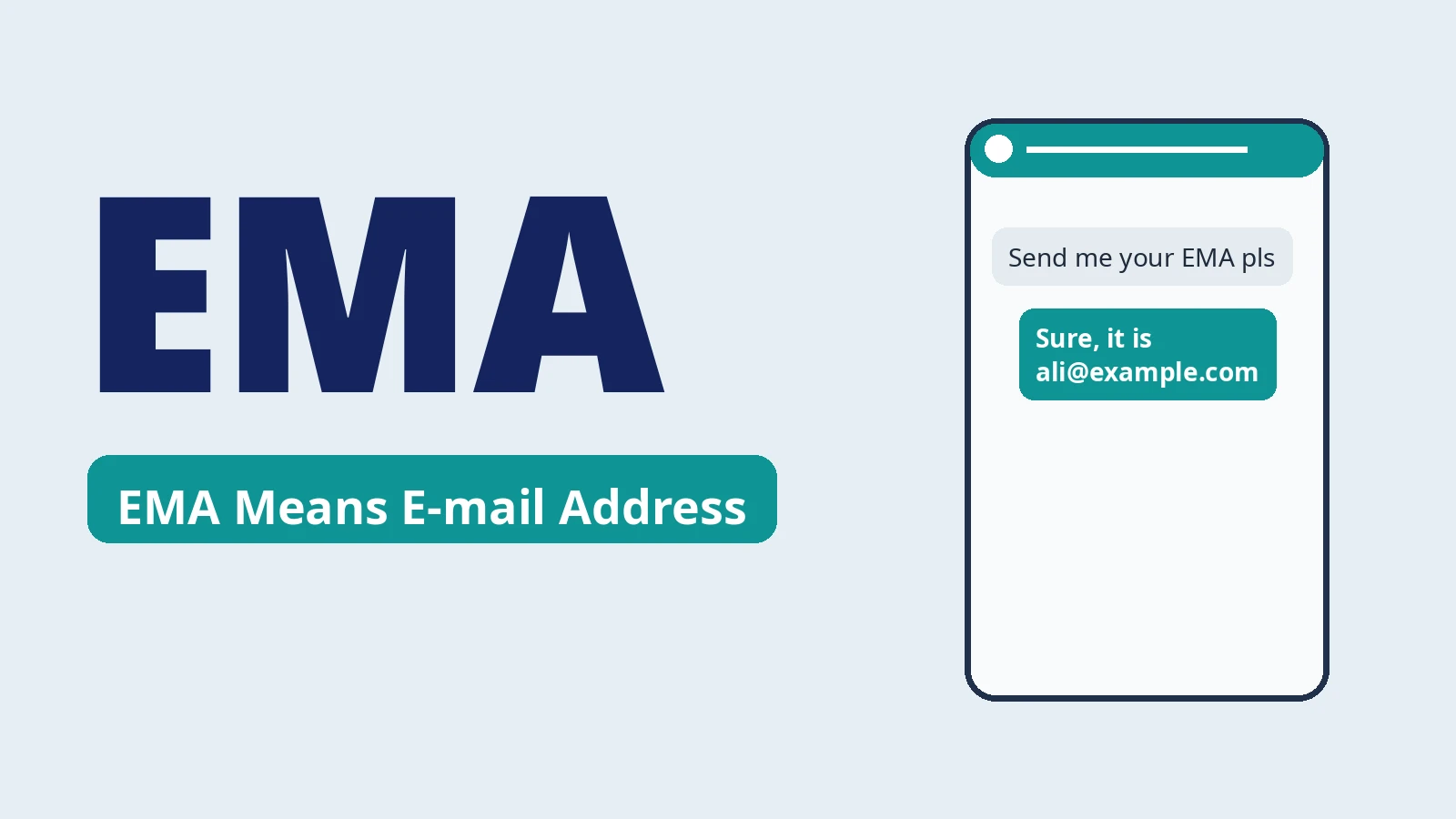
Your colleague messages you out of nowhere: “Send EMA pls.”
No file attached. No link. No explanation. Just three letters and a polite “please”. Do they want a document? A report? A meeting?
Here is the short answer: EMA means “e-mail address”. Your colleague is asking for your email address, probably to send you a file or add you to a thread. It is a rare shorthand, so most people have never seen it before, and that is exactly why it causes confusion.
In this guide you will see EMA in real chats, learn why it is so uncommon, find out where it fits and where it fails, and learn the trading meaning that can trip up anyone who searches for it.
What Does EMA Mean in Text?
EMA stands for E-mail Address.
That lead rests on solid agreement. CyberDefinitions gives “E-mail Address” as its quick answer for EMA and calls it the most common meaning in texting, while flagging that EMA is a rare term. The top niche guide for “EMA meaning in text” agrees word for word, describing EMA as the email address shorthand people use to save time when sharing contact details. Acronym lists back it up too, with TheFreeDictionary listing “Electronic Mailing Address” among EMA expansions. No dictionary contradicts this lead. The only honest warning is about frequency: EMA is real, but it is not mainstream.
Quick definition: EMA means “e-mail address”. It is used in texts and chats as a short way to ask for, share, or refer to someone’s email address, usually when files, invites, or login details are involved. As an EMA email address abbreviation, it saves typing but costs clarity with strangers.

The rarity matters. Unlike BRB or LOL, EMA never went viral. Most people write out “email” or “email address” in full, so EMA only appears in small circles, quick work chats, and messages from people who love compressing everything. If you have never seen it, that does not mean the sender made it up. It means you met one of texting’s quieter shortcuts.
EMA Meaning in Easy Words
Think of EMA as a nickname for your email address.
Your email address is long. It has a name, an at sign, and a domain, and typing it on a phone keyboard is annoying. EMA skips all of that:
EMA = “What is your email address?” in three letters.
It works like other contact shortcuts. People write “phone no” instead of “phone number” and “IG” instead of “Instagram”. EMA does the same job for email. The sender is not being mysterious. They are being lazy in a useful way, and they assume you will fill in the rest from context.
The catch is that the assumption often fails. Because EMA is rare, the reader usually stops and wonders what it means, which wipes out the time the shortcut saved. That tension runs through this whole guide: EMA is efficient only when both people already know it.
Where Is EMA Used?
EMA shows up wherever people swap contact details quickly. Common places include:
- Work chats where a colleague needs your email to send a file
- WhatsApp messages when someone wants to add you to a mailing list
- Instagram DMs when a buyer or collaborator asks for a contact address
- Freelance and hiring chats where email is the next step after a first message
- Group chats where an organizer collects addresses for invites
The EMA meaning in texting and social media is the same everywhere, and the EMA meaning in WhatsApp and Instagram follows the same pattern, usually in a short request like “Drop EMA”.
Nobody uses EMA to mean a message itself or a mailbox app. It points at the address only.
Example situations:
- A client asks for your EMA to send a contract
- A friend asks for your EMA to share photos from a trip
- A teacher collects EMAs for a class mailing list
- A seller asks for your EMA to send an invoice
- A new contact asks for your EMA after meeting you at an event
Why Do People Use EMA?
It saves typing
“E-mail address” is thirteen characters plus a space. EMA is three. In a fast chat, that saving feels worth it, especially when the sender asks for addresses all day.
It sounds like insider shorthand
Short forms signal fluency. Someone who writes EMA is showing they live in chats and work messages, the same way “ASAP” signals urgency. The problem is that EMA never became widely known, so the insider signal often lands as confusion instead.
It keeps the chat moving
When both people know the code, “Send EMA” moves faster than “Could you please send me your email address so I can forward the file?” The whole point is speed, and in a trusted work chat it delivers.
Real-Life Examples of EMA
Here is how EMA actually looks in real chats, with the meaning spelled out each time. These EMA abbreviation examples in messages show both the smooth cases and the confused ones:
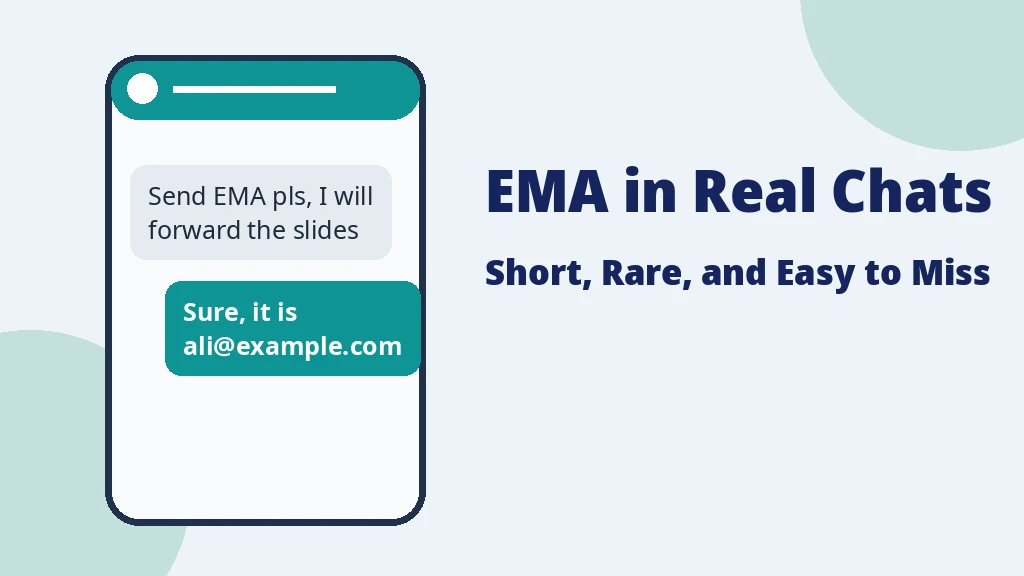
Example 1:
- Colleague: “Send EMA pls, I will forward the slides.”
- You: “Sure, it is ali@example.com.”
Meaning: Please send me your email address so I can send you the slides. The file context makes the meaning clear.
Example 2:
- Friend: “Drop your EMA, I will share the trip photos.”
- You: “Here you go: sara@example.com.”
Meaning: Share your email address with me. Photos and sharing are the giveaway.
Example 3:
- Client: “Kindly share EMA for the invoice.”
- You: “No problem, sending it now.”
Meaning: Please give me your email address so I can send the invoice. Formal tone, same shorthand.
Example 4:
- Friend: “What is your EMA?”
- You: “Do you mean my email address?”
- Friend: “Yes, sorry, email address.”
Meaning: What is your email address? This is the honest reality of EMA: even friendly chats sometimes need a clarification round.
Example 5:
- Organizer: “Everyone, please send EMA by Friday for the invites.”
- You: “Done, just sent mine.”
Meaning: Everyone should send their email address before Friday so invites can go out. The group context removes all doubt.
EMA vs Other Email Shorthand
EMA is not the only short way to talk about email, and the comparison shows why it struggles. The EMA vs email address shorthand question comes down to clarity: every rival is longer, but every rival is instantly understood.
| Term | Meaning | When to use it |
|---|---|---|
| EMA | E-mail address | Only with people who already know it |
| Electronic mail or the address | Everyday use, always understood | |
| Electronic mail, formal spelling | Formal writing and older style guides | |
| Mail ID | Email address, common in South Asia | Regional chats where it is standard |
| DM | Direct message, not email at all | Private chat on a social app |
Key difference: “Email” works with everyone, while EMA works only with insiders. DM is the trap to avoid: a DM lives inside an app, while an EMA is an address you can write to from anywhere. If someone asks for your EMA, they want an address, not a chat inside the app you are already using. For a related short form that causes its own confusion in work chats, here is what BRB means in text and why it fits quick pauses better than contact requests.
EMA Variations You Should Know
“Ema” as a name. Ema is also a personal name, a variation of Emma. If a message says “Ema is coming today”, that is a person, not an abbreviation. Capital letters and context separate the name from the shorthand.
Lowercase “ema” vs capital “EMA”. In casual chats people type “ema” in lowercase, which makes it even easier to mistake for a name. Capital EMA in a trading chart or a medical paper means something else entirely, which brings us to the big rival sense.
EMA in trading. The EMA meaning in trading is completely different: Exponential Moving Average, a technical indicator that tracks price trends. It is the dominant general meaning of EMA, and it dominates search results. In a chat about stocks, EMA means the indicator. In a chat about contact details, EMA means e-mail address. The topic of the conversation decides.
EMA as an institution. The European Medicines Agency also uses EMA as its short name, and researchers use EMA for Ecological Momentary Assessment, a study method. Both are formal uses that never appear as casual chat shorthand. If the message is not about contact details, trading, medicine, or research, ask what the sender means.
How to Reply to EMA
Your reply depends on whether you understood the request and whether you want to share your address.
If you know what it means: just send the address. “Sure, it is ali@example.com” is all it takes, and it keeps the chat moving.
If you are not sure: ask in one line. “Do you mean my email address?” clears it up without embarrassment, and most senders will confirm right away.
If you do not want to share it: offer an alternative. “I would rather keep chatting here, is that OK?” sets a boundary politely.
If you are the sender: do the other person a favour and spell it out the first time. “Can you share your email address (EMA)?” teaches the shorthand while getting the answer. After that, EMA alone will work with that person. For a short form that closes a chat for the night rather than asking for contact details, here is what DWU means in text.
When to Use EMA (and When to Avoid It)
Good situations:
- Messaging a colleague who already uses EMA themselves
- Quick work chats where files and invoices move by email
- Group chats collecting addresses for invites
- Notes and checklists where space is tight
Avoid using EMA when:
- The other person may not know it, which is most people
- The message is formal, such as a first email to a client
- The chat is about trading, where EMA means Exponential Moving Average
- Clarity matters more than saving a few keystrokes
Learning how to use EMA in a text comes down to one rule: use it only after the other person has used it first, or after you have spelled it out once. That way the shortcut saves time instead of creating a second message asking what it means.
Common Misunderstandings About EMA
It does not mean an email message. EMA is the address, not the message itself. “Send EMA” means send the address, not forward an email you received.
It does not mean “email me”. That is close, but not exact. “Email me” is an action. EMA is a noun, the address the action needs.
It is not a typo for “EMMA”. Emma is a name. EMA is an abbreviation. Autocorrect sometimes pushes one toward the other, so read the sentence before assuming.
It is not always about trading. Search results are full of trading charts, but a friend asking for your EMA in a personal chat is not asking about moving averages. Context beats search results every time.
It is not widely understood. The biggest misunderstanding is assuming everyone knows EMA. Most people do not, so the kindest use of EMA is a rare one, saved for people who already speak the same shorthand.
Frequently Asked Questions
What does EMA mean in text?
EMA means e-mail address in text. It is a rare shorthand used to ask for, share, or refer to someone’s email address, usually when files, invites, or invoices are involved.
What is the full form of EMA in texting?
The EMA full form in texting is e-mail address. Acronym lists also record it as electronic mailing address, which means the same thing.
What is EMA in chat?
In chat, EMA is a short request for an email address. A message like “Send EMA pls” means “Please send me your email address.”
Is EMA a common texting term?
No, EMA is rare in texting. CyberDefinitions flags it as a rare term, and most people write out “email” or “email address” instead. Expect the other person to ask what it means.
What does EMA mean in trading?
In trading, EMA means Exponential Moving Average, a technical indicator that tracks price trends. That is the dominant general meaning, but it is not the texting meaning.
Should I use EMA or just write email?
Write “email” unless the other person already uses EMA. The full word is understood by everyone, while EMA only saves time when both people already know it.
Related Texting Slang
Keep exploring the dictionary: the meaning of CV, dni meaning in text, ETP, when someone texts you FYI, GB.
Final Thoughts
EMA is a small, honest shortcut with one big weakness: hardly anyone knows it. When both people know the code, “Send EMA” is fast and clean. When they do not, it costs an extra message of confusion, which defeats the purpose. Use it with people who already use it, spell it out the first time with everyone else, and never assume a trading chat and a contact chat mean the same thing by those three letters.
The references agree on the chat meaning. CyberDefinitions defines EMA as e-mail address in texting, while noting it is a rare term, and Investopedia explains the trading sense, Exponential Moving Average, so you can tell the two worlds apart at a glance.
2 thoughts on “EMA Meaning in Text | Rare, Short, and Easy to Misread”