You are scrolling a feed when a post starts with two small letters: “CW: grief.” The next line is hidden, or the post continues below a warning. Do you read on, or do you scroll past? Those two letters just gave you a choice.
Here is the short answer: CW means “Content Warning.” It is a label placed before a post about a sensitive topic, so readers can decide for themselves whether to read on. You will see it on TikTok, X, Tumblr, Reddit, and other platforms, usually written as “CW: topic” at the very start.
Content warnings are about consent and care, not censorship. They do not hide a post or judge it. They simply say, in advance, what kind of content is coming, so nobody walks into a difficult topic unprepared. This guide explains how CW works, how it differs from TW, how to write one well, and how to reply when you see one.
📌 What Does CW Mean in Text?
CW stands for Content Warning.
A content warning is a short note at the top of a post, video caption, or thread that names a sensitive subject discussed inside. The usual format is simple: “CW” followed by a colon and the topic, for example “CW: grief” or “CW: discussion of illness.” The reader then chooses whether to continue, skip, or come back later.
✅ Quick definition: CW means “Content Warning,” a label placed before sensitive content on social media so readers can choose whether to engage with it. It is written as “CW: topic” at the start of a post, and it covers subjects readers may find upsetting, such as grief, illness, or violence, named plainly without graphic detail.
Content warnings grew out of online communities where people share personal stories. Over time, the practice spread to mainstream platforms, where creators now add CW labels to captions, threads, and video descriptions as a normal courtesy.
💡 CW Meaning in Easy Words
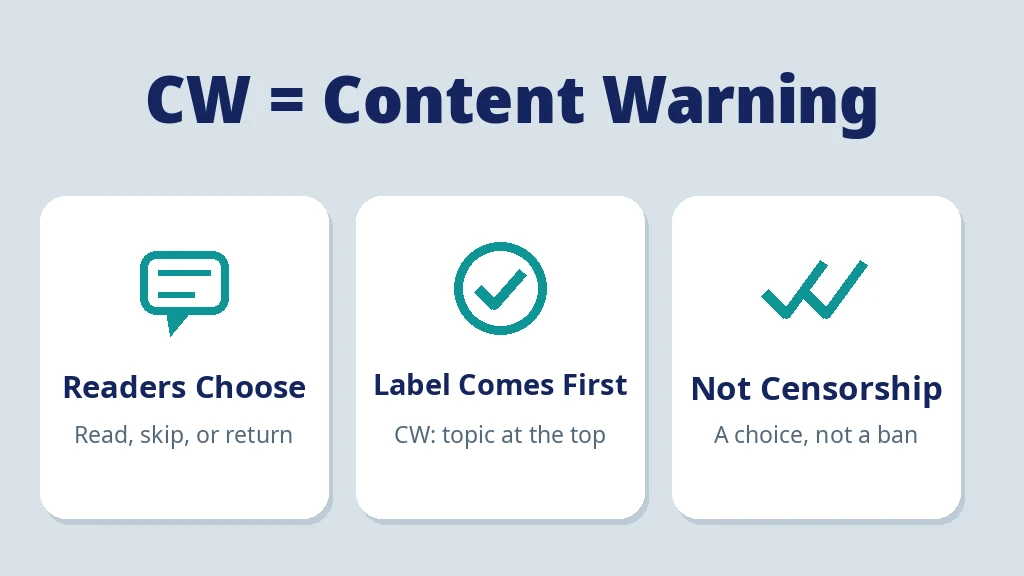
Think of a content warning like a sign on a door.
👉 The sign does not lock the door
👉 It tells you what is inside
👉 You decide whether to walk in
So in the simplest words:
CW = “Heads up, this post covers a sensitive topic.”
That is all it does, and that is enough. Someone grieving, recovering, or simply having a hard day can skip a post about loss, while someone ready to support a friend can read it with care.
Creators also benefit. A clear CW builds trust with an audience, because it shows the poster thought about readers before posting. A post that blindsides people with a heavy topic often gets a worse reaction than the same post with a simple warning at the top.
🌍 Where Is CW Used?
CW lives wherever people share personal stories online.
📱 Common places:
- TikTok captions and video descriptions
- X (Twitter) threads and posts
- Tumblr posts and reblogs
- Reddit support and discussion communities
- Instagram captions and stories
- Personal blogs and fan communities
🗣️ Example situations:
- A creator discusses grief and warns readers first
- A thread about illness starts with a CW for health topics
- A fan post discusses a distressing scene in a show
- A personal story mentions a difficult life event
- A news discussion covers a violent event with a warning
🤔 Why Do People Use CW?
🔥 It gives readers a choice
Choice is the core reason. A reader who knows what is coming can decide to read now, read later, or skip entirely.
😑 It prevents painful surprises
Scrolling is fast and unplanned. Without a warning, a reader can land mid story on a topic that hits close to home, with no time to prepare. A CW slows that moment down just enough.
💬 It builds trust in communities
Communities that warn consistently feel safer to post in, and readers return because they feel respected.
📈 It does not reduce reach for the right audience
A warning does not push readers away. It helps the right readers, those ready for the topic, find the post, while letting others pass by without distress. Everyone wins.
💬 Real-Life Examples of CW
Examples:
Example 1:
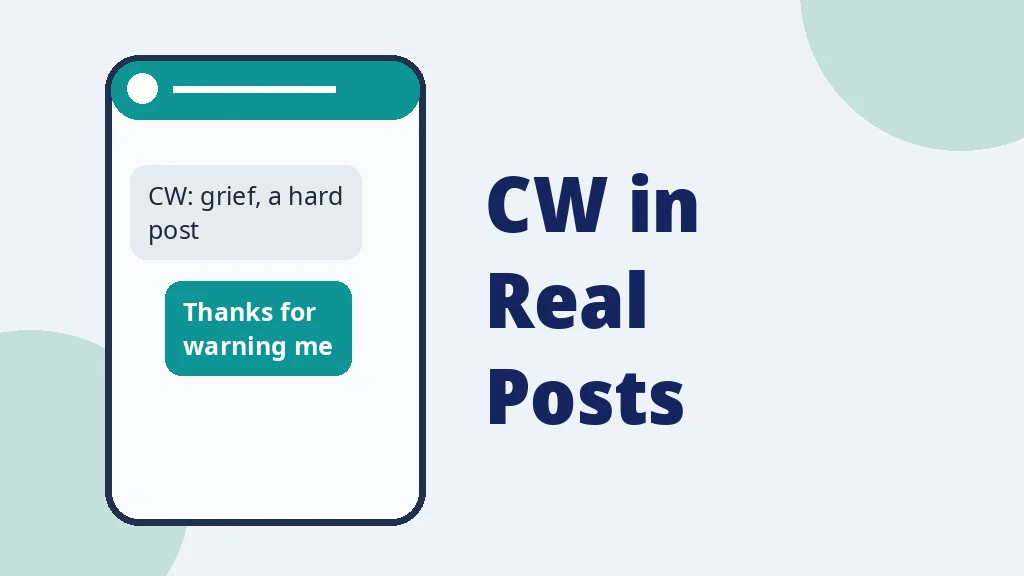
- Post: “CW: grief. Today marks a year since we lost my grandmother, and I wanted to share what helped me through it.”
👉 Meaning: A warning that the post discusses loss, so readers who are grieving can choose whether to read it.
Example 2:
- Video caption: “CW: discussion of illness. Sharing my hospital story in case it helps someone going through the same thing.”
👉 Meaning: A heads up that health and hospital topics follow, named plainly without detail in the warning itself.
Example 3:
- Thread: “CW: spoilers and a distressing scene. The new episode has a moment some viewers may find hard to watch.”
👉 Meaning: A combined warning for plot spoilers and an upsetting scene, so viewers can decide before reading further.
Example 4:
- Comment: “Thanks for adding the CW, I was not ready for that topic today.”
- Poster: “Of course, take care of yourself.”
👉 Meaning: A reader thanking a poster for the warning, showing how much the courtesy is valued.
⚖️ CW vs Similar Terms
| Term | Meaning | How it differs |
|---|---|---|
| CW | Content Warning | General heads up about sensitive content |
| TW | Trigger Warning | Warns about content that may trigger a trauma response |
| NSFW | Not Safe For Work | Flags adult or explicit content, not sensitive topics |
| Spoiler | Plot reveal warning | Protects a story, not a reader’s wellbeing |
| CW (other senses) | Clockwise, Calendar Week, more | Field meanings, not social media labels |
🧠 Key difference:
- CW and TW overlap, but they are not identical. TW historically points at content that could trigger a trauma response, while CW is the broader, more general label for any sensitive topic.
- Many communities now prefer CW because it is wider and less clinical. Some use both, or use CW for general topics and TW for specific trauma related ones.
- NSFW is different again. It flags content unsuitable for work or public screens, usually adult or explicit material, not a sensitive personal topic.
Warning labels are part of a bigger online etiquette. Here is what AWH means in text, a reaction term that, like CW, is all about reading the feeling behind a message before you reply.
🔁 CW Variations You Should Know
“CW: topic” format is the standard. Put the label first, name the topic in a few plain words, and keep graphic detail out of the warning itself. The warning should inform, not shock.
Other senses of CW: Outside social media, CW can mean Clockwise, Calendar Week, Chemical Warfare or Chemical Weapons, Continuous Wave, or The CW television network. Context makes the difference obvious.
↩️ How to Reply to CW
Your reply depends on whether you read the post or skipped it.
If you read it and want to respond: lead with care. “Thanks for sharing this, I am here for you” fits a personal story far better than jumping straight to advice or opinions.
If you skipped it: you do not owe an explanation. A simple “Thanks for the warning, I will catch up later” is polite, and most posters appreciate it.
If a post needed a CW and lacked one: raise it kindly and privately when possible. “Would you mind adding a CW next time?” lands better than a public complaint.
And if a friend warns you before a heavy vent, a plain “I am here, take your time” tells them the warning worked and you are listening. No long reply is needed. Your patience is the reply.
⏰ When to Use CW (and When to Avoid It)
✅ Good situations:
- Posting about grief, illness, or other sensitive life events
- Discussing a distressing scene in a show, book, or game
- Sharing a personal story that touches on a hard topic
- Starting a thread where heavy topics are likely to appear
- Venting to a friend about a tough week, with a quick heads up first
⚠️ Avoid using CW when:
- The post has no sensitive content, since over warning trains readers to ignore labels
- The warning itself contains graphic detail, which defeats its purpose
- You are using it as a joke about a trivial topic, which weakens trust in real warnings
- A platform already hides the content behind its own sensitive media screen
⚠️ Common Misunderstandings About CW
Let’s clear up the confusion around CW:
❌ CW is not censorship. It does not remove or hide a post from willing readers. It adds information before the post so readers can choose.
❌ CW and TW are not exactly the same. They overlap heavily, and many people use them interchangeably, but TW has the narrower trauma related history, while CW is the broader general label.
❌ A CW does not mean the post is graphic. Many warned posts discuss a topic gently and personally, with no detail at all. The warning is about the subject, not the intensity.
❌ CW does not always mean Clockwise. In instructions, recipes, and directions, CW means clockwise, and in business planning it can mean calendar week. On social media, though, Content Warning is the reading to assume first.
💡 Pro Tips for Content Warnings
✅ Put the label first. A warning buried at the end helps nobody. “CW: topic” belongs at the very top, before any detail.
✅ Name the topic plainly. Vague labels like “CW: stuff” force readers to guess. One or two clear words let them decide in seconds.
✅ Keep the warning detail free. The label should inform, not upset. Save the story for below the warning, where readers have chosen to continue.
Related Texting Slang
Keep exploring the dictionary: how people actually use chile, dab, the DM meaning, in plain words, FYP in chats and texts, GOAT in chats and texts, IYKYK, explained with real examples.
Frequently Asked Questions
What does CW mean in text?
CW means “Content Warning,” a label placed before a post about a sensitive topic so readers can choose whether to read on. It is usually written as “CW: topic” at the start of a post.
How do I write a content warning?
Put “CW:” at the very start, then name the topic in a few plain words, for example “CW: grief.” Keep graphic detail out of the warning itself, and list multiple topics separated by commas if needed.
What is the difference between CW and TW?
CW (Content Warning) is the broader, general label for sensitive content. TW (Trigger Warning) historically points at content that may trigger a trauma response. Many communities use them interchangeably, but CW is now the more common general term.
Where is CW used most?
CW is most common on TikTok, X, Tumblr, and Reddit, especially in communities that share personal stories, fan content, and support discussions. It also appears in Instagram captions and blog posts.
Does CW mean anything else?
Yes. Outside social media, CW can mean Clockwise, Calendar Week, Chemical Warfare or Chemical Weapons, Continuous Wave, or The CW television network. On social media, Content Warning is the standard reading.
🧾 Final Thoughts
CW is a small label with a kind job. Two letters, a colon, and a topic give every reader a choice they would not otherwise have, and that choice is what makes online communities feel safer to share in.
Now you know what CW means, how it differs from TW, how to write one, and how to reply when you see one. Next time a post opens with “CW: topic,” you will know what is being offered: not a barrier, but a moment to decide.
For the background, Wiktionary lists content warning among the senses of CW, and Wikipedia describes content warnings as notices that precede content which may be disturbing, letting audiences decide whether to engage with it.