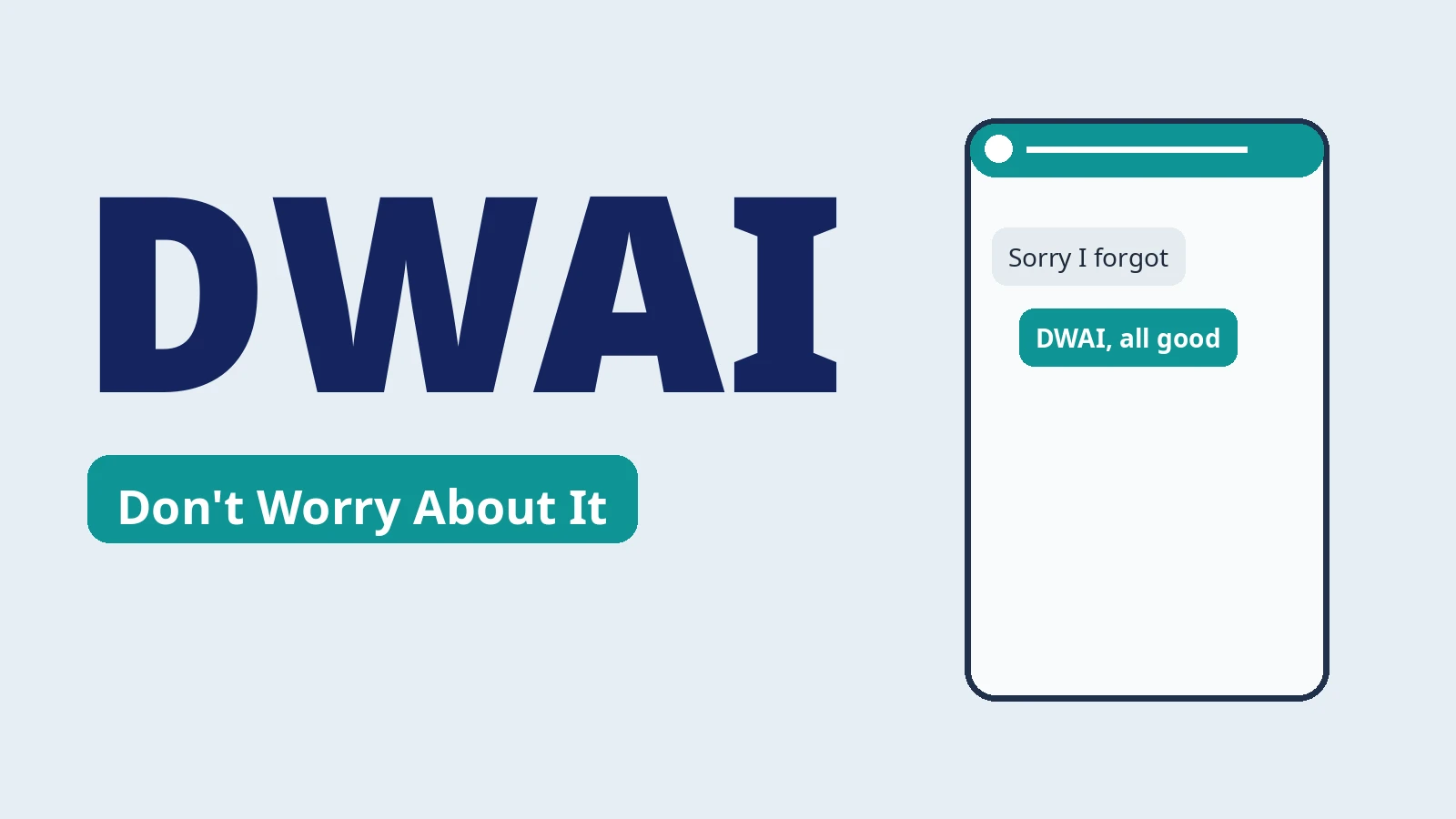
You just sent an apology text, and your stomach tightens a little while you wait. Then the reply arrives: “dwai.” Is that a good thing, or a polite way of saying “whatever, I don’t care”?
Here is the short answer: DWAI means “Don’t Worry About It.” It is a short, warm reply people send after an apology or a small mistake, and it means the issue is not a big deal, they are not upset, and you can stop worrying about it.
This guide explains DWAI in plain words, where it shows up, how it differs from DW and NP, when it can fall flat, and what to send instead when a longer answer is needed.
What Does DWAI Mean in Text?
DWAI stands for Don’t Worry About It. When someone types it in a text message, a chat app, or a comment, they are telling you that whatever you are stressing over is minor, forgiven, or already forgotten.
Quick definition: DWAI means “Don’t Worry About It.” It is used in texts and online chats to reassure someone after an apology or a small mistake, and to signal that there is no resentment and no need for further explaining.
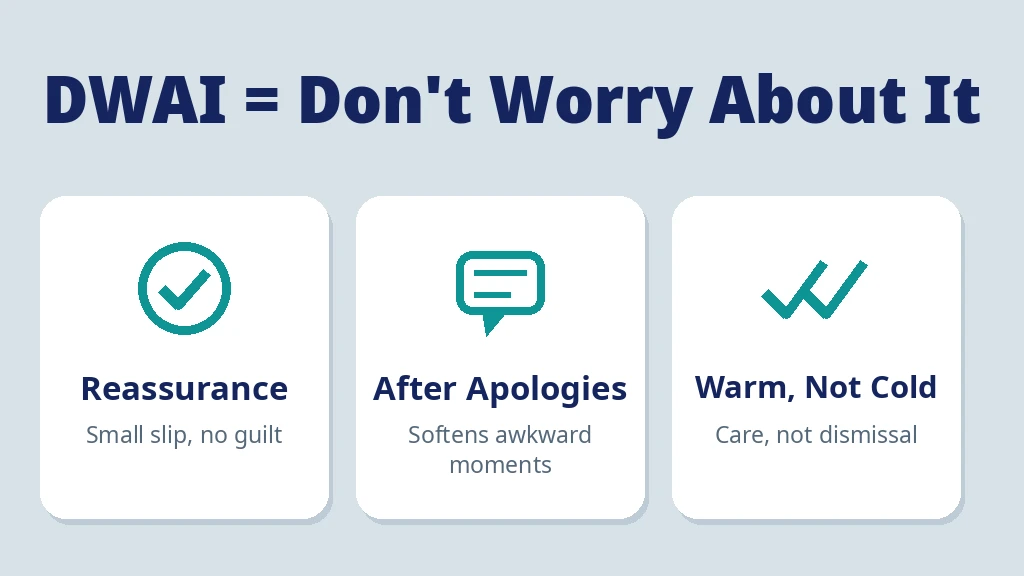
DWAI is pronounced “D-way” when people say it out loud, though most people only ever type it. It is usually written in lowercase as “dwai,” and it works as a complete reply on its own. You do not need to add anything to it, though adding a short sentence, as in “dwai, seriously, it’s fine,” makes the reassurance land even better.
Think of DWAI as a warm pat on the back in text form. It does not just acknowledge your message. It actively releases the guilt attached to it. That is why it feels so relieving to receive after an apology.
DWAI Meaning in Easy Words
In plain words, DWAI usually means one of these: “It’s fine.” “No big deal.” “You don’t need to stress about this.” “I’m not upset with you.” “Let it go, we are good.”
If a friend apologizes for forgetting to reply, and you answer “dwai,” you are saying, “I know you were busy, and it did not damage anything between us.” If a coworker worries about a small slip in a report, and you answer “dwai, we can fix it together,” you are saying, “This is fixable, and I am not holding it against you.”
DWAI is slightly warmer and more complete than a bare “dw.” The extra words, “about it,” point directly at the thing being worried over, which makes the reassurance feel personal rather than generic.
Where Is DWAI Used?
You will see DWAI in text messages, WhatsApp and Messenger chats, Instagram and Snapchat DMs, and group chats, especially when someone apologizes in front of others and deserves a graceful public reply. It also appears in casual work chats, like informal Slack messages between close coworkers, though it belongs firmly in casual territory.
It is not used in formal writing, professional emails, or official messages. Those settings need full sentences and a clear tone. DWAI is for low-stakes, everyday moments: a late reply, a missed plan, a wrong message sent to the wrong chat, a small favor forgotten.
DWAI stays remarkably consistent across platforms. Unlike some slang that shifts meaning by app, DWAI almost always carries the same gentle, comforting tone wherever it appears.
Why Do People Use DWAI?
People use DWAI because it reassures quickly and kindly. A long explanation after a small apology can make the moment feel bigger than it is. DWAI keeps it small, which is exactly what the other person needs.
It also softens the mood after an awkward moment. A wrong message, a forgotten plan, or a clumsy comment can leave a chat feeling tense. DWAI releases that tension in four letters. It shows empathy too: the sender noticed the other person’s worry and chose to answer it directly instead of ignoring it.
Finally, DWAI ends unnecessary guilt. Some people apologize in loops, saying sorry again and again. A clear DWAI breaks the loop. It says, “Heard, forgiven, done,” so both people can move on to normal conversation.
Real-Life Examples of DWAI
Real chats show how DWAI works better than any definition. Read each example, then check the short note underneath it.
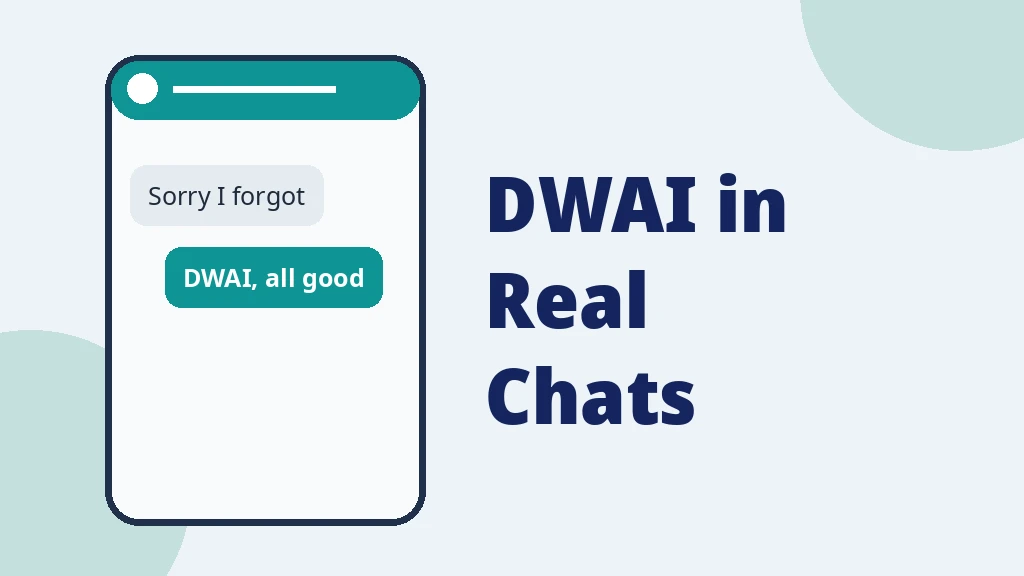
Example 1:
Friend: “Sorry I forgot to text you back yesterday!”
You: “dwai, I know you were busy.”
Meaning: Reassurance that a small mistake is not a problem at all, with a reason that shows understanding.
Example 2:
Friend: “I feel bad I couldn’t make it to your thing.”
You: “dwai, there will be other times.”
Meaning: Genuine comfort. The missed event is treated as a scheduling fact, not a personal slight.
Example 3:
Friend: “Ugh, I sent that message to the wrong chat lol.”
You: “dwai, happens to everyone.”
Meaning: A light, easygoing brush-off. The awkward slip is normalized, so embarrassment fades.
Example 4:
Coworker: “I think I messed up the report a bit.”
You: “dwai, we can fix it together.”
Meaning: Support plus a plan. The reassurance is paired with teamwork, so it does not sound dismissive.
Example 5:
Friend: “Sorry, I was short with you earlier. Long day.”
You: “dwai. Get some rest, we are good.”
Meaning: Forgiveness for a tone slip, with a caring follow-up that proves the friendship is intact.
Notice the pattern. In every example, DWAI answers a worry, not a question. It is a response term. You send it after someone else shows concern, not as an opening line.
DWAI vs Similar Internet Terms
DWAI has close neighbors, and the differences are worth knowing. DW means “Don’t Worry” and is the shorter cousin: same comfort, slightly less specific. DWAI points at the specific worry (“about it”), while DW is a general calm-down. In practice, people use them interchangeably, and nobody will fault you for picking either one.
NP means “No Problem” and usually answers a thank-you or confirms a favor was easy. It is neutral, while DWAI is warm. “All good” is similarly relaxed but vaguer. “It’s fine” can sound flat or even distant without a friendly tone. IDC means “I Don’t Care,” which is dismissive, the opposite of DWAI’s care. “No worries” is the closest full-phrase cousin, friendly and almost identical in meaning.
One DWAI reading belongs outside texting entirely. In New York and Colorado law, DWAI stands for Driving While Ability Impaired, a traffic charge for driving with impaired ability, usually at a lower level than a full DUI charge. That is a legal term, not a texting meaning, and it only fits in legal or news contexts. In a chat, DWAI means “Don’t Worry About It.” You can see how other short forms carry context meanings too in our guide to SMH meaning in text, and how quick replies work in our guide to BRB meaning in text.
When to Use DWAI (and When to Avoid It)
Use DWAI when a friend apologizes for something small, when someone feels guilty over a minor mistake, in casual conversations where reassurance is needed, and when you want to keep the mood light and stress-free. In those moments, DWAI shines.
Avoid DWAI when someone is dealing with something serious or emotionally heavy, because a four-letter reply can feel like you are not listening. Avoid it in formal or professional communication. Avoid it when a deeper conversation or explanation is actually needed, and avoid it with people you are not close to, since it may feel too casual.
A good rule is to match the size of your reply to the size of the problem. Small problem, small reply. Big problem, real conversation. DWAI is the right size for small problems only.
Common Misunderstandings About DWAI
The first misunderstanding is thinking DWAI means the sender does not care. It does not. DWAI is meant to comfort, not dismiss. It usually shows care, not indifference. The confusion comes from brevity: short replies can feel cold when the relationship is new or the tone is unclear.
The second is assuming DWAI fixes every situation. It does not. For bigger issues, a fuller, more detailed response works better. The third is reading too much into short replies generally. Since texting removes tone of voice, a brief comforting phrase can feel unclear. Pairing DWAI with a friendly emoji or a short follow-up sentence removes most of that doubt.
The fourth is confusing DWAI with sarcasm. Without added context, any short reply can read as sarcastic, especially between people who tease each other often. If sarcasm is your usual style, add a warm emoji so the comfort reads clearly. The fifth is confusing the texting DWAI with the legal DWAI. Same letters, different worlds, and context tells you which one you are in.
How to Reply to DWAI
Replying to DWAI is simple, because DWAI itself closes the worry loop. A plain “Thanks, I appreciate it” is enough. A light “Thanks, you are the best” works too. You do not need to apologize again. Apologizing again restarts the loop DWAI just closed.
If you sent DWAI and the other person keeps apologizing, add one warm sentence: “Seriously, dwai, we are good.” The repetition proves you mean it. If the issue turns out to be bigger than a small slip, switch to full words and talk it through. DWAI can open a conversation, but it cannot replace one.
When you want to return the kindness later, remember the moment. The next time that person worries over something small, a quick DWAI from you will feel just as relieving as theirs felt to you.
Pro Tips for Using DWAI
Pair DWAI with a warm emoji, like a smile, to reinforce the comforting tone. Send it quickly after an apology, because timing makes reassurance feel more genuine. A DWAI sent hours later still helps, but a fast one helps more.
Save DWAI for situations that are actually minor. For bigger issues, a more detailed response works better, and using DWAI there can feel dismissive. Avoid using it sarcastically unless the other person clearly understands your usual tone. And follow up if needed: a short sentence after DWAI, like “seriously, it’s fine,” makes the reassurance land even better.
Used well, DWAI turns a tense or awkward moment into something light and easy. That is really the whole point of the phrase, and it is why it has lasted as texting shorthand.
Frequently Asked Questions
What does DWAI mean in text?
DWAI means “Don’t Worry About It.” It is a quick, reassuring reply used after an apology or a small mistake.
Is DWAI the same as NP?
They are similar, but DWAI carries a warmer, more comforting tone, while NP, or “No Problem,” feels more neutral and straightforward.
What is the difference between DWAI and DW?
DW means “Don’t Worry” and DWAI means “Don’t Worry About It.” They are used in almost the same situations, with DWAI sounding a touch more complete and specific.
Can DWAI be used in serious situations?
It is best used for small, everyday mistakes. For deeper or more serious conversations, a fuller, more detailed response works better.
Is DWAI only used by younger people?
Not really. While it is common among younger texters, it is widely understood and used across different age groups in casual digital conversations.
Does DWAI ever mean something else?
Yes, in legal contexts in New York and Colorado, DWAI means Driving While Ability Impaired. In texting and chats, though, it means “Don’t Worry About It.”
Related Texting Slang
Keep exploring the dictionary: the meaning of bet, cap in chats and texts, when someone texts you DWN, FR in chats and texts, when someone texts you FRL.
Final Thoughts
DWAI is a small phrase with a warm job. It tells someone that a small mistake is forgiven, that no resentment lingers, and that the conversation can go back to normal. Used at the right moment, it is genuinely thoughtful, not lazy.
Now you know the dwai meaning in text in plain words, when it comforts, when it falls flat, and what to send instead when a situation needs more. Next time someone sends you a quick “dwai,” you will know exactly what they meant, and you can return the kindness just as easily.
For the reference side, CyberDefinitions gives “Don’t Worry About It” as the quick answer for DWAI in texting, with the same reassurance use described in this guide, which confirms why the texting default is so consistent across chats and platforms.