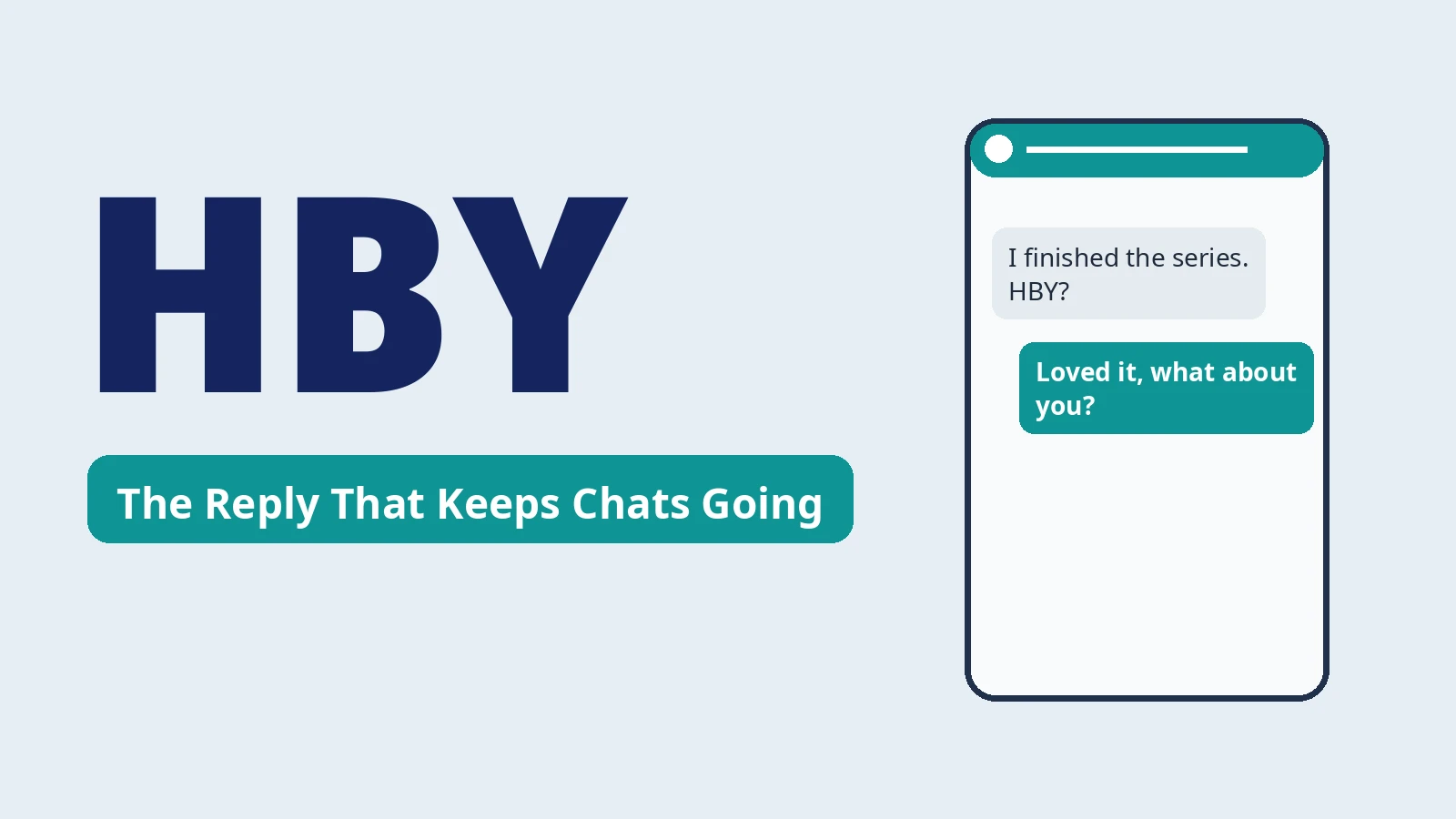
You answer a question, then you add three small letters at the end: “HBY?” Your friend reads it, smiles, and answers straight away. If you have ever wondered what those letters were doing there, you are not alone.
Here is the short answer: HBY means “how about you?” It is the quick way to hand a question back after you have answered it yourself, so the conversation does not stop with you.
In this guide you will learn the hby meaning in text, why it is spelled HBY and not HAY, when it sounds friendly and when it falls flat, and what to say when someone sends it to you.
What Does HBY Mean in Text?
HBY stands for How About You?
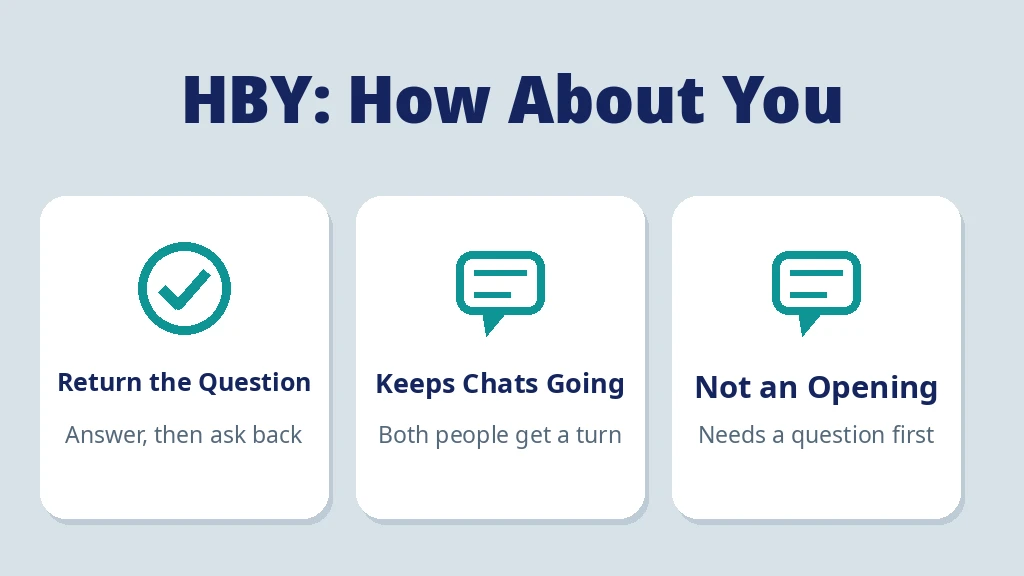
It is a return question. Somebody asks you something, you answer, and then you ask the same thing back in three letters instead of three words. That is the whole job of HBY, and it does it well.
Quick definition: HBY means “how about you?” It is used in casual texts and chats to return a question to the other person after answering it, and to keep the conversation going.
The spelling looks odd until you say the phrase out loud in a relaxed way. In fast, casual speech, “how about you” often sounds more like “how bout you”. The word “about” shrinks to “bout”, and that gives us the B in HBY. If the abbreviation followed the written phrase letter by letter, it would be HAY, but nobody talks like that, so nobody types it like that either.
HBY is almost always a question, even when the question mark is missing. People write “HBY” and “HBY?” interchangeably, and readers understand both as a question because of where HBY sits in the message: right after an answer, at the end of a thought, waiting for a reply.
HBY Meaning in Easy Words
Think of a game of catch. Someone throws you a question. You catch it, answer it, and throw it straight back. HBY is that throw back.
Without it, a chat can feel one sided. One person asks, the other answers, and then silence. With it, both people get a turn, and the chat keeps moving without anyone having to think up a brand new topic.
In the simplest words:
HBY = “Now you tell me.”
It is polite, it is short, and it shows interest. You are not just answering and walking away. You are saying, in effect, “I told you my side, and I actually want to hear yours.”
Where Is HBY Used?
HBY lives in casual, private conversations. It is most at home in one to one chats, where two people are catching up, making plans, or passing the time.
Common places:
- WhatsApp and Messenger chats with friends and family
- Snapchat messages and replies to stories
- Instagram DMs
- TikTok comments and replies, usually between people who already know each other
- Discord and group chats, when the question is aimed at one person in the group
Typical situations:
- Returning a “how are you” or “what are you doing” question
- Sharing plans and asking about the other person’s plans
- Giving an opinion and asking whether the other person agrees
- Checking in after a piece of news, good or bad
HBY is not a formal tool. You would not put it in a work email, a message to a teacher, or a first message to a stranger. In those settings it can look careless, because it asks the other person to do the decoding work. Among friends, that decoding work is part of the fun.
Why Do People Use HBY?
It keeps the conversation balanced
A chat where only one person asks questions feels like an interview. HBY fixes that in three letters. It turns an answer into an exchange, and both people end up sharing.
It saves typing without losing warmth
Typing “how about you?” takes a second longer, and in a fast chat that second matters. HBY carries the same friendly meaning, so people reach for it when the chat is already moving quickly.
It works as a soft rescue
Sometimes you do not know what to say next. You have answered, and your mind has gone blank. HBY buys you a graceful next step: hand the question back and let the other person carry the chat for a turn.
Everyone in the chat already knows it
HBY has been around since the early days of SMS and chat rooms. That long history means most regular texters read it instantly, with no pause and no confusion.
Real-Life Examples of HBY
Here is how HBY actually shows up in daily chats:
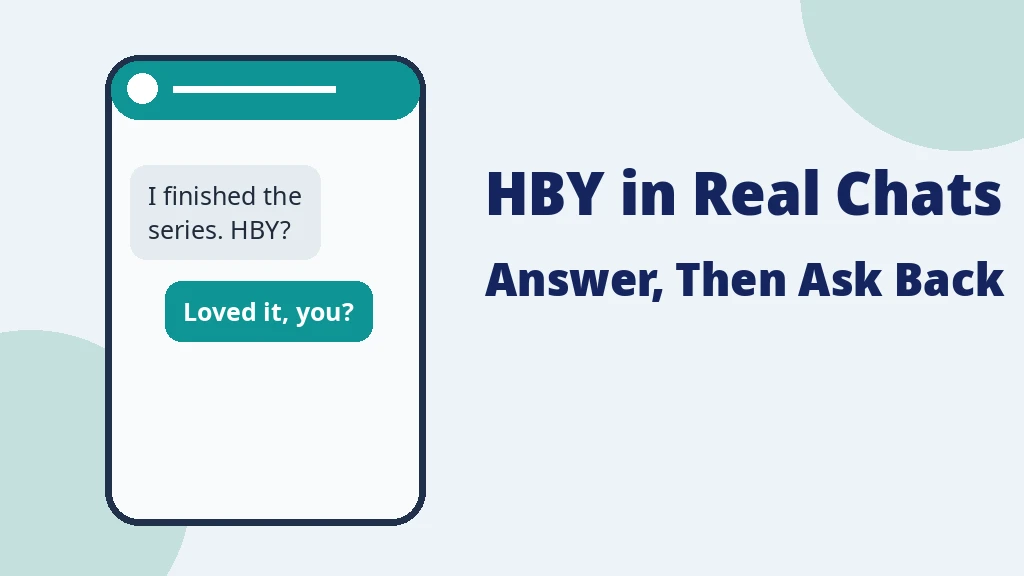
Example 1:
- Friend: “How was your weekend?”
- You: “Really good, I finally finished that series. HBY?”
Meaning: You answered, then returned the same question. The chat stays balanced.
Example 2:
- Friend: “Are you going to the match tonight?”
- You: “Definitely! HBY?”
Meaning: A plan is shared, then the question is handed back to confirm the other person’s plan.
Example 3:
- Friend: “I think the new cafe is overrated.”
- You: “I liked it, actually. HBY?”
Meaning: An opinion is given, then the other person’s opinion is invited. Note that HBY here does not mean “do you agree”, it means “what do you think”.
Example 4:
- Friend: “I am so tired today.”
- You: “Same, I barely slept. HBY?”
Meaning: A feeling is shared, then the same check in is returned. This is HBY at its friendliest.
Example 5:
- Friend: “Do you think the moon landings were faked?”
- You: “Of course not! HBY?”
Meaning: Even a joke or debate question can be returned with HBY. It keeps the back and forth going.
HBY vs Similar Terms
| Term | Meaning | Use it when |
|---|---|---|
| HBY | How About You? | Returning a question just asked to you |
| HBU | How Bout U? | Exactly the same job as HBY, shorter spelling |
| HYB | How You Been? | Checking in after time apart |
| HRU | How Are You? | Opening a check in, not returning one |
| WBU | What About You? | Returning a question about a thing, not a feeling |
Key difference: HBY and HBU are the same phrase in two spellings. Pick either one and stay consistent in a chat, or your friend may wonder whether you meant two different things. HYB is the one to watch, because it looks almost identical but asks a different question: it asks how someone has been over time, while HBY asks about the topic just discussed.
And if a friend replies to your HBY with a short send-off instead of an answer, that is a different kind of message altogether. Here is what GN means in text and why it usually ends a chat rather than continuing one.
HBY Variations You Should Know
HBU is the closest twin of HBY. It shortens both “about” to “bout” and “you” to “u”. The meaning is identical, so treat HBU and HBY as two spellings of one phrase, not two different slang terms.
WBU (what about you) is the cousin for things rather than feelings. “I am going to the gym, WBU?” works, and so does HBY in the same spot, but WBU fits slightly better when the question was about a plan or a choice.
Lowercase “hby” feels softer and more casual than “HBY”. The meaning does not change, but the energy does: lowercase reads like a quiet, relaxed question at the end of a long chat, while capitals read like a normal, clear question.
HBY on its own is rare and usually confusing. Because HBY returns a question, it needs an answer in front of it. A message that only says “HBY?” with no context leaves the reader guessing what question is being returned.
How to Reply to HBY
Replying to HBY is simple: answer the question that was handed back to you.
If it follows a feeling question: answer honestly and briefly. “Pretty good, just busy with work” is enough, and you can return it again if you want, although two returns in a row can start to feel like a loop.
If it follows a plan question: give your plan. “Yes, I am going, see you there” or “Not this time, I have an early start” both work, and both close the loop cleanly.
If it follows an opinion question: give your opinion, even if it differs. HBY is an invitation to share, not a test with a right answer, so disagreeing politely is fine.
If you do not want to answer: you can deflect gently instead of leaving the question hanging. “Long story, I will tell you tomorrow” or “Still deciding, I will let you know” keeps the chat friendly without forcing an answer you are not ready to give.
One habit to avoid: answering HBY with another HBY and nothing else. “HBY?” followed by “HBY?” is a loop with no content, and it usually ends with both people laughing or both people giving up.
When to Use HBY (and When to Avoid It)
Good situations:
- Returning a friendly check in from a friend or family member
- Sharing plans and asking about the other person’s plans
- Keeping a slow chat moving when you are stuck for a new topic
- Showing interest after you have shared your own news
Avoid using HBY when:
- The message is formal, for work, school, or anyone you do not know well
- The other person shared serious or sad news and needs a real response, not a returned question
- You are opening a conversation, because there is no question to return yet
- The chat is already going in circles with repeated return questions
Common Misunderstandings About HBY
HBY does not mean “how are you”. It returns a question, so its exact meaning depends on the question before it. If nobody asked you anything, HBY has nothing to return, and it will confuse the reader.
HBY does not mean “happy birthday you”. That reading appears in some slang lists, but it is not how people use HBY in real chats. For a birthday, people write HB or spell the wish out in full.
HBY is not the same as HYB. The letters are almost identical and the meanings are close, but HBY returns the current question while HYB asks how someone has been over a longer stretch of time.
HBY is not rude. On its own it is friendly and neutral. It only feels cold if the answer before it was cold, or if it is used to dodge a serious conversation that deserved a fuller reply. If you ever need a clean way to step away from a chat instead of returning every question, here is what BRB means in text and when a short break message fits better.
Frequently Asked Questions
What does HBY mean in text?
HBY means “how about you?” It is a short way to return a question after answering it, so the conversation keeps going with both people sharing.
Why is it HBY and not HAY?
Because in relaxed speech “how about you” sounds like “how bout you”. The word “about” shrinks to “bout”, which gives the B in HBY instead of the A in HAY.
What is the difference between HBY and HBU?
There is no difference in meaning. HBU shortens “you” to “u” as well as “about” to “bout”, so HBY and HBU are two spellings of the same phrase.
What is the difference between HBY and HYB?
HBY returns the question just asked, while HYB asks “how you been?” after time apart. The letters look similar, but the questions are different.
Is HBY rude?
No, HBY is friendly and neutral in casual chats. It only feels cold if it is used to dodge a serious topic that deserved a fuller reply.
Can I start a conversation with HBY?
It is better not to. HBY returns a question, so it works best after you have answered one. Opening with it leaves the reader guessing what you are returning.
How do you reply to HBY?
Answer the question that was handed back to you: a feeling, a plan, or an opinion. A short honest answer is enough, and you do not have to return the question again.
Related Texting Slang
Keep exploring the dictionary: HBU in chats and texts, when someone texts you ISO, how people actually use Namaste, SMH in chats and texts, how people actually use WYN.
Final Thoughts
HBY is a small phrase with a clear job: answer, then ask back. It means “how about you?”, and it keeps chats balanced by making sure both people get a turn to share.
Now you know why it is spelled HBY, how it differs from HBU and HYB, and how to reply without falling into a loop of returned questions. The next time a chat ends with HBY, you will know exactly what is being asked of you, and you will have an answer ready.
The reference guides agree on this reading too. CyberDefinitions defines HBY as “How About You”, used to confirm the other person’s plans or to assess their opinion after answering a question, which matches exactly how the phrase works in real chats.