If you have spent any time scrolling through social media or listening to modern music, you have likely encountered the term opp. It shows up in rap lyrics, viral TikTok videos, and even in the casual text messages of teenagers across the globe. You might be a parent trying to understand the latest teen slang, or perhaps you are just curious about why this word suddenly seems to be everywhere.
Understanding current internet culture is a great way to stay connected, but it can feel like learning a new language. This term is more than just a passing trend; it represents a specific shift in how people identify conflict and social dynamics in digital spaces. Let us look at what this word really means, where it came from, and how you should navigate its usage in your own daily conversations.
Defining the Term and Its Modern Usage
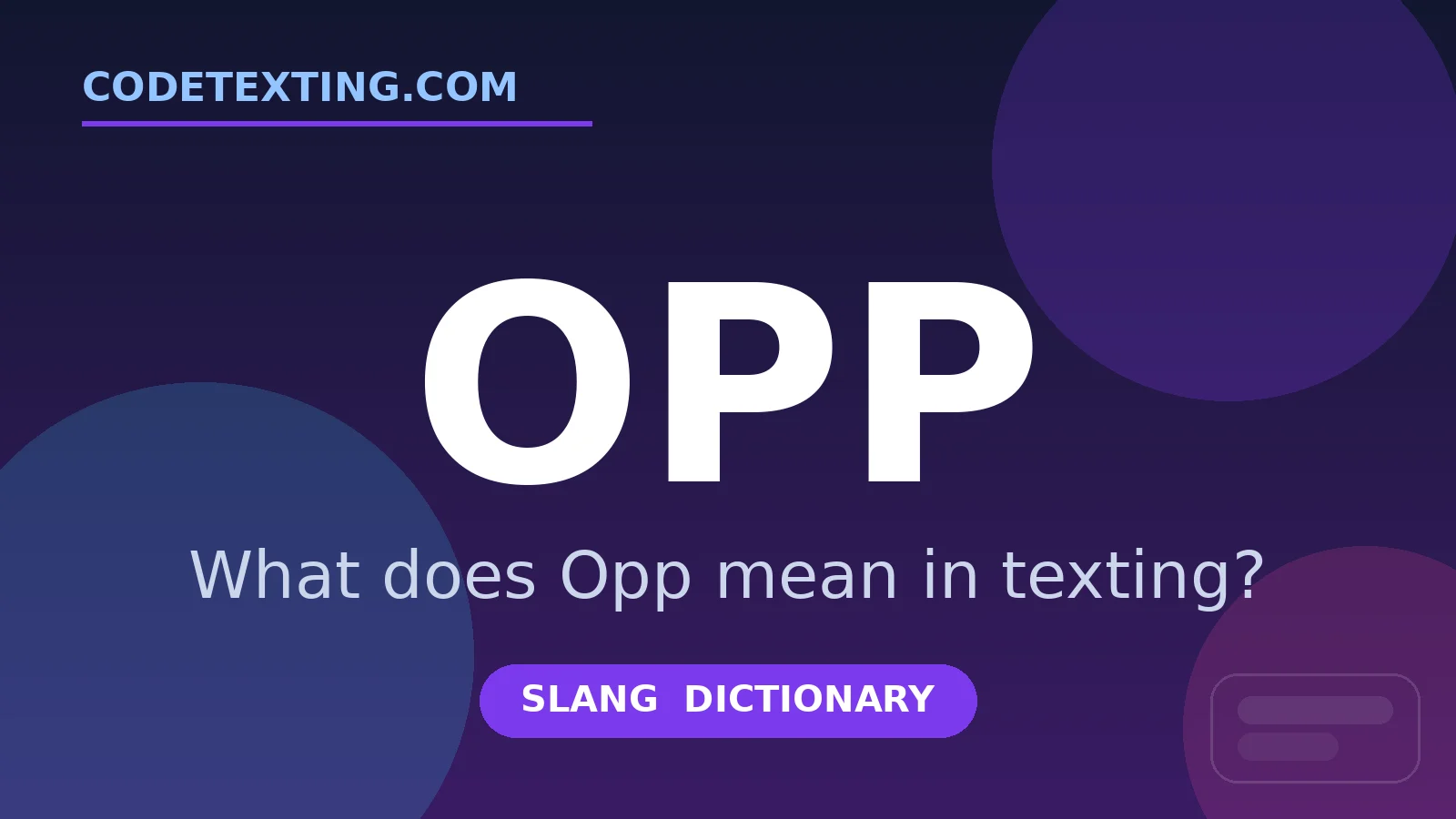
The slang word opp is short for opposition. At its core, it refers to an enemy, a rival, or someone who is working against you. When someone calls another person an opp, they are identifying them as a person who is not on their side.
This could be someone they are actively fighting with, a competitor in a game, or simply someone whose values or actions stand in direct contrast to their own. In many circles, it carries a sense of tension or distrust.
You might hear it used in a sentence like, “I cannot believe he showed up to the party; he is definitely an opp.” In this case, the speaker is labeling the person as an outsider or a threat to their social circle. Another common usage appears in gaming, where a player might say, “Watch out for the opps in the next room.”
Here, the term is used to describe enemy players who are trying to defeat the user. The meaning remains consistent across these scenarios: it is always about identifying someone who is actively standing in the way of your goals or your peace of mind. It is a label of conflict that signals to others that a particular person should be viewed with caution or suspicion.
The History and Evolution of the Concept
The term originated in the world of hip-hop and street culture. For decades, rappers have used the word to describe rivals, whether those rivals are from different neighborhoods or competing record labels. In the context of rap, being an opp was a very serious designation.
It often implied actual physical danger or long-standing feuds between groups. This is why the term carries such a heavy weight even today.
As social media platforms like Twitter and Instagram grew, the language of street culture began to permeate mainstream conversation. Teens began adopting these terms to describe their own social lives, even when the stakes were much lower. What started as a term for dangerous gang rivalries became a way to describe a student who snitched on a friend or a person who acts fake in a friend group.
This evolution shows how language moves from specific subcultures into the general lexicon. While the original intensity of the word has faded in many suburban or casual contexts, the basic idea of identifying an enemy remains the core of its usage. Today, it is a staple of digital communication, used by millions of people who may have never experienced the environment from which the word originally emerged.
Usage Across Different Social Contexts
The way people use this word changes depending on where they are. In text messages, it is often used in a joking, hyperbolic way.
For example, if a friend tells you they are going to the store to buy your favorite snack, you might jokingly say, “If you forget the chips, you are an opp.” This is a playful way to tease a friend, showing that the term is not always meant to be taken literally.
In gaming, the usage is almost always functional. Players use it to communicate threats to their teammates quickly. If a player shouts, “The opps are flanking us,” they are providing critical information that helps the team survive.
It is a shorthand that saves time during high-pressure matches. On social media, you might see people posting about their opps in a way that feels more performative. A user might post a picture with a caption saying, “Out here living my best life while the opps are watching.”
This is a way to project confidence and success in the face of perceived jealousy or negativity from others. Because the context shifts so drastically, it is important to look at the tone of the conversation before deciding if the speaker is genuinely angry or just being playful.
Common Misconceptions and Clarifications
One of the biggest misconceptions about this word is that it always implies violence. While its roots are tied to serious conflicts, most people using it today are not talking about physical fights. It is very common for teens to use it to describe minor annoyances.
If a teacher assigns extra homework, a student might jokingly call that teacher an opp. It is a way to vent frustration using slang that feels relevant and modern.
Another point of confusion is the spelling. Some people get confused between op and opp. While they sound similar, they serve different purposes.
Op is often an abbreviation for operator or original poster on forums, whereas opp specifically refers to opposition. Mixing these up can lead to misunderstandings, especially in online forums where technical terms are common. It is also worth noting that the term can be considered inappropriate in professional settings.
Using it in an email to a boss or in a formal report would be seen as unprofessional and confusing. It is strictly a casual term meant for peer-to-peer communication. Understanding these boundaries is key to using the word correctly without causing awkwardness or misinterpretation in sensitive environments.
Similar Terms and Alternatives
There are many ways to express the idea of an enemy or a rival. Depending on the setting, you might want to use a word that is less aggressive or more specific.
For instance, in a professional setting, we might use the word competitor or opponent. These words convey the same sense of being on opposite sides of a goal without the slang baggage of the word opp.
| Term | Context | Tone |
|---|---|---|
| Opp | Casual, Social Media | Slang / Intense |
| Rival | Sports, Career | Formal |
| Adversary | Literature, Formal | Serious |
| Hater | Social Media | Informal / Dismissive |
| Competitor | Business | Neutral |
Using these alternatives can help you navigate conversations where slang might feel out of place. If you are talking to a parent or a teacher, using the word rival is much clearer and avoids the need for a long explanation of what you mean.
It is all about choosing the right tool for the job. While slang is great for bonding with friends, having a diverse vocabulary allows you to switch gears when the situation calls for a more respectful or clear tone.
How to Respond to Being Called an Opp
If someone calls you an opp, your response should depend entirely on your relationship with that person. If it is a close friend joking around, you can respond with humor.
You might say, “I am not an opp, I am just hungry!” or “You are the real opp for not sharing those fries.” This keeps the energy light and shows that you understand the joke.
If you are being called an opp by someone you do not know well, or if the tone feels hostile, it is usually best to disengage. Responding with more aggression often fuels the fire and makes the situation worse. In many cases, people use this word to get a reaction out of others.
By staying calm and not taking the label to heart, you remove the power behind the insult. For those interested in learning more about how to communicate effectively online, you can check out the Pew Research Center for insights into digital social trends. They provide a wealth of data on how language and behavior shift across different online platforms, which can help you understand the broader context of why these trends occur.
Regional and Cultural Differences
The term has spread globally through the internet, but it is not used the same way everywhere. In the United States, it is deeply tied to urban culture and rap music.
In other countries, the term might be picked up by fans of American pop culture, but it may not carry the same historical weight. In some places, it might be used ironically by people who are disconnected from its original roots.
It is also important to remember that not everyone follows the same trends. A teen in a rural area might use the word because they saw it on TikTok, while a teen in a city might use it as part of their daily dialect. Because of this, it is impossible to say exactly how the word will be received in any given room.
If you are traveling or meeting new people from different backgrounds, it is always a good idea to listen to how they use language before jumping in with your own slang. Cultural context is everything. What is considered a harmless joke in one neighborhood might be seen as offensive or aggressive in another, so being observant is a valuable skill.
Usage in Dating Apps and Online Communities
In the world of online dating, you might see people mention their opps in their bio or during a chat. This is often a red flag for many users.
If someone is constantly talking about their enemies or people who are out to get them, it can signal drama or instability. Most people on dating apps are looking for a positive connection, not a list of conflicts.
In gaming communities, the term is as common as breathing. You will hear it in voice chats, read it in team messages, and see it in forum threads. It is a standard part of the gaming vernacular.
If you are new to gaming, learning this term will help you understand what is happening during a match. It is a shorthand that keeps the game moving. However, just like in social media, it is best to avoid using it in a way that targets other players for harassment.
Gaming is meant to be fun, and using slang to belittle others can lead to being muted or banned from servers. Always prioritize good sportsmanship, even when you are frustrated with the other team.
Hidden Meanings and Professional Suitability
While the term is mostly used for lighthearted banter or gaming, it is important to be aware that it can have darker connotations. In specific neighborhoods or intense social situations, being labeled an opp can be a precursor to real conflict.
This is why it is vital to read the room. If you are in a situation where people are genuinely angry, do not use the word lightly.
Regarding professional communication, the rule is simple: keep it out of the office. Using slang in a workplace can undermine your credibility. Employers value clear, concise communication that everyone can understand, regardless of their age or background.
If you need to describe a difficult situation or a conflict with a coworker, use professional language. Instead of saying “he is my opp,” try saying “we have a difference of opinion on this project.”
This is much more effective and avoids any confusion or negative perceptions. Always keep your professional brand in mind when you are at work or networking.
What does OPP mean in texting?
The slang word opp is short for opposition. That is the short version. The full breakdown with examples is in the sections above.
How do you use OPP in a sentence?
The conversation samples in this article are your cheat sheet. See where OPP lands in a sentence, then try it yourself.
Where did OPP come from?
OPP started in online chats and comment sections, then went mainstream. Check the origin section for the details.
Where do people use OPP the most?
TikTok comments, Snapchat, and group chats. That is where OPP lives. You will rarely see it in emails or formal writing, and that is by design.
How should you reply when someone says OPP?
Match their energy. If a friend drops OPP jokingly, laugh it off or fire back with your own slang. If a stranger says it coldly, do not engage.
Frequently Asked Questions
Is opp a bad word?
It depends on the context. It is generally not a swear word, but it can be used aggressively. 2. Should I use this word around my parents? Probably not, unless you want to spend twenty minutes explaining what it means. 3. Can girls use this term? Yes, the term is gender-neutral and used by everyone. 4. Does it always mean someone is a gang member? No, that is a common misconception. It is used for anything from snacks to gaming rivals. 5. Is it okay to use in a job interview? Absolutely not. Keep your language professional and formal in all job-related settings. 6. Does the term change based on where I live? Yes, the intensity and frequency of its use vary by region and social group. Understanding the slang you hear every day is a great way to stay in the loop. By knowing the history, the proper context, and the potential pitfalls, you can use these terms confidently without accidentally offending anyone or sounding out of touch. Whether you are gaming with friends or just browsing your feed, you now have the tools to understand this popular word. Remember that language is always changing, and what is popular today might be replaced tomorrow. Keep an open mind, stay observant, and always choose your words based on the person you are talking to and the situation you are in. Communication is a skill that evolves, and keeping up with these trends is just one part of being a well-rounded and socially aware individual in our fast-paced, digital world.
What does OPP mean in texting?
The slang word opp is short for opposition. That is the short version. The full breakdown with examples is in the sections above.
How do you use OPP in a sentence?
The conversation samples in this article are your cheat sheet. See where OPP lands in a sentence, then try it yourself.
Where did OPP come from?
OPP started in online chats and comment sections, then went mainstream. Check the origin section for the details.
Where do people use OPP the most?
TikTok comments, Snapchat, and group chats. That is where OPP lives. You will rarely see it in emails or formal writing, and that is by design.
How should you reply when someone says OPP?
Match their energy. If a friend drops OPP jokingly, laugh it off or fire back with your own slang. If a stranger says it coldly, do not engage.