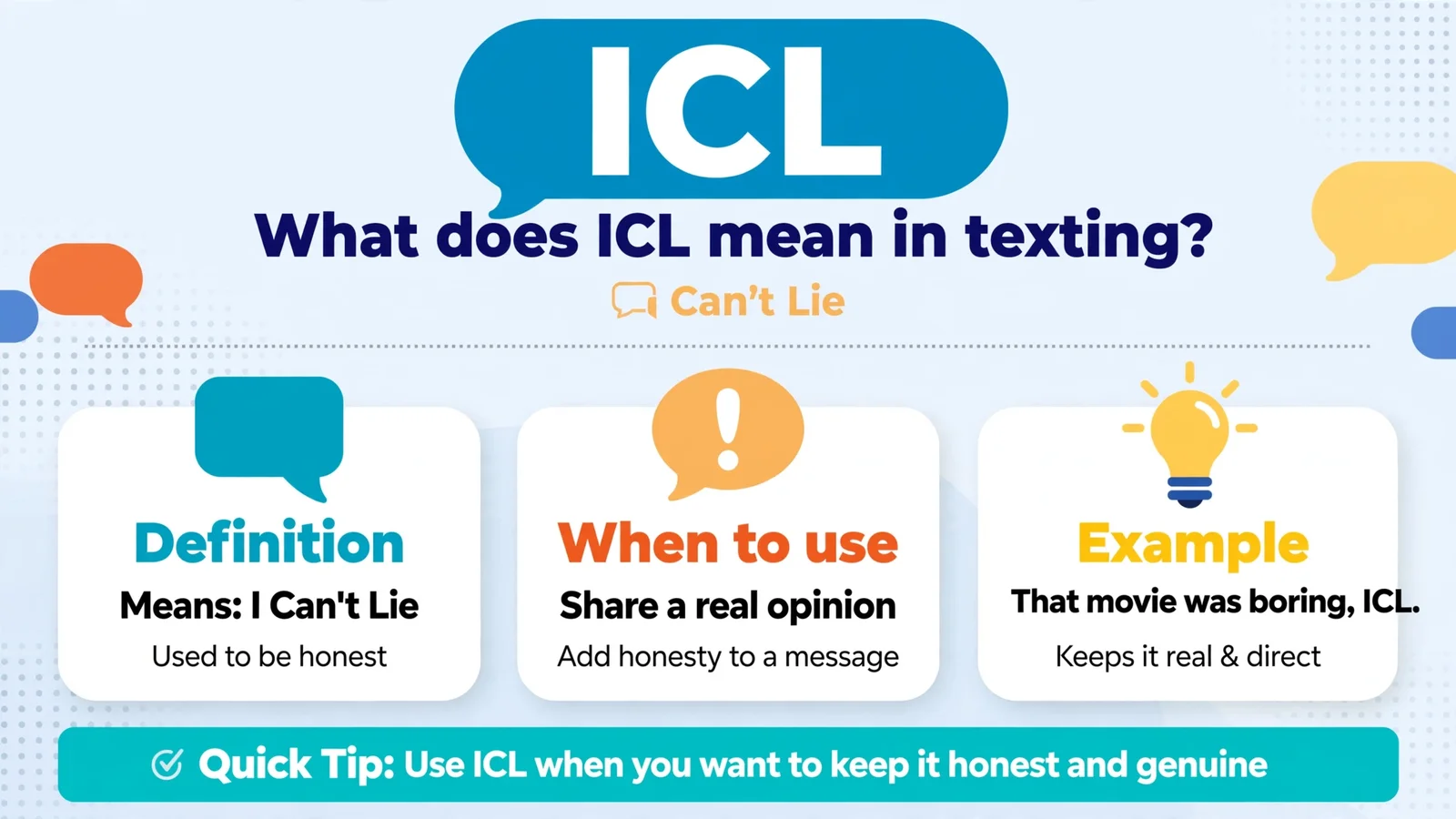
People pronounce ICL letter by letter: “I-C-L.” It is an initialism (a type of acronym) used as internet slang. ICL means “I can’t lie.” People use it at the start or end of a message. In fact, it signals that an honest, blunt, or vulnerable opinion is coming. When someone texts “ICL,” they are telling you they are being real with you.
ICL: Meaning & Origin
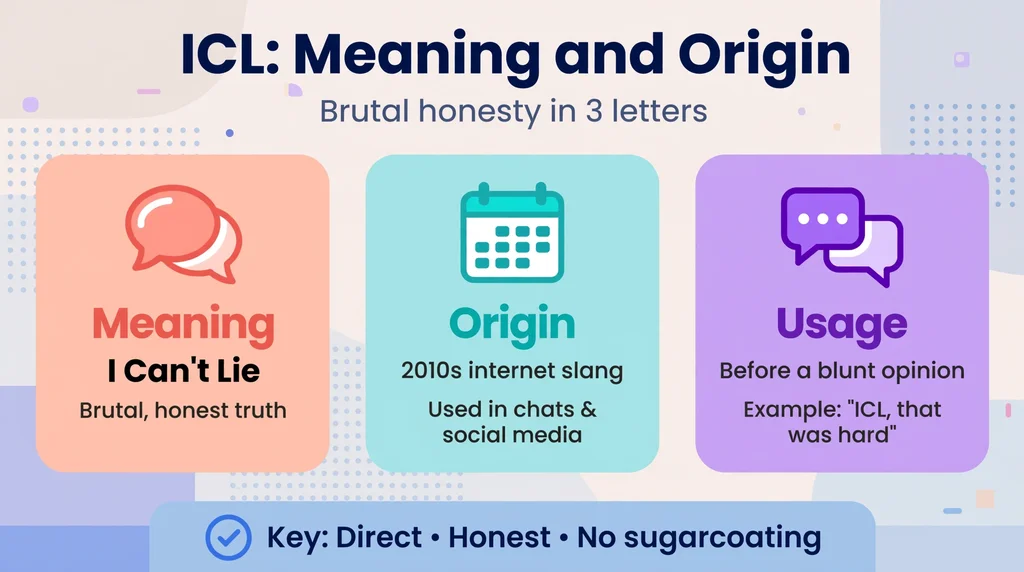
ICL stands for “I can’t lie.” It is shorthand for the fuller spoken phrase “I can’t lie about this.” That phrase has been part of casual American English for decades, particularly African American Vernacular English (AAVE). In everyday speech, saying “I can’t lie” before a statement flags sincerity. In other words, you are telling the listener that what follows is your genuine feeling. Still, that holds even if the feeling might be unpopular or uncomfortable.
As texting culture took over, people compressed long phrases. “Talk to you later” became TTYL, “to be honest” became TBH, and “I can’t lie” became ICL. The abbreviation first spread through text messages, Snapchat, and Twitter in the late 2010s. Then it exploded with Gen Z and Gen Alpha on TikTok. As a result, it became a staple of the honesty-focused slang family. For instance, that family includes NGL (not gonna lie), TBH (to be honest), and no cap (no lie).
ICL hit a new level of fame in 2024 and 2025. That is when it became part of the viral “TS PMO ICL” spam trend on TikTok. For example, commenters flooded videos with walls of acronyms like TS (that sh*t), PMO (piss me off), and ICL. Often, these had no real meaning attached. The joke was the chaos itself. But beneath the meme, the core meaning of ICL stayed stable: “I can’t lie,” used to preface an honest take.
One note: you may occasionally see ICL claimed to mean “I care less.” However, this is rare, and most people consider it a misunderstanding. When people want to express indifference, they use other slang like IDC (I don’t care). In fact, in texting and on social media, “I can’t lie” is the dominant meaning. It is also the intended meaning of ICL almost every time.
ICL in Conversation: Real Examples
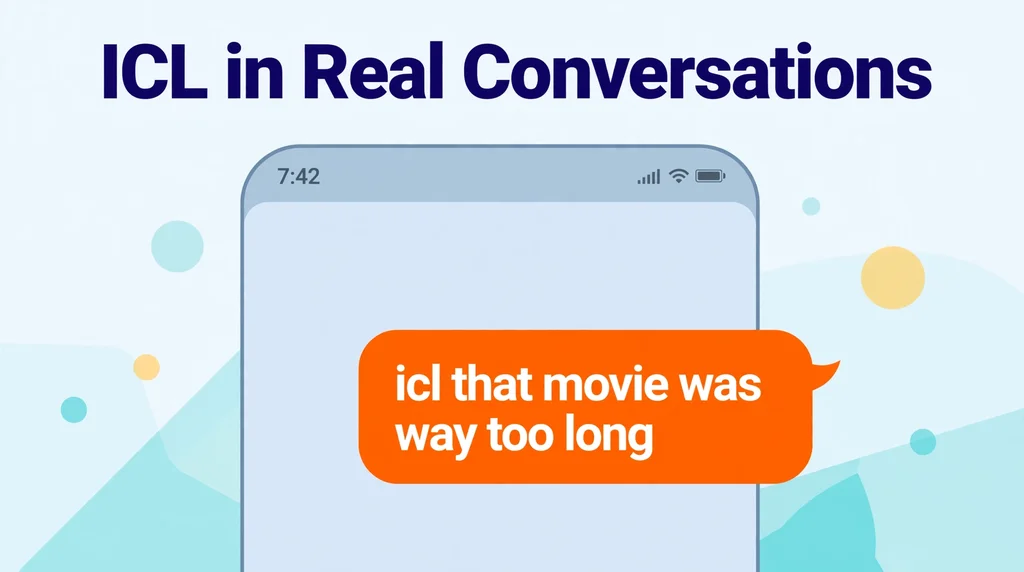
Here is how ICL actually shows up in everyday digital life, across different platforms and situations.
1. Texting between friends
- Maya: do you actually like the new album or are you pretending
- Jordan: icl the first three songs slap and then it falls off
- Maya: see?? I thought it was just me
- Jordan: icl I almost skipped the whole second half
2. A TikTok comment
- @sophie.eats: *posts a restaurant review video*
- Commenter: ICL this is the only review I trust, everyone else is just getting paid lol
- @sophie.eats (reply): ICL the fries really were that good, no notes
3. Gaming chat
- Player1: that was actually insane bro
- Player2: icl you carried that round fr
- Player1: nah ICL we all sold it and the enemy team sold harder
4. Group chat confession
- Leo: guys the party is tonight, who is coming?
- Ava: icl I am kind of tired and might just stay home
- Leo: noooo come on
- Ava: icl I will probably still come, I just needed to say it out loud
Notice the pattern: ICL almost always comes right before the honest part. It works as a warning light that tells the reader, “brace yourself, here comes the real opinion.”
How to Use ICL
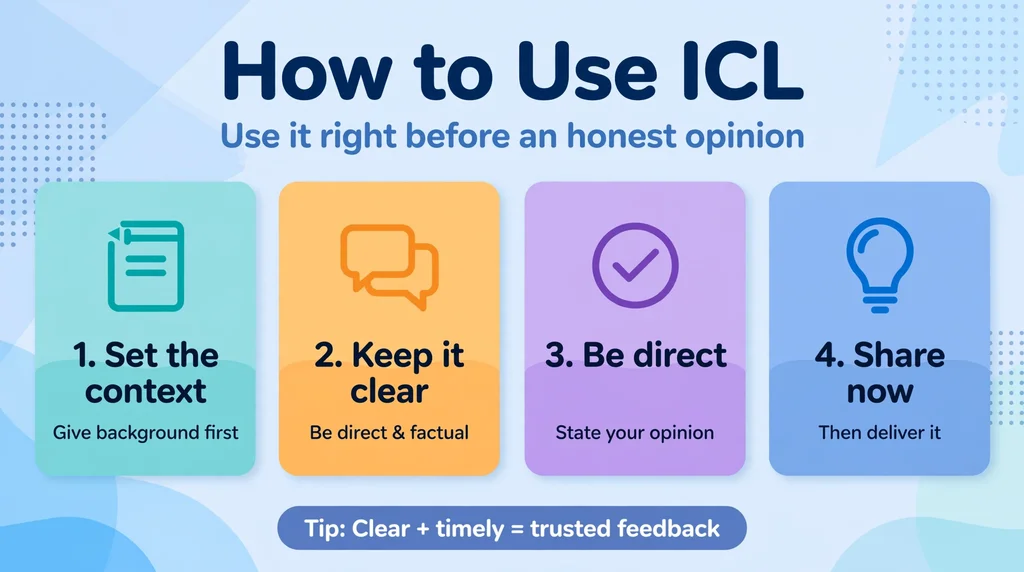
Using ICL is simple. Drop it at the beginning of a sentence (“ICL, that movie was better than the book”). You can also drop it at the end (“that was better than the book, ICL”). Of course, both placements work and mean the same thing. It pairs naturally with other slang from the honesty family. For instance, you will often see “ICL, no cap, that was crazy.” You might also see “ICL fr, I was not expecting that ending.”
ICL shines when you want to:
- Share an opinion that might be unpopular or surprising (“ICL, I like the prequels better”)
- Make a compliment feel more genuine (“ICL, you absolutely nailed that presentation”)
- Admit something small (“ICL, I forgot to reply yesterday”)
- Soften a blunt statement just enough to stay friendly
How to Reply to ICL
There is no special reply required. Instead, just respond to the honest statement itself, the way you would answer any message. If a friend says “ICL, I did not love the party,” you can reply “oh no, what happened?” A simple “yeah same honestly” works too. You can also mirror their energy. For example, “ICL, me too” works as a natural agreement.
One thing to watch for is tone. Because ICL signals blunt honesty, the sentence after it can sting a little. If someone texts “ICL, that haircut is not doing you any favors,” they probably mean real talk, not an attack. Read the relationship and the context before reacting. If you are unsure whether someone is joking, it is fine to ask: “wait, are you serious lol?”
When Not to Use ICL
ICL is casual by nature, so there are places it does not belong. Skip it in job applications, cover letters, emails to teachers or professors, and any formal or professional writing. Saying “I can’t lie” out loud to a grandparent or a boss can also land wrong. That is because the blunt honesty it signals can sound too forward in a serious setting.
There is also a style trap: do not lean on ICL too often. If every opinion starts with “ICL,” it stops sounding honest. Instead, it starts sounding like a habit. Worse, it can sound like you are hedging every thought. Instead, save it for the moments where sincerity actually matters.
Finally, remember that ICL gets used sarcastically a lot online. Someone replying “ICL this is the best day of my life” under a traffic jam video is clearly joking. Of course, context and tone decide whether the honesty is real or ironic. So read the room before taking the statement at face value.
ICL vs. Similar Slang
ICL belongs to a crowded family of honesty acronyms. Here is how it compares to its closest cousins:
- ICL vs. NGL (not gonna lie): Nearly identical. NGL sounds slightly more casual. ICL, on the other hand, can carry more emotional weight. It sounds as if the admission is a little harder to say.
- ICL vs. TBH (to be honest): TBH is more neutral and often used as a conversation opener (“TBH, what did you think?”). ICL feels more personal and dramatic.
- ICL vs. IDC (I don’t care): Totally different. IDC expresses indifference. If you see ICL and wonder whether it means “I care less,” it almost certainly does not.
- ICL vs. Mid: These are opposites in spirit. “Mid” dismisses something as average, while ICL opens a door to a genuine opinion, which might be positive or negative.
For Parents: Is "ICL" Safe?
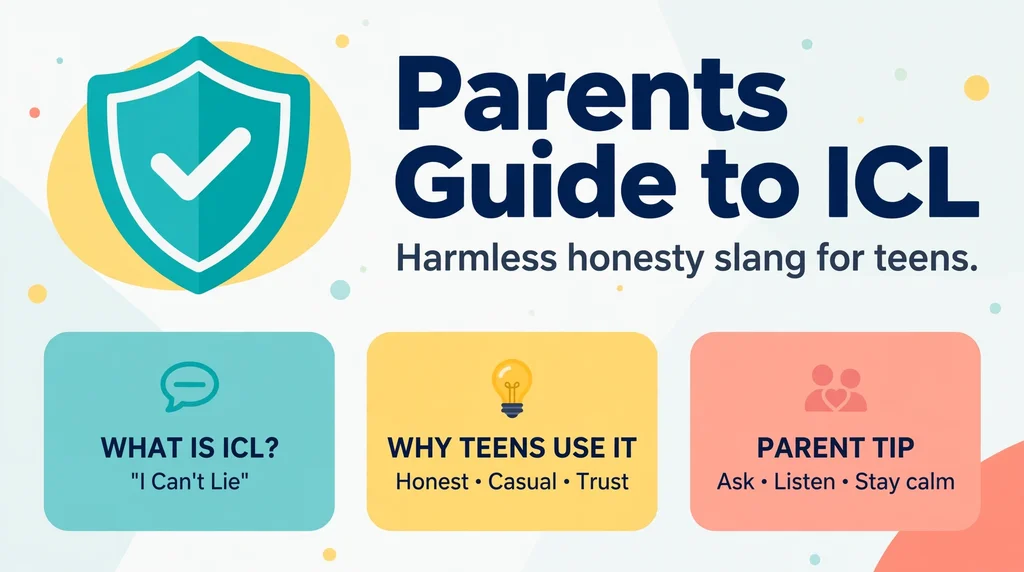
ICL is a safe, harmless term. It simply means “I can’t lie” and is used by teens to emphasize honesty in texts, TikTok comments, and DMs. There is nothing vulgar, sexual, or threatening about it. The only mild caution is context. ICL often introduces blunt opinions, so kids may occasionally give or receive surprisingly direct feedback. For instance, “ICL, your playlist is mid.” Still, that is normal teen social communication, not a red flag. If your child texts you “ICL” before a big admission, expect an honest confession, not a crisis.
Frequently Asked Questions
What does ICL mean in texting?
In texting, ICL means “I can’t lie.” It is used at the start or end of a message to signal that an honest or blunt opinion is coming, like “ICL, I was nervous before the interview.”
What does ICL mean on TikTok?
On TikTok, ICL also means “I can’t lie.” Creators and commenters use it to flag a genuine opinion, especially in captions, comment sections, and reaction videos. It became especially visible during the viral “TS PMO ICL” comment-spam trend.
Is ICL the same as NGL?
Almost. ICL stands for “I can’t lie” and NGL stands for “not gonna lie,” and both introduce honest opinions or admissions. NGL tends to sound slightly more casual, while ICL can feel a little more sincere or dramatic depending on the sentence.
Does ICL mean “I care less”?
Very rarely. “I care less” is an occasional alternate reading, but it is widely considered a misunderstanding of the term. In texting and social media slang, ICL almost always means “I can’t lie.” If you want to express indifference, IDC (I don’t care) is the standard term.
How do you pronounce ICL?
Say each letter separately: “I-C-L.” It is an initialism, not a word you blend into a single sound.
Is ICL safe for kids to use?
Yes. ICL is completely safe, clean slang with no vulgar or harmful meaning. Parents can treat it like any other honest conversational filler, similar to “to be honest” or “frankly.”
Is ICL the same as TBH?
Almost. Both introduce an honest opinion, but TBH ("to be honest") is softer and older, while ICL ("I can't lie") sounds blunter and more Gen Z. ICL usually comes before a harsher truth.
What does ICL mean on Snapchat?
The same as everywhere else: "I can't lie." On Snapchat it usually appears as a sticker or caption before an unfiltered opinion about a snap, a story, or someone's outfit.
Conclusion
ICL is one of those rare slang terms whose meaning has stayed remarkably stable. From its roots in the spoken phrase “I can’t lie” through text messages, Snapchat, and the TikTok “TS PMO ICL” era, it has always meant the same thing: a small flag that says, “here comes the truth.” Whether it prefaces a compliment, a confession, or a hot take, ICL makes digital conversation feel a little more human and a little more honest. So the next time a text opens with ICL, brace yourself: unfiltered honesty is coming.
Discover More: If you found ICL useful, keep exploring the honesty-slang family. Check out what TS and PMO mean (the other two thirds of the famous TikTok trio), see why people say no cap to stress the truth, or test your skills on FAFO and cooked, two more Gen Z staples that thrive on blunt opinions.
Sources: Know Your Meme: what does ICL mean