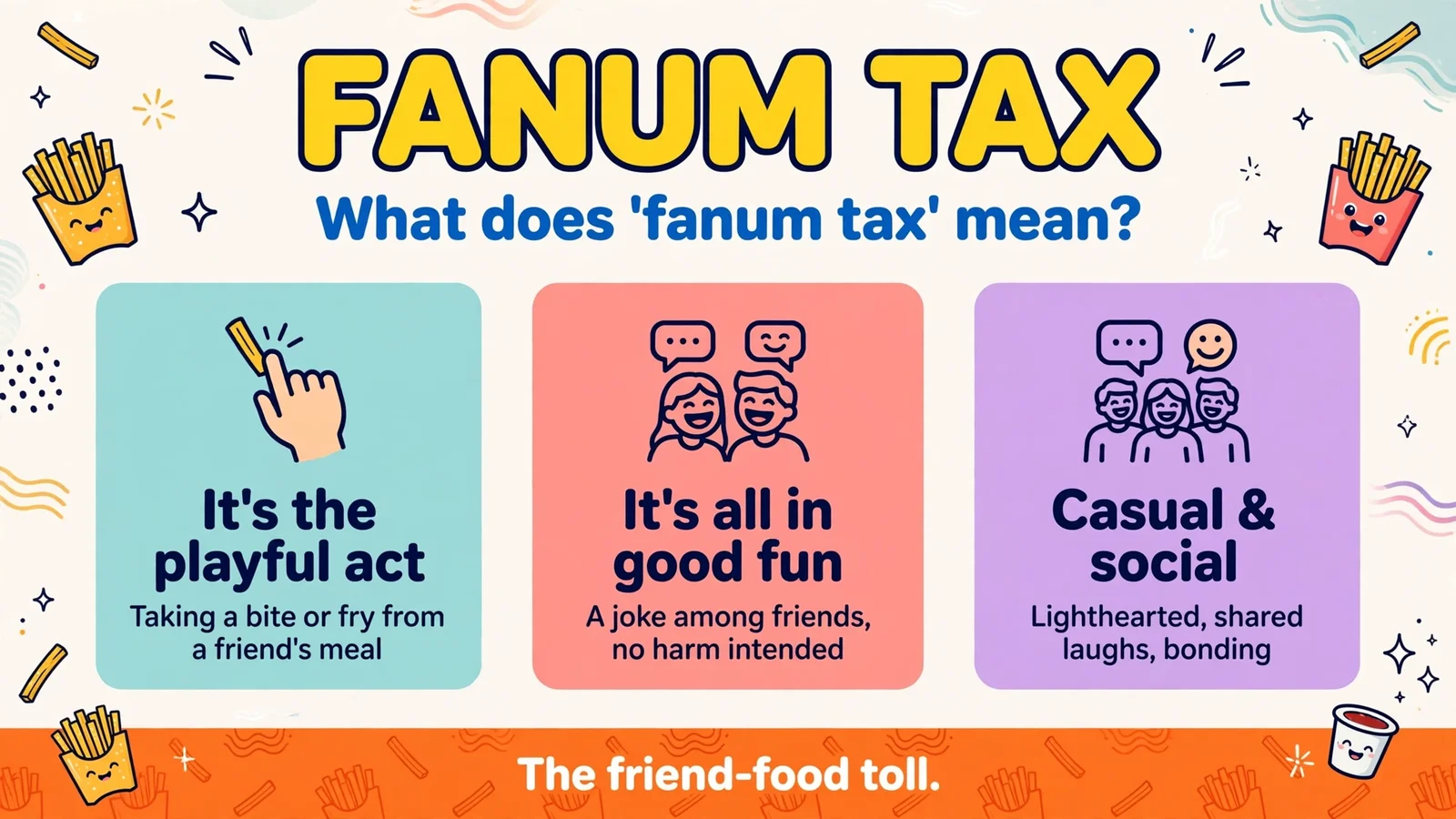
Pronunciation: FAN-um taks. Part of speech: noun phrase (also used as a verb: “he fanum taxed my fries”).
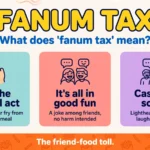
Fanum tax meaning slang, in short: it is a joking “tax” a friend takes from your food. They take it one bite at a time. Imagine someone reaches across the table, grabs a fry or a cookie off your plate, and grins. If they say “fanum tax” while doing it, they are not stealing. Instead, they are quoting streamer Fanum. He turned snatching bites of his friends’ meals on stream into a famous internet bit.
Meaning and Origin of Fanum Tax
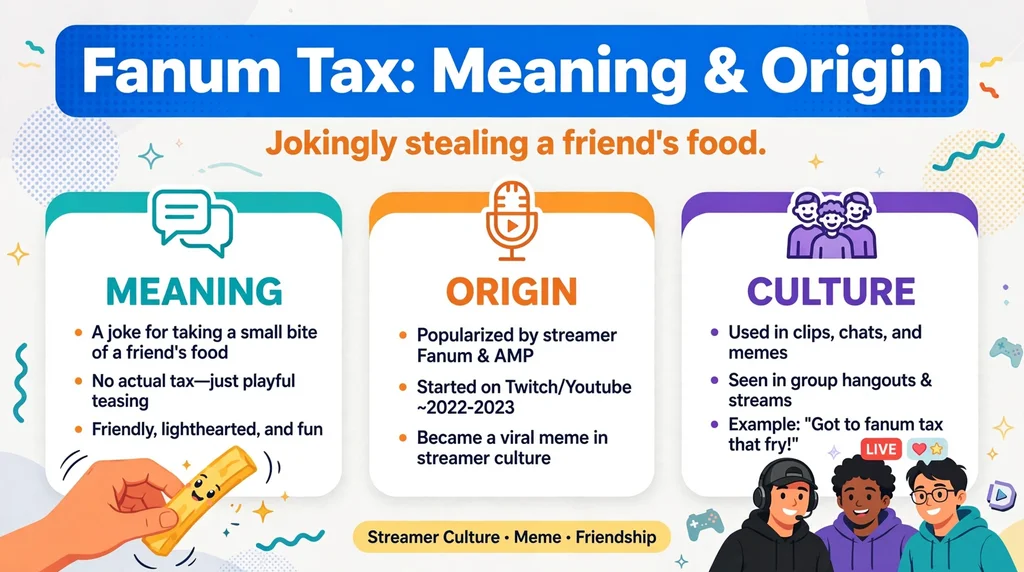
At its simplest, a fanum tax is the playful price you pay for eating in front of your friends. The joke works like a real tax. Of course, nobody voted for it, and nobody can avoid it forever. The collector takes their cut with complete confidence. The difference is that the IRS accepts checks, while Fanum accepts fries.
The term comes from Fanum, a Twitch streamer and YouTube creator. His real name is Roberto Escanio, and he is a member of the creator group AMP. Starting in 2022, he made it a recurring on-stream bit. The bit was simple: “tax” the food of friends who happened to be eating around him. The bit got its most famous outing during a stream hosted by fellow creator Kai Cenat. Fanum burst in and snatched a plate of cookies. As a result, that split-second gag became a running joke between the two, and eventually the entire streaming world.
From Twitch clips, the phrase spread to TikTok, YouTube, and group chats everywhere through 2023. Then in October 2023 it went fully mainstream. The trigger was a viral parody song by TikToker @ovp.9. “Sticking Out Your Gyatt for the Rizzler (Fanum Tax)” chained the phrase together with sigma, gyat, and skibidi. Its lyrics were deliberately nonsensical. That song gave the term a second life as meme filler. It became the kind of word Gen Alpha drops into sentences just for the chaos of it. But the original food joke never died. Kids in school cafeterias and friends at drive-thrus still shout “fanum tax” right before grabbing a bite.
Fanum himself has joked that the tax runs about five to ten percent of the meal. Anything more than that, he has implied, and you are just being greedy. In fact, the phrase even spawned a derivative, “fanum tax evasion,” for the art of successfully guarding your plate. As the Merriam-Webster slang entry notes, it is a humorous term for taking someone’s food. It can also mean feeling entitled to some of it, and it doubles as a nonsense meme expression online.
Fanum Tax in Real Conversations
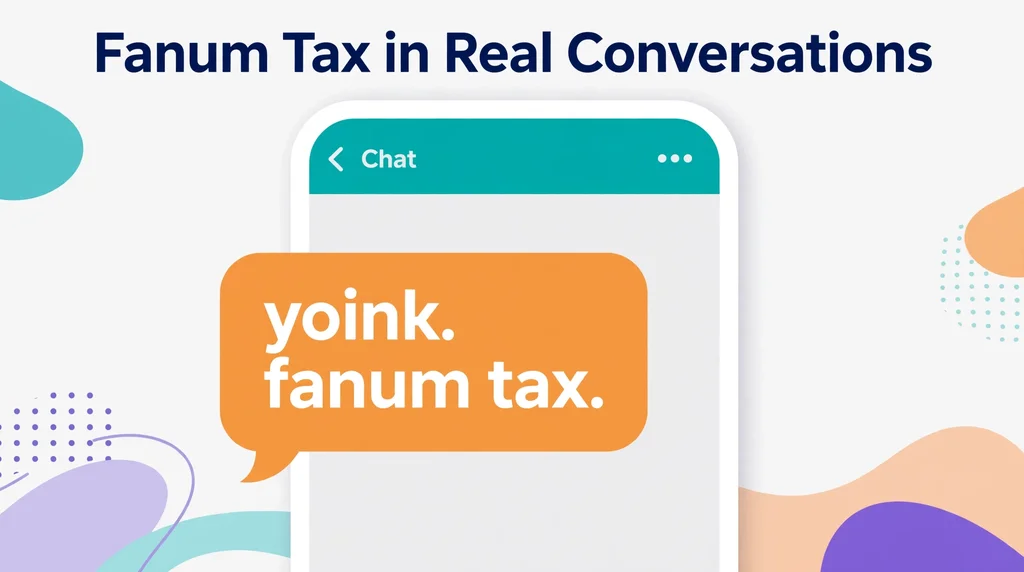
Here is how the term actually shows up in the wild, across four different settings.
1. Texting between friends
- Marcus: just got wings, extra ranch
- Dev: on my way. fanum tax incoming
- Marcus: do NOT touch my wings
- Dev: too late, tax collected 😤
2. TikTok comment section
- @snackgoblin: POV: your friend opens chips next to you
- @user4021: fanum tax activated
- @user4021: bro ate 40% of the bag and called it 10% 💀
- @snackgoblin: tax evasion failed successfully
3. Gaming chat on Discord
- Nova: brb grabbing pizza rolls
- KaiFan22: leave two for the fanum tax
- Nova: I came back and the plate was EMPTY
- Roommate (typing from Nova’s account): taxes must be paid
4. Family group chat
- Mom: who ate the last slice of cake??
- Jake (14): fanum tax
- Mom: what does that even mean
- Jake (14): it means the cake was delicious
- Dad: your tax rate is now 100% of your allowance
How to Use Fanum Tax (and How to Reply)
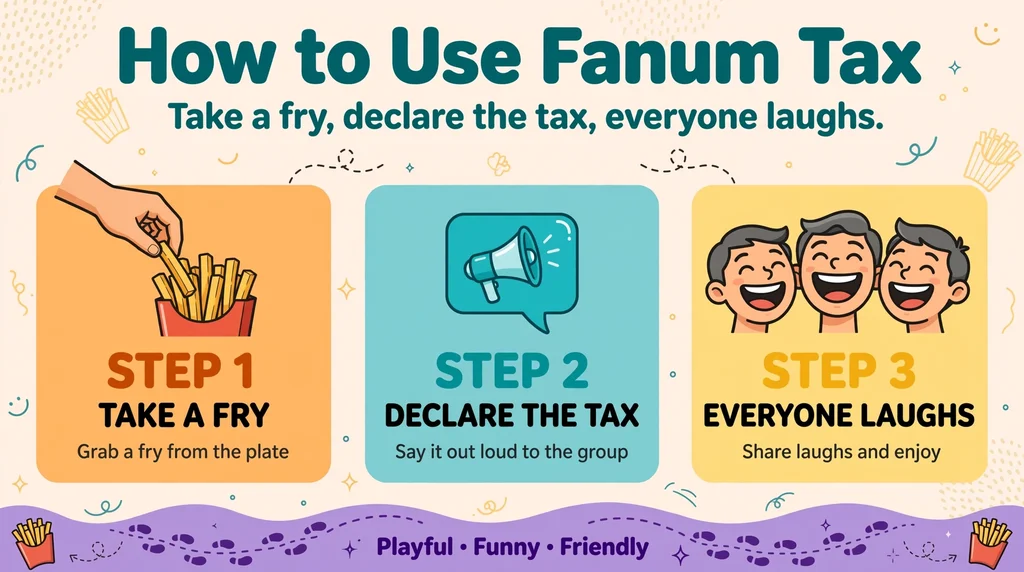
Using the term correctly is mostly about timing and tone. The fanum tax is a friendship joke, not a license to actually take people’s food. So follow these guidelines, and you will land the bit instead of starting a fight.
When to say it: Say “fanum tax” the moment you take a small bite of a friend’s food. Pick someone you are close with and who is in on the joke. You can also say it just before taking the bite, as a playful warning. For instance: “Careful, the fanum tax is real in this house.” As a verb, it slots into normal sentences. For example, you can say “He fanum taxed my fries” or “I got fanum taxed at lunch.” Or warn: “No fanum tax today, I am guarding this plate.”
Keep the cut small: The whole joke is built on the idea of a modest toll. For instance, think five to ten percent: one fry, one cookie. But grabbing half the meal is not a tax. It is just rude, and no meme will save you.
Read the room: For example, use it with friends, siblings, and classmates who know the meme. Do not “tax” a stranger’s food, a coworker’s lunch, or anyone who has not agreed to the bit. Consent is the difference between a joke and a complaint.
How to reply when someone taxes you: You have options. Play along (“Fine, but that is your whole allowance for the week”), escalate the joke (“Tax evasion! You will never take me alive”), or set a boundary (“One fry. That is the whole tax code.”). If you want to keep your food safe, announce “no fanum tax” before you open it. Or physically shield the plate, like Kai Cenat barricading his door with furniture. That move is itself part of the meme’s lore.
Related slang you will often see next to it includes the 6-7 chant and Ohio jokes. It also includes bet as an all-purpose agreement. They all belong to the same wave of chaotic Gen Alpha internet humor.
For Parents: Is Fanum Tax Safe?
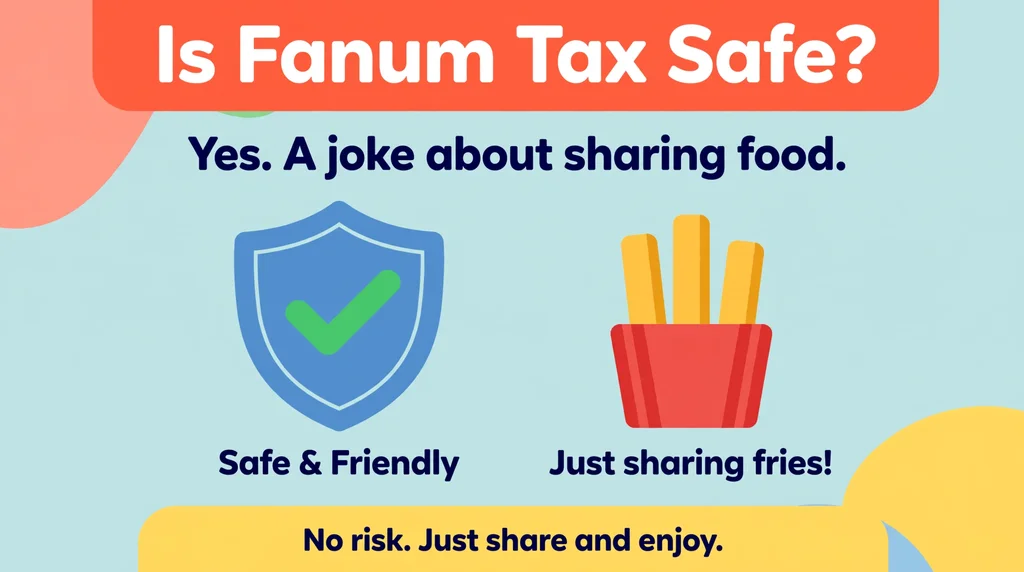
Yes, fanum tax is harmless. It is simply a joking way kids describe taking a bite of a friend’s food, named after a streamer. There is no sexual, violent, or hateful meaning behind it. The only caution worth mentioning is manners. So make sure your child understands the joke only works with willing friends. It does not work with strangers or anyone who does not want to share. For a deeper parent-friendly breakdown, see this guide to fanum tax for families.
Frequently Asked Questions
What does fanum tax mean in slang?
In slang, “fanum tax” means jokingly taking a bite of a friend’s food as if collecting a tax. It is named after the streamer Fanum, who popularized the bit of snatching food from friends on stream. It can be a noun (“pay the fanum tax”) or a verb (“he fanum taxed my fries”).
Who is Fanum and why is there a tax named after him?
Fanum is a Twitch streamer and YouTube creator (real name Roberto Escanio) and a member of the creator group AMP. Starting in 2022, he turned “taxing” his friends’ food during streams into a recurring comedy bit, most famously when he grabbed cookies during a Kai Cenat stream. Viewers named the gag the fanum tax, and the phrase spread from there.
Is fanum tax stealing?
Not in the way the joke intends it. The fanum tax is a playful bit between friends where taking a small bite is framed as an unavoidable toll. Real stealing is taking food from someone who does not want to share, which is exactly what the joke is not about. The humor only works when everyone is in on it.
What is fanum tax evasion?
“Fanum tax evasion” is a spinoff joke meaning you successfully protected your food from being taxed. Hiding your snacks, eating quickly, or physically guarding your plate all count as evasion. It comes from a viral moment when Kai Cenat barricaded his door with furniture to keep Fanum away from his food, then shouted that he had evaded the taxes.
Why do people say fanum tax in songs and memes?
In October 2023, TikToker @ovp.9 released the viral parody song “Sticking Out Your Gyatt for the Rizzler (Fanum Tax),” which strung the phrase together with other Gen Alpha slang like skibidi, gyat, and sigma in deliberately nonsensical lyrics. That gave “fanum tax” a second life as meme filler, used for absurdity rather than its literal food meaning.
Is it still okay to say fanum tax in 2026?
The literal food joke is still widely understood and still gets laughs among friends, especially around streaming culture. The meme-filler usage from the 2023 song reads as dated now, so dropping it into random sentences may mark you as behind the trend. Used in its original food-tax sense, it remains perfectly fine.
Who started the fanum tax?
The streamer Fanum, a member of AMP, who jokingly took food from his friends on stream and called it a "tax." Clips of him grabbing cookies and fries went viral, and viewers started declaring "fanum tax" whenever they took a friend's snack.
Is the fanum tax real stealing?
No, it is a joke between friends. The whole point is that everyone laughs: you take one fry, announce "fanum tax," and the group plays along. Taking food from strangers and calling it a tax would just be stealing.
Conclusion
The fanum tax is one of those rare slang terms with a clear paper trail: a streamer, a plate of cookies, and a joke about friendship that the whole internet decided to adopt. Whether you are the collector or the one paying up, it is really a compliment disguised as a toll. Your food was worth stealing, and your friendship was worth joking about. So the next time a fry vanishes from your plate, you will know the tax collector has struck.
Just remember the golden rule of the tax code: take a little, never a lot, and only from people who laugh about it.
Discover more slang: if your food slaps, expect the tax collector. When the meal is pure gas, guard it well. Call your twin before the plate is empty, and if lunch goes wrong anyway, at least you are not cooked. For the full picture of this slang wave, check out sigma, Ohio, and the 6-7 chant.
Sources: Merriam-Webster slang entry · guide to fanum tax for families