A sales manager drops it into a group chat: “Put it in the CRM.” A friend starting a small business asks: “Do I need a CRM yet?” If you have never worked in sales, those three letters can feel like a locked door.
Here is the short answer: CRM means “Customer Relationship Management.” It is both a strategy and a piece of software for keeping track of customers, leads, and sales, so no customer and no deal slips through the cracks. Salesforce and HubSpot are the best known examples.
CRM is not slang, and it is not a joke term. It is business language that has become so common that it now shows up in everyday work chats, freelancer messages, and startup conversations. This guide explains it in plain words: what it is, how the software works, why teams rely on it, and how to reply when someone mentions it.
📌 What Does CRM Mean in Text?
CRM stands for Customer Relationship Management.
At its simplest, customer relationship management is the way a business remembers its customers. Who are they? What did they buy? What did they ask about last time? When should someone follow up? A CRM system stores those answers in one place, so the whole team works from the same facts instead of scattered notes, memory, and inbox searches.
✅ Quick definition: CRM means “Customer Relationship Management,” a strategy and software for managing customer interactions, leads, and sales in one place. Common CRM tools include Salesforce and HubSpot, and teams use them to track contacts, follow up on time, and close deals without losing track of anyone.
It helps to keep the two halves separate. The strategy is the idea: treat customers well, remember what they need, and follow up on time. The software is the tool that makes the idea possible at scale. When someone says “our CRM,” they usually mean the software. When someone says “we need better CRM,” they might mean the whole approach, not just the app.
There is no established texting slang sense for CRM beyond this business meaning. It means the same thing in a work message, an email, and a sales meeting.
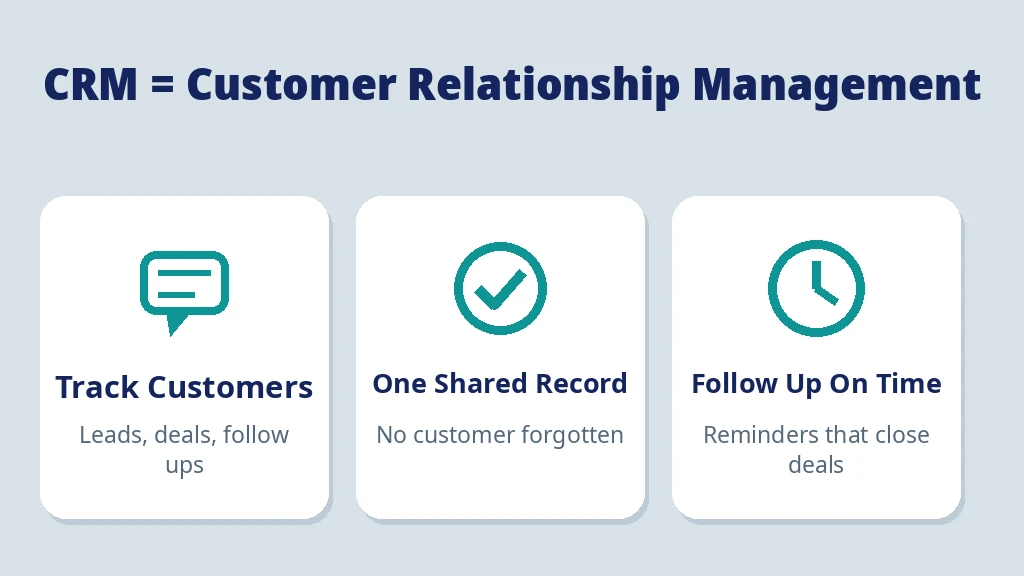
💡 CRM Meaning in Easy Words
Think of a CRM like a smart address book with a memory.
👉 A normal address book stores names and numbers
👉 A CRM also stores every conversation and deal
👉 It reminds you who to contact, and when
So in the simplest words:
CRM = one place where a business remembers every customer.
Imagine a shop owner who knows every regular by name, remembers what they bought last month, and never forgets a promise to call back. A CRM gives a whole team that same memory, even when the team has hundreds or thousands of customers. Nobody has to rely on one person’s notebook.
For a freelancer or a tiny business, the CRM might be a simple list of clients and follow ups. For a large company, it might be a huge system with pipelines, marketing emails, and support tickets, all connected.
🌍 Where Is CRM Used?
CRM lives wherever a business talks to customers: selling, supporting, or keeping customers.
📱 Common places:
- Sales team chats about leads and deals
- Marketing emails and campaign planning
- Customer support tickets and follow ups
- Startup and freelancer groups discussing tools
- Job postings that ask for CRM experience
- Business software reviews and comparisons
🗣️ Example situations:
- A salesperson logs a call so a teammate can follow up
- A shop owner checks which customers have not ordered in months
- A support agent reads past messages before replying
- A manager reviews the sales pipeline for the month
- A freelancer tracks proposals sent to new clients
🤔 Why Do People Use CRM?
🔥 Nothing gets forgotten
Without a CRM, customer details live in inboxes, notebooks, and people’s heads. When someone leaves or forgets, the knowledge leaves with them. A CRM keeps it in one shared place.
😑 Follow ups happen on time
Most lost sales are not lost on price. They are lost because nobody followed up. A CRM reminds the team who to contact, which stops warm leads from going cold.
💬 Everyone sees the same story
When support, sales, and marketing share one record, a customer does not have to repeat their story three times. That alone makes customers more patient and more loyal.
📈 Managers can see the pipeline
A pipeline shows every deal and its stage, from first contact to closed sale. Managers can spot problems early instead of discovering them at the end of the month.
💬 Real-Life Examples of CRM
Let’s see how CRM actually appears in daily work messages:
Example 1:
- Manager: “Log that call in the CRM before you leave.”
- Sales rep: “Done, with the follow up set for Thursday.”
👉 Meaning: Record the customer conversation in the system so the follow up is not lost.
Example 2:
- Freelancer: “I finally moved my clients into a CRM.”
- Friend: “No more spreadsheet chaos?”
👉 Meaning: Switched from messy spreadsheets to one organized customer system.
Example 3:
- Support agent: “Check the CRM before you reply to her.”
- Teammate: “Got it, she emailed twice already.”
👉 Meaning: Read the customer’s history first, so the reply fits what already happened.
Example 4:
- Founder: “Do we need a CRM yet, or is it too early?”
- Advisor: “If you are losing track of leads, it is time.”
👉 Meaning: Deciding whether the business has outgrown notes and memory.
Example 5:
- Sales chat: “That deal moved to the next CRM stage.”
- Manager: “Great, keep the momentum going.”
👉 Meaning: A deal advanced in the pipeline, from interest toward a closed sale.
⚖️ CRM vs Similar Business Terms
| Term | Meaning | What it handles |
|---|---|---|
| CRM | Customer Relationship Management | Customers, leads, sales, support |
| CMS | Content Management System | Website content and pages |
| ERP | Enterprise Resource Planning | Stock, finance, operations |
| Lead | A potential customer | One person or company, not software |
| Pipeline | Stages of a sale | Where each deal stands |
🧠 Key difference:
- CRM is about people and relationships. CMS is about website content. The letters look alike, but the jobs are completely different.
- ERP is bigger and wider. It covers stock, accounts, and operations, while CRM stays focused on customers.
- A lead is not software at all. It is a person who might buy. A CRM is the system that tracks that person.
Office short forms travel in packs, so one new term usually brings friends. Here is what BTO means in text, another abbreviation you will meet in the same work chats as CRM.
🔁 CRM Variations You Should Know
Salesforce is the largest and best known CRM platform. It is highly customizable, which suits big teams, but it can feel heavy for a tiny business.
HubSpot is another major CRM, popular with smaller teams because it bundles marketing and sales tools in one place and starts with a free tier.
Zoho CRM and Pipedrive are common alternatives for budget conscious teams and simple visual pipelines.
CRM vs crm is not a meaning change. Capital CRM is the standard form in writing. Lowercase “crm” in a fast chat means the same thing, just typed quickly.
↩️ How to Reply to CRM
Your reply depends on what the other person is asking.
If they ask you to update it: confirm the task. “On it, I will log the call in the CRM now” tells them the record will exist, which is the whole point.
If they ask whether you need one: answer with your pain point. “We keep losing follow ups” is a yes. “We have ten clients and a shared sheet works fine” is a fair no, for now.
If you do not know the tool they use: ask. “Which CRM are you on, Salesforce or HubSpot?” is a normal question, and it shows you understand the landscape even if you have not used that exact tool.
And if a teammate pings you about a CRM task while you are away from your desk, a quick BRB reply, like “BRB, will update it in five,” keeps the team informed.
⏰ When to Use CRM (and When to Avoid It)
✅ Good situations:
- Talking to sales, marketing, or support teams
- Planning follow ups, pipelines, or customer campaigns
- Comparing business software for a team
- Writing a job application that asks for CRM experience
⚠️ Avoid using CRM when:
- The reader has no business background and will not know the term
- A plain word like “customer list” would be clearer
- You are chatting with friends, where business jargon feels out of place
- The message needs the full term spelled out for a formal record
⚠️ Common Misunderstandings About CRM
Let’s clear up the confusion around CRM:
❌ CRM is not just software. Buying software without a follow up habit changes nothing. The strategy, regular updates, and shared records are what make it work.
❌ CRM is not only for huge companies. Freelancers and small shops use simple CRMs too. The system just needs to fit the size of the customer list.
❌ CRM is not the same as a CMS. A CMS runs website content. A CRM runs customer relationships. Mixing them up in a meeting causes real confusion.
❌ A CRM does not sell for you. It organizes, reminds, and reports. People still make the calls, write the messages, and close the deals.
💡 Pro Tips for CRM
✅ Log calls the same day. A CRM is only as good as its records. Notes written a week later are vague, and vague notes lead to awkward follow ups.
✅ One record per customer. Duplicates split the story across two profiles. Merge them early, so support and sales always see the full history.
✅ Review the pipeline weekly. A short weekly check catches stalled deals while they can still be saved, instead of discovering them at month end.
Related Texting Slang
Keep exploring the dictionary: ATM, CV, EMA, when someone texts you FYI, FYP in chats and texts.
Frequently Asked Questions
What does CRM mean in text?
CRM means “Customer Relationship Management,” a strategy and software for managing customer interactions, leads, and sales in one place. Salesforce and HubSpot are well known CRM tools.
What does a CRM actually do?
A CRM stores customer contacts, records conversations, tracks deals through a sales pipeline, and reminds the team when to follow up, so no customer or deal is forgotten.
Is CRM software or a strategy?
It is both. The strategy is remembering customers and following up well. The software is the tool that makes that possible when a team has too many customers to track by memory.
What is a CRM example?
Salesforce is the largest example, and HubSpot is another major one, popular with smaller teams. Zoho CRM and Pipedrive are also widely used alternatives.
Do small businesses need a CRM?
Not always. A small list can live in a spreadsheet. But once leads start slipping, follow ups get missed, or several people share customers, a simple CRM usually pays for itself in saved time.
🧾 Final Thoughts
CRM sounds like jargon until you translate it: a system for remembering customers properly. Strategy first, software second, and regular updates always.
Now you know what CRM means, how the software works, what a pipeline is, and how to answer when a colleague says “put it in the CRM.” If your own follow ups are slipping, that might be your sign that a simple CRM is worth trying.
For the standard definition, Wikipedia describes customer relationship management as a process for managing interactions with customers, while Salesforce explains it as technology for managing all of a company’s relationships and interactions with customers and potential customers.