You are reading a message, you reach the last line, and there it sits on its own: “BR.”
Is it a greeting? A goodbye? A typo? Two letters should not be this confusing, yet BR is one of the most context dependent abbreviations in texting, because the same two letters can close a polite email, greet a friend, or stand in for a longer pause.
Here is the short answer: BR means “Best Regards” when it closes a message, and “Be Right Back” when it appears mid-chat before a pause. The sign-off is the dictionary documented lead sense, the one to assume when BR sits at the end of a note, under a name, or as a closing. The pause sense is its casual chat twin, a short form of BRB that friends and gamers use constantly. Position changes everything, and this guide to the br meaning in text will show you how to read that position in seconds, so you never reply to the wrong BR again.
What Does BR Mean in Text?
BR stands for Best Regards in its documented lead sense, the sign-off. In casual chats, the same two letters also carry the pause sense, Be Right Back.
It is a shortened closing. Instead of typing out “best regards” at the end of an email, a work chat, or a polite message, the writer types BR, adds a name, and stops. The message is finished, the tone is polite, and nothing more is expected from the reader except a reply in their own time.
Quick definition: BR means “Best Regards” at the end of a message, a short, polite sign-off meaning “I wish you well.” In casual chats it also means “Be Right Back,” a quick way of saying “I am stepping away and will return in a moment.”
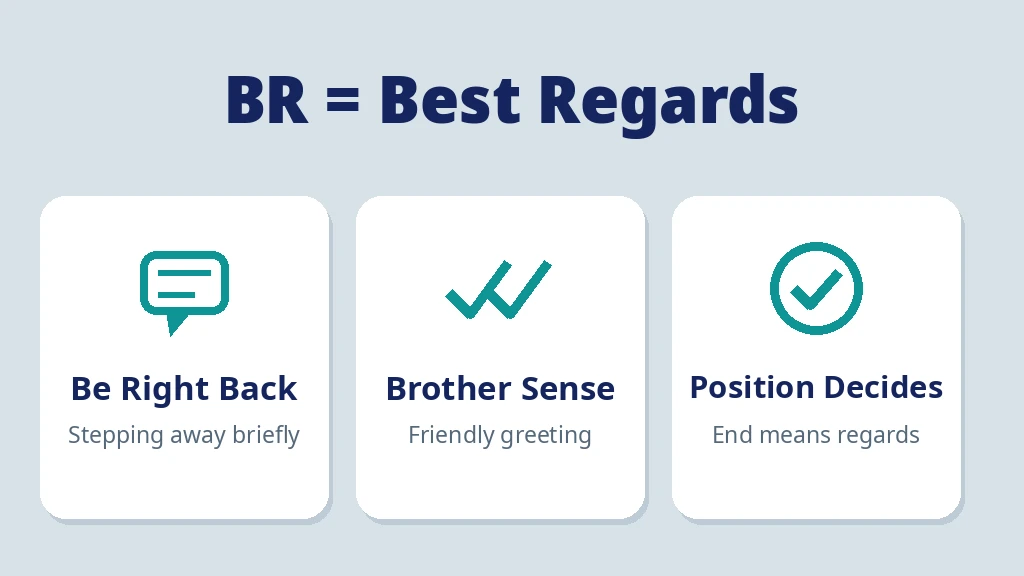
That sounds simple, and at the end of a message it usually is. The trouble starts when BR shows up somewhere else. Put it in the middle of a fast chat, right before someone goes quiet for a minute, and BR means be right back. Put it at the start of a sentence as a word to address someone, and it stops behaving like a sign-off and starts behaving like a greeting. That is why so many guides disagree about BR: they are each describing a different position in the message.
BR Meaning in Easy Words
Think of it like this:
You finish a message, and you want to end politely without writing a full formal closing. You type BR, then your name. Done. That is the whole job of the lead meaning.
So in the simplest words, the br meaning in text is a closing first, and a greeting second:
BR at the end of a message = “Best regards, take care.”
Now change the spot. Your friend texts, “Thanks br, that helped a lot.” There, BR is not closing anything. It is addressing you, the way “bro” or “brother” would. Same letters, different job, and the sentence around it tells you which job it is doing.
Finally, imagine a chat where someone writes, “BR, grabbing my charger.” There, BR means be right back: the person is stepping away and will return in a moment. It works as a shorter form of BRB, and in fast chats and gaming lobbies, where every keystroke counts, it is used all the time.
Three spots, three readings: end of message means Best Regards, the middle of a fast chat before a pause means be right back, and addressing a person means brother or bro.
Where Is BR Used?
BR lives in two quite different worlds: polite written messages and fast casual chats. That split is exactly why it confuses people.
Polite and work messages:
- Emails and work chats, as a short sign-off under the main message
- WhatsApp messages to colleagues, clients, or teachers, where a full closing feels too formal
- Messages to someone you do not know well, where a friendly but respectful ending helps
- Short replies that still need a polite finish, such as “Noted, thanks. BR, Ali”
Casual chats and social media:
- Instagram and TikTok comments, where “br” addresses a friend the way “bro” does
- WhatsApp chats between friends, where “thanks br” means “thanks, brother”
- Gaming chats, where “br” commonly means be right back before a quick pause
- Group chats, where regulars shorten everything and context fills in the gaps
The pattern is simple: the more formal the setting, the more likely BR means Best Regards, and the more casual the setting, the more likely it means brother or a quick pause.
Why Do People Use BR?
It saves time without sounding rude
Typing “best regards” in full, every time, gets old fast in a busy inbox. BR keeps the politeness and drops the typing. The reader still feels respected, and the writer moves on to the next message.
It softens a short message
A two word reply such as “Noted.” can read as cold. Add BR and a name, and the same reply reads as polite and finished.
It fits the speed of casual chat
Between friends, nobody wants to type “brother” in full when “br” does the same job. It is warm, quick, and familiar.
Everyone in the group already knows the code
Inside a work team or a friend group, BR becomes shorthand everyone recognises. Outsiders may pause over it, but insiders read it instantly, which is the whole point of chat shorthand.
Real-Life Examples of BR
Let’s see how BR actually works in daily messages. Watch the position in each one, because that is what decides the meaning.
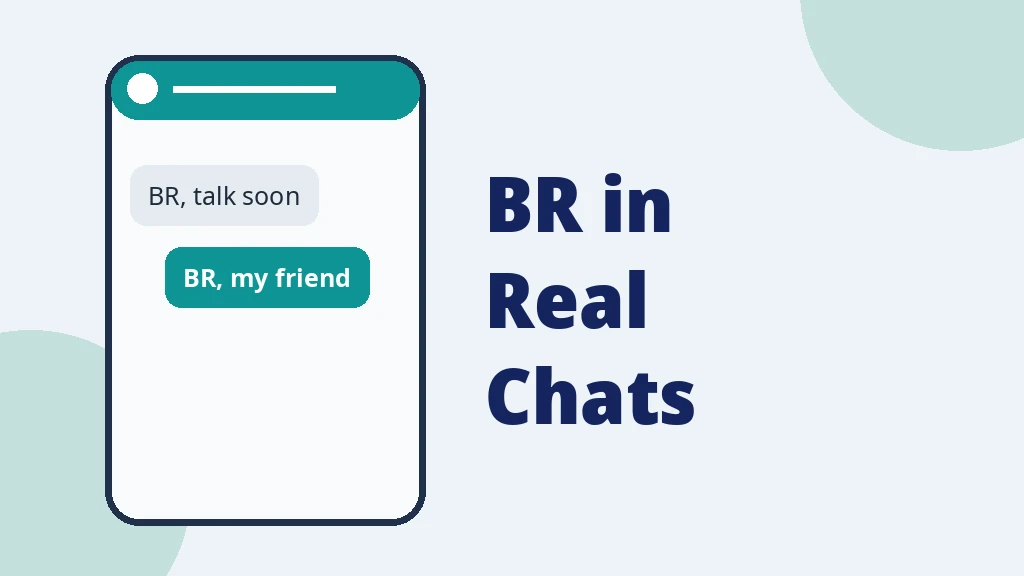
Example 1:
- Colleague: “Please send the updated file by Friday. BR, Sara”
Meaning: Best Regards. BR sits at the end, under the request, as a polite sign-off.
Example 2:
- Friend: “Thanks br, you saved me today”
Meaning: Brother or bro. BR addresses the friend directly, mid-sentence, as a warm greeting.
Example 3:
- Chat: “BR, one minute, my food just arrived”
Meaning: Be Right Back. The writer is pausing the chat for a moment and will return shortly. In casual chats, this short form does the same job as BRB.
Example 4:
- Work chat: “Got it, thanks. BR”
Meaning: Best Regards. Even without a name after it, BR at the very end of a work message reads as a closing, not a greeting.
BR vs Similar Terms
| Term | Meaning | When it appears |
|---|---|---|
| BR | Best Regards | End of a message, as a sign-off |
| BR | Brother or bro | Addressing a friend, mid-message |
| BR | Be Right Back | Mid-chat, right before a short pause |
| BRB | Be Right Back | Before a short pause in a chat |
| BRGDS | Best Regards | Older email shorthand for the same sign-off |
| Regards | Polite closing, in full | Formal emails and letters |
| Bro | Brother, friend | Casual address, in full |
Key difference:
- BR as Best Regards finishes a message. Nothing is expected to follow it except a reply later.
- BR as brother starts or colours a message. It addresses someone, and the conversation keeps going.
- BRB is the full form of the pause promise. BR is its shorter chat form: same meaning, used when the chat is moving fast and the pause is obvious from context.
BR Variations You Should Know
br vs BR is about tone, not meaning. Lowercase “br” feels casual and fast, which suits the brother sense and the clipped pause sense. Capital “BR” feels a little more deliberate, which suits the sign-off sense. The position still matters more than the capitalisation.
BR with a name (“BR, Sara”) is the strongest sign-off signal there is. When you see BR plus a name at the end, read it as Best Regards with confidence.
BR in gaming is where the pause sense lives most. In a lobby, “br” before an action (“br, restarting”) means be right back, and regular players read it instantly. If you are new to the group and unsure, wait a minute before replying as if the person had signed off.
How to Reply to BR
Your reply depends on which BR you just received.
If it closed a work message: reply to the content, not to the sign-off. “Thanks, Sara, I will send it by Friday” is perfect. You do not need to mirror BR unless that is your own habit.
If a friend called you br: reply warmly and carry on. “Anytime br” or “Haha, of course” matches the tone. There is nothing to decode and nothing to correct.
If it looks like a pause: wait, then reply when they return. “No rush” or “Take your time” is polite, and it avoids piling up messages while they are away.
If you genuinely cannot tell: use a neutral reply that works for every sense. “Got it, thanks” is safe after a sign-off, harmless after a greeting, and fine after a pause. You can always ask later, “Did you mean you were stepping away?” if the conversation stalls.
The same context rule applies to other short reactions. For example, here is what SMH means in text and how its tone changes with the situation around it.
When to Use BR (and When to Avoid It)
Good situations:
- Closing a work email or chat politely when a full closing feels too heavy
- Ending a message to a colleague, client, or teacher with a friendly but respectful tone
- Addressing a close friend as br in a casual chat where everyone uses that shorthand
- Keeping a short reply warm instead of blunt, by adding a polite finish
Avoid using BR when:
- The chat is formal or the reader is new to you. BRB is the clearer pause form there, because a stranger may read BR only as a sign-off
- The message is highly formal, such as a job application or an official letter. Write “Best Regards” in full
- You are talking to someone who may not know chat shorthand. A full closing removes all doubt
- The conversation is serious or sensitive. Short forms can read as dismissive when someone needs a real answer
- You are addressing a stranger as br. As a greeting, it assumes familiarity, and with a stranger it can feel too forward
Common Misunderstandings About BR
Let’s clear up the confusion around BR:
It does not have one meaning in every message. Position and setting decide the reading, and the lead reading is Best Regards at the end of a message.
Its pause sense is real, not just a typo. In casual chats, BR for be right back is a genuine shortened form of BRB, used on purpose by people who type fast. But position still rules: at the end of a work email, BR is a deliberate sign-off, not a pause, and reading it as one would misread a perfectly normal closing.
It is not rude as a sign-off. In most workplaces it is now normal shorthand, closer to “Thanks” than to silence. Do not read rudeness into someone else’s BR.
It is not the same as “bro” in every case. As an address it is close to bro, but as a sign-off it has nothing to do with bro at all. Swapping the two readings is the most common BR mistake, and it is exactly what the position test prevents.
It is not a country code in a chat. BR is the country code for Brazil and the chemical symbol for bromine, but neither belongs in a texting conversation.
Frequently Asked Questions
What does BR mean in text?
BR means “Best Regards” when it closes a message, and “Be Right Back” when it appears mid-chat before a short pause. It can also mean brother or bro when it addresses someone. The position in the message tells you which meaning is in play.
What is the full form of BR?
The full form of BR in its lead sense is “Best Regards.” It is a polite closing, meaning in plain words that the writer wishes you well.
Does BR mean brother?
Yes, in casual chats BR can mean brother or bro, but only when it addresses someone, such as “thanks br.” At the end of a work message, BR means Best Regards, not brother.
Does BR mean be right back?
Yes. In casual chats and gaming, BR is widely used as a short form of BRB, meaning the person is stepping away and will be back shortly. It is the same promise as BRB in fewer letters. At the end of a message, though, BR means Best Regards instead, so read the position before you decide.
What does BR mean on WhatsApp and Instagram?
It depends on the chat. In a work message, BR at the end usually means Best Regards. In a friendly comment or DM, “br” usually means bro.
Is it polite to sign off with BR?
Yes, in most everyday work messages it is polite and normal. For highly formal messages, such as a job application, write “Best Regards” in full instead.
How do you reply when someone ends a message with BR?
Reply to the content of the message, not to the sign-off. A simple “Thanks, I will take care of it” works. If a friend used br as a greeting, reply warmly and carry on with the conversation.
Related Texting Slang
Keep exploring the dictionary: how people actually use BRB, the meaning of CY, CYA, what GN means in a text, HBU, explained with real examples.
Final Thoughts
BR is small, polite, and trickier than it looks. Trust Best Regards when BR closes a message, and trust be right back when it shows up mid-chat before a pause. That, in full, is the br meaning in text: a closing, a pause, and a greeting, all decided by position.
Now you know how to read it: check the position first, then the setting, then the relationship. End of message plus a work setting means Best Regards, a mid-chat pause means be right back, and an address to a friend means bro.
The references back up that picture. CyberDefinitions defines BR in text as Best Regards, the sign-off used to wrap up online conversations, while Dictionary.com lists brother among its BR abbreviations, matching how friends use br as an address. The be right back sense comes from everyday chat use, where BR works as the short form of BRB.
1 thought on “BR Meaning in Text | Why Context Changes Everything”