
Your friend ends a chat with “cya!” and you smile. Then, in a work email thread, you spot “CYA” in all caps, and the mood feels completely different. Same letters, totally different message.
That is the trick with this one. Here is the short answer: in friendly chats, CYA means “see you,” a casual goodbye. At work, CYA can mean “cover your ass,” a warning to protect yourself from blame by keeping proof. Context tells you which one you just read.
This guide covers both senses of cya meaning in text, the clues that separate them, the reply that fits each one, and the mistake that happens when the workplace sense lands in a friendly chat.
📌 What Does CYA Mean in Text?
CYA has two well established meanings, and you need both to read it correctly.
Sense 1, the friendly goodbye: CYA stands for See You, usually read as “see ya.” It closes a chat the way a wave closes a visit. Someone types it when they are leaving for now and expect to talk again later.
Sense 2, the workplace warning: CYA stands for Cover Your Ass, meaning protect yourself from blame by documenting decisions, keeping emails, and getting things in writing. It is blunt, practical advice, not a goodbye at all.
✅ Quick definition: CYA means “see you” as a casual goodbye in chats, and “cover your ass” as workplace advice to document your work so blame cannot land on you unfairly.
The sound trick explains the goodbye sense: C sounds like “see,” Y sounds like “ya,” and A adds the “bye” feeling of “see ya.” The workplace sense uses the same letters as initials, which is why the two meanings collide in one short form.
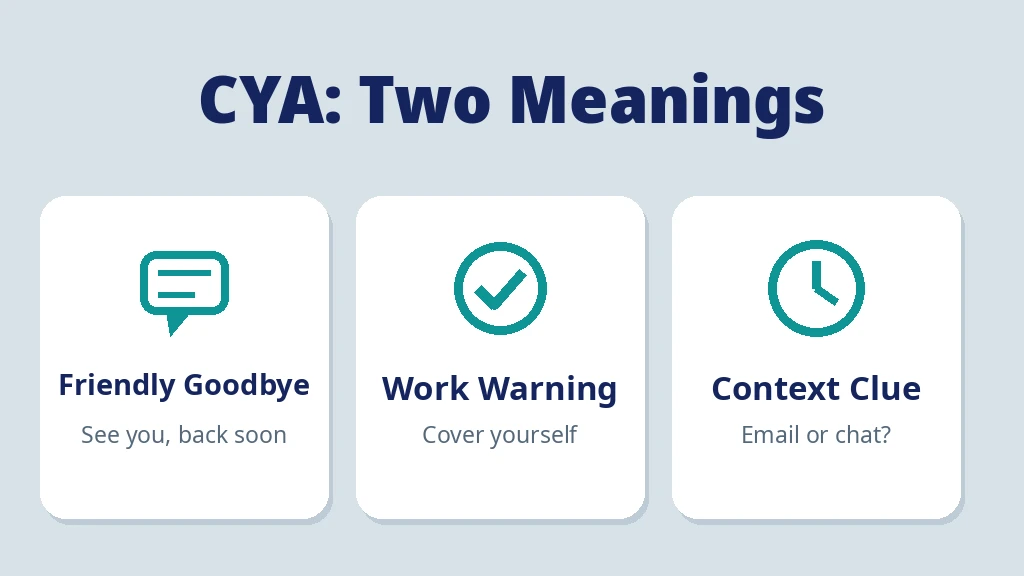
Most of the time, the setting decides for you. End of a casual chat means goodbye. A message near words like email, record, proof, approval, or blame means the workplace sense. When neither clue is present, assume the friendly sense in a chat with friends, and ask before assuming the sharper one.
💡 CYA Meaning in Easy Words
Think of it like this:
👉 A friend says “cya” at the end of a chat
👉 In real life, they would wave and say “see ya”
👉 A coworker says “CYA” about a risky decision
👉 In real life, they would say “get that in writing first”
So in the simplest words:
CYA = “See ya later” with friends, “protect yourself” at work.
One version warms a goodbye. The other version warns you to keep proof. The letters are identical, so the sentence around them does all the work.
🌍 Where Is CYA Used?
CYA travels in two very different worlds, and it rarely mixes them up by accident.
📱 The goodbye sense appears in:
- WhatsApp and Messenger chats with friends
- Snapchat and Instagram direct messages
- Gaming chats and Discord servers
- Text messages after making plans
- Comments where a conversation is winding down
💼 The workplace sense appears in:
- Office chats and emails about decisions and approvals
- Messages about audits, reviews, and responsibility
- Advice between coworkers before a risky sign off
- Notes about keeping records, tickets, and written proof
The goodbye sense is far more common in everyday texting. The workplace sense shows up when stakes are higher and someone wants a paper trail.
🤔 Why Do People Use CYA?
🔥 As a goodbye, it is fast
Three letters replace “see you later.” When someone is already leaving, CYA gets the goodbye sent before they put the phone down.
😊 As a goodbye, it sounds warm
“See ya” feels friendlier than a flat “bye.” CYA keeps that warmth while staying short, which is why friends use it at the end of almost every chat.
🛡️ At work, it is a shortcut for a real warning
“Cover your ass” is a whole piece of advice in three letters: document the decision, save the email, confirm in writing. Coworkers use it when they want someone to be careful, not careless.
💬 It signals insider knowledge
Both senses mark the speaker as someone who knows the shorthand of their group, whether that group is a friend circle or an office team. Outsiders may miss the second sense entirely, which is part of why context matters so much.
💬 Real-Life Examples of CYA
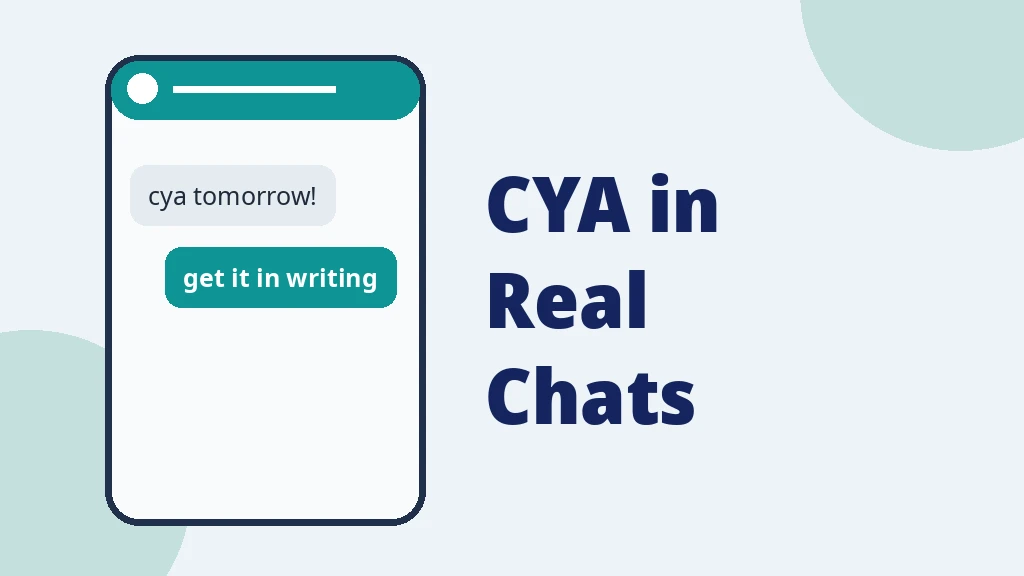
Let us see how people actually use CYA in daily conversations, in both senses:
Example 1 (goodbye):
- Friend: “That was fun, I have to run now 🏃”
- You: “cya tomorrow!”
👉 Meaning: A warm goodbye. You will talk again tomorrow, nothing more to read into it.
Example 2 (goodbye with a plan):
- Chat: “See you at the match on Saturday?”
- Reply: “yes! cya there”
👉 Meaning: Confirmation plus goodbye. CYA confirms the plan and ends the chat in one move.
Example 3 (workplace warning):
- Coworker: “The boss changed the deadline again, but only on a call”
- Reply: “CYA, get the new date in an email before you start”
👉 Meaning: Protect yourself. Get the decision in writing so you cannot be blamed for following the old date.
Example 4 (workplace warning):
- Chat: “Should I approve this without the signed form?”
- Reply: “CYA on this one, wait for the signature”
👉 Meaning: Do not take the risk alone. Wait for proof before you put your name on it.
Example 5 (the misfire to avoid):
- Friend: “Thanks for helping me move today, you are the best!”
- Wrong reply: “CYA, I kept all the receipts lol”
👉 Meaning: This lands badly. Your friend hears the workplace sense in a warm moment, and a sweet thank you turns awkward. In a friendly chat, keep CYA as a goodbye only.
⚖️ CYA vs Similar Internet Terms
| Term | Meaning | Watch out for |
|---|---|---|
| CYA | See you / Cover your ass | Two senses, context decides |
| CY | See you | Goodbye only, no workplace sense |
| CU | See you | Goodbye only, spelled with U |
| BRB | Be right back | Not a goodbye, promises a quick return |
| GTG | Got to go | Announces leaving, not a warning |
🧠 Key difference:
- CY and CU are safe goodbyes with one meaning each. CYA is the only one in this group that can flip into a workplace warning.
- Caps are a soft clue, not a rule. Lowercase “cya” usually means goodbye, and all caps “CYA” often signals the workplace sense, but friendly chats use caps for emphasis too, so never rely on caps alone.
- BRB is not a goodbye at all. It promises a return to the same chat, while the friendly CYA closes the chat for now.
And if a friend signs off with the shorter version instead, here is what BRB means in text and why it is different from a real goodbye.
🔁 CYA Variations You Should Know
CYA tomorrow, CYA later, CYA soon are the common goodbye extensions. Adding a time turns a vague farewell into a small promise about when you will talk again.
CYA l8r is a playful, old school spelling of “see you later.” It looks dated now, but older chats and memes still use it for a joking goodbye.
CY is the shorter goodbye cousin. When you only mean “see you,” CY avoids the workplace sense entirely, which makes it the safer pick in any mixed audience.
cya vs CYA is about tone, not a strict rule. Lowercase “cya” feels casual and friendly. All caps “CYA” feels louder and more serious, and in a work thread it usually means the warning sense. Read the sentence around it before deciding.
↩️ How to Reply to CYA
Your reply depends entirely on which CYA you just received.
If it is a friendly goodbye: echo it back. “cya!” or “cya tomorrow 👋” closes the loop neatly.
If it names a time or place: confirm it. “See you then” or “cya there” shows you noted the plan.
If it is a workplace warning: take the advice seriously. Thank them, then actually get the decision in writing: a follow up email, a saved ticket, or a confirmed message. A reply like “good call, I will get it confirmed in writing” shows you understood.
If you are unsure which sense it is: do not guess out loud. A neutral “noted, thanks” works in both worlds, and you can check privately before acting on the sharper reading.
⏰ When to Use CYA (and When to Avoid It)
✅ Good situations:
- Ending a chat with a friend or classmate
- Confirming a plan while saying goodbye
- Warning a trusted coworker to document a decision
- Leaving a gaming lobby or group thread
- Any casual chat where the goodbye sense is obvious
⚠️ Avoid using CYA when:
- The audience mixes friends and coworkers, and the warning sense could misfire
- You are writing to a boss, a client, or anyone formal
- The conversation is warm or emotional, and a blunt warning would spoil it
- You only mean goodbye and a safer form like CY or “see you later” is available
⚠️ Common Misunderstandings About CYA
Let us clear up the confusion around CYA:
❌ CYA does not always mean goodbye. In a work thread about proof, approvals, or blame, it is a warning, not a farewell. Reading it as a goodbye there means missing real advice.
❌ CYA does not always mean the warning. In a friendly chat, it is almost always “see ya.” Assuming the workplace sense there turns a warm goodbye into an insult.
❌ Caps alone do not settle it. Friends type “CYA!” for excitement, and coworkers type “cya” quietly as advice. Caps are a hint, the surrounding words are the evidence.
❌ CYA is not rude by itself. The goodbye sense is friendly, and the workplace sense is protective advice between colleagues. It only feels rude when the wrong sense lands in the wrong conversation.
💡 Pro Tips for Using CYA
When in doubt, pick the clearer form. Use “see you later” with anyone who might not know the slang, and save CYA for friends who already use it. At work, use the warning sense only with trusted colleagues, never in a message that could be forwarded to a boss or client without context. And if you ever send the workplace CYA by mistake in a friendly chat, a quick “sorry, I meant see ya!” fixes it faster than any long explanation.
Related Texting Slang
Keep exploring the dictionary: how people actually use CYC, when someone texts you DWS, HBU in chats and texts, cap in chats and texts, gn meaning in text.
Frequently Asked Questions
What does CYA mean in text?
In friendly chats, CYA means “see you,” a casual goodbye. At work, CYA can mean “cover your ass,” advice to document decisions so blame cannot land on you unfairly. Context decides which sense applies.
What is the full form of CYA?
CYA has two full forms: “see you” in casual texting, and “cover your ass” in workplace slang. Both are well established, so neither one alone tells the whole story.
Is CYA rude?
The goodbye sense is friendly, not rude. The workplace sense is blunt, but it is meant as protective advice between colleagues, not as an insult. It only feels rude when the workplace sense lands in a friendly chat by mistake.
What does CYA mean on Snapchat and WhatsApp?
On Snapchat and WhatsApp, CYA almost always means “see you.” Friends use it at the end of a conversation as a quick, warm sign off.
How can you tell which CYA someone means?
Look at the setting and the nearby words. End of a casual chat means goodbye. Words like email, record, proof, approval, or blame point to the workplace sense. Caps are only a soft hint, not proof.
How do you reply when someone sends CYA?
For a goodbye, echo it back with “cya!” or confirm a plan with “cya tomorrow.” For a workplace warning, thank them and actually get the decision in writing.
🧾 Final Thoughts
CYA is one abbreviation with two jobs. With friends it is a warm “see ya” at the end of a chat. At work it is a blunt reminder to keep proof before you take a risk. Both senses are real, and the sentence around the letters tells you which one you are reading.
Now you know the cya meaning in text in both worlds, the clues that separate a goodbye from a warning, and the reply that fits each one. Next time CYA lands in your chats, pause for one second, check the context, and you will read it right.
For the dictionary side of the story, Dictionary.com covers the “see you” sense of CYA, and CyberDefinitions lists both the casual goodbye and the workplace warning, which matches exactly the dual reading real chats show.
4 thoughts on “CYA Meaning in Text | Friendly Goodbye or Office Warning?”