
You see “boi” in a comment and your brain stalls for a second. Is it a typo for “boy”? A name? A joke you are supposed to already know?
Here is the short answer: BOI is a playful, stylized spelling of “boy.” It sounds exactly the same, but the spelling adds attitude: it can be funny, friendly, ironic, or rooted in a subculture, depending on who writes it and where.
This guide explains the boi meaning in text, where the spelling came from, how it works in memes and chats, and the one rule that matters most: do not use it to label someone else’s identity.
What Does BOI Mean in Text?
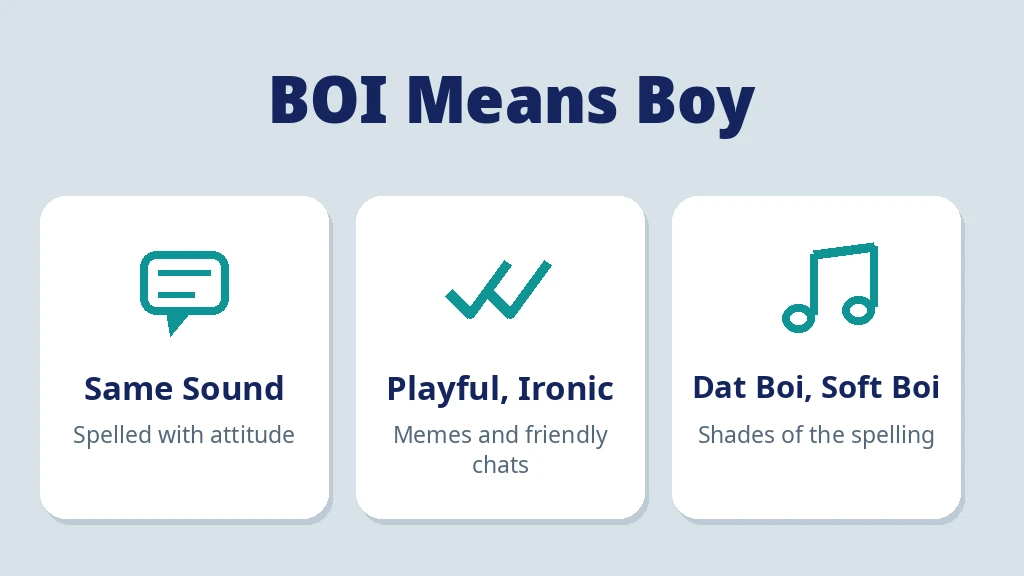
BOI means Boy, spelled differently on purpose.
It is not a new word, and it sounds the same. Say it out loud and you get “boy.” The change is visual and social: writing “boi” instead of “boy” signals that the message is casual, playful, or part of an online or street culture where the spelling itself is the joke or the badge.
Quick definition: BOI is a slang spelling of “boy” used in texts, memes, and social media as a friendly address, a joke, or a marker of a playful, rebellious, or androgynous style. It can also describe a masculine-presenting person in LGBTQ contexts, where it is a matter of self-identification.
Plural: “bois,” sometimes “boiz.”
One honest note: BOI also stands for Beneficial Ownership Information in business and legal writing about company filings. That is a completely different acronym that happens to share letters. If you see BOI in a company document, it is not slang. If you see it in a chat or a meme caption, it is almost certainly “boy.”
BOI Meaning in Easy Words
Think of BOI like wearing a band T-shirt instead of a plain one. The shirt is still a shirt, but the choice says something about taste, humor, and which group you feel part of.
Writing “boy” is neutral. Writing “boi” adds a wink. It can say “we are friends,” “this is a joke,” “I am part of this scene,” or all three at once.
So in the simplest words:
BOI = “boy, but with personality.”
The personality changes with the speaker, which is why the rest of this guide walks through the main flavors one by one instead of pretending there is only one.
Where Did BOI Come From?
The spelling has roots in 1990s hip-hop and African American Vernacular English. Rapper Antwan Andre Patton took the stage name Big Boi as one half of Outkast, in line with other deliberate street spellings of the era, and the spelling traveled from there.
In the mid-to-late 1990s, “boi” picked up a second life in skateboarding, rave, and emo scenes, where it described a softer, more sensitive kind of masculinity: the skate kid, the emo kid, the kid who did not fit the tough-guy mold. From there it spread into LGBTQ culture in the 2000s, where it became a way for young, masculine-presenting people, including butch lesbians and transmasculine people, to name themselves.
Then came the meme that made it famous everywhere. In 2015, a Tumblr post said “Here come dat boi. O shit waddup!” and in 2016 a Facebook page paired the phrase with a green frog riding a unicycle. Dat Boi went viral as a deliberately absurd joke, and it also drew criticism as an appropriation of Black and queer culture.
Where Is BOI Used?
BOI shows up in friendly, funny, and subcultural spaces, almost never in formal ones.
Common places:
- Texts and group chats between friends
- Instagram, TikTok, and X (Twitter) captions and comments
- Memes, especially Dat Boi and its remixes
- Skate, emo, hip-hop, and queer community spaces online
- Music and fan culture, from Outkast to Avril Lavigne’s “Sk8er Boi”
Example situations:
- Greeting a friend: “Yo, boi, what are we doing tonight?”
- Reacting with mock drama: “Oh boi, here we go again.”
- Captioning a photo of a friend, a pet, or even an object, as a joke
- Describing a style: a soft boi, a skate boi, an emo boi
- Greeting someone warmly in North Wales, where “boi” works like “mate”
Why Do People Use BOI?
It is friendlier than “boy”
“Hey, boy” can sound flat or even rude. “Hey, boi” sounds like a friend talking. The spelling softens the word and adds warmth.
It signals belonging
Using “boi” tells readers which world you are speaking from: internet culture, skate culture, hip-hop, emo, or queer culture. It is a small badge that says “I know this reference.”
It makes jokes funnier
Memes run on deliberate misspellings, and “boi” is one of the greats. Calling a frog, a cat, or a car “dat boi” is funny precisely because the word does not quite fit, and everyone knows it.
It names an identity, for those who choose it
For some people, “boi” is how they describe their own gender expression: youthful and masculine-presenting, not bound to traditional masculinity. That use deserves respect, and it is never a label to stick on someone who has not chosen it.
Real-Life Examples of BOI
Here is how BOI actually looks in chats, captions, and memes.
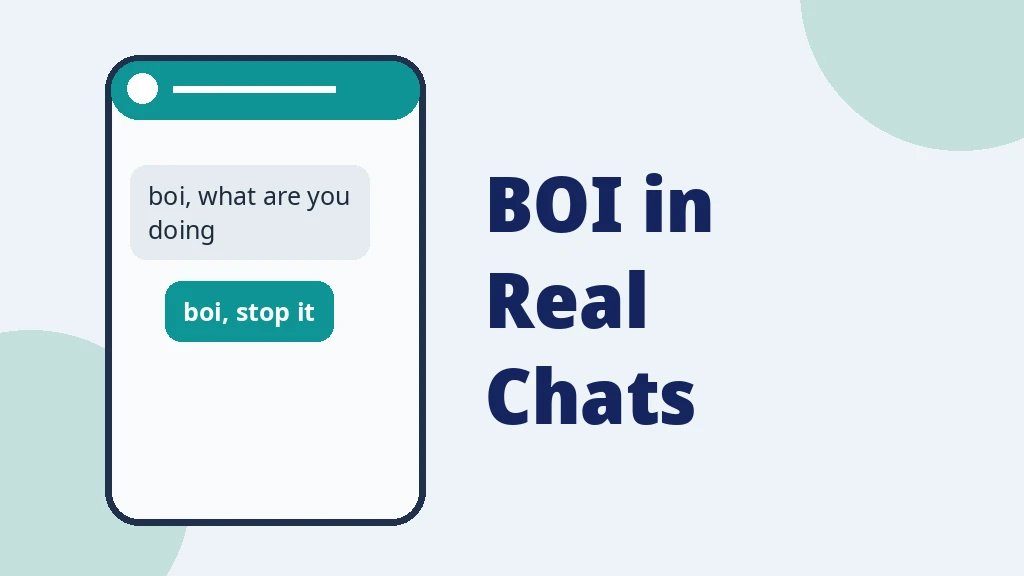
Example 1 (friendly greeting):
- Friend: “Yo, boi, are we going to the game tonight?”
- You: “You know it. Pick you up at seven.”
Meaning: A warm address for a male friend, like “bro” or “dude,” with extra playfulness.
Example 2 (mock drama):
- Friend: “He texted his ex again.”
- You: “Oh boi, here we go again.”
Meaning: An exclamation of amused disbelief, like “oh boy” with the volume turned up.
Example 3 (Dat Boi):
- Comment: “Here come dat boi! O shit waddup!”
- Reply: “The frog on the unicycle lives forever.”
Meaning: A direct Dat Boi reference. “Dat boi” means “that boy,” said in a playful, exaggerated accent spelling.
Example 4 (style label, self-chosen):
- Friend: “I am going full soft boi this winter. Sweaters and feelings.”
- You: “Respect. The sweaters suit you.”
Meaning: A style and mood label the person chose for themselves, mixing softness with a masculine-presenting style.
BOI vs Similar Terms
| Term | Meaning | How it differs from BOI |
|---|---|---|
| BOI | Playful spelling of boy | The baseline: same sound, extra attitude |
| Boy | A male child or young man | The standard, neutral spelling |
| Bro / Dude | A male friend or peer | Gendered friend words, without the meme history |
| Bruh | A reaction word, like “bro” with disbelief | More of an exclamation than an address |
| Dat boi | “That boy,” as a meme phrase | A fixed meme caption, not a general address |
The key difference is tone, not dictionary meaning. “Boy” states a fact. “Boi” performs a vibe. That is why swapping them changes a message even though the sound stays the same.
BOI Variations You Should Know
Soft boi: A young man, or masculine-presenting person, who is openly emotional, gentle, and sensitive, often with a soft, vintage style. The term can be affectionate or teasing, depending on who says it.
Skate boi: A skater kid: baggy clothes, sneakers, a board, and a laid-back attitude. Avril Lavigne’s “Sk8er Boi” helped push this spelling into pop culture in the early 2000s.
Emo boi: A person in emo culture: emotional lyrics, dark or layered clothes, and an openness about feelings that traditional tough masculinity hides.
Sad boi: A sensitive young man who openly shares sadness, especially about relationships, often late at night. “Sad boi hours” means the overnight hours when those feelings come out in texts.
Dat boi: The meme phrase, always with “dat” instead of “that.” It is a caption and a greeting for the frog meme, not a word you would use in a normal sentence about a real person.
Boi in Wales: In North Wales, “boi” is a familiar greeting for anyone, like “mate” or “pal,” regardless of gender. A Welsh “All right, boi?” is friendliness, not slang about identity.
How to Reply to BOI
Your reply depends on which BOI you just got, so match the flavor.
If it is a friendly greeting: Greet back the same way. “Yo! What is up?” or “Hey, what are we doing today?” keeps the warmth going.
If it is a joke or meme: Laugh along or add to the bit. “Dat boi indeed” or a laughing emoji is enough, and over-explaining the joke kills it.
If it is “oh boi” as an exclamation: Treat it like a reaction, not an address. Reply to the news itself, not to the word. That kind of reaction word works the same way as SMH, a short reaction to something silly or disappointing, except “oh boi” leans amused rather than annoyed.
If someone uses “boi” for themselves: Use it back only if they do, and in the way they do. Mirror their language, and do not turn their identity word into a joke.
If you are not sure what they mean: Ask lightly. “Do you mean the meme, or just saying hi?” is a friendly question, and it beats guessing wrong.
When to Use BOI (and When to Avoid It)
Good situations:
- Greeting close friends in chats and comments
- Memes, captions, and jokes where the audience knows the reference
- Describing your own style, like soft boi or skate boi, if that is how you see yourself
- Playful exclamations like “oh boi” between friends
- A friendly greeting in Wales, where it is everyday speech
Avoid using BOI when:
- Writing formally, for work, school, or official messages
- Labeling someone’s gender or identity when they have not used the word for themselves
- Mocking queer, emo, or skate culture from outside it
- Talking to someone who may hear it as an insult or a mistake, rather than a joke
- Writing about company filings, where BOI means Beneficial Ownership Information and slang will confuse everyone
Common Misunderstandings About BOI
BOI is not a typo. It is a deliberate respelling. Correcting someone’s “boi” to “boy” misses the joke and the culture behind it.
BOI is not only a meme. Dat Boi made it famous, but the spelling existed in hip-hop, skate, emo, and queer communities long before the frog.
BOI is not only for boys. Dictionary.com notes it is used for men, girls, women, and even things that are not human, especially in memes. The word follows the joke, not the gender.
BOI is not a word to put on strangers. When it describes identity, it belongs to the person using it for themselves. Using it to label someone else, especially to mock them, is disrespectful.
BOI is not the business acronym in chats. Beneficial Ownership Information belongs in filings and compliance guides. In a text, a caption, or a meme, BOI means boy.
Pro Tips for Using BOI Well
First, use it with people who will get it: BOI charms friends while confusing strangers, so let the context pick the flavor. A greeting, a meme caption, and a self-description are three different uses.
Third, if you are describing a person, use the words they use for themselves. That rule matters more than any slang guide, including this one.
Frequently Asked Questions
What does BOI mean in text?
BOI is a playful, stylized spelling of “boy” used in texts, memes, and social media as a friendly address, a joke, or a marker of a playful or subcultural style. It sounds exactly like “boy.”
Is BOI a typo for boy?
No. BOI is a deliberate respelling. People write “boi” instead of “boy” to add humor, friendliness, or subcultural flavor, and correcting it misses the point.
What does “dat boi” mean?
“Dat boi” means “that boy,” written in a playful accent spelling. It is the caption of the viral 2016 meme featuring a green frog riding a unicycle, greeted with “Here come dat boi! O shit waddup!”
What is a soft boi?
A soft boi is a young man or masculine-presenting person who is openly emotional and gentle, often with a soft, vintage style. The term can be affectionate or teasing, depending on tone and who uses it.
What does BOI mean in LGBTQ contexts?
In LGBTQ contexts, “boi” can describe a youthful, masculine-presenting person, including butch lesbians and transmasculine people. It is a self-identification term, so use it for someone only if they use it for themselves.
Does BOI mean something in business?
Yes, but it is a different acronym. In business and legal writing, BOI means Beneficial Ownership Information, details about who owns or controls a company, filed with regulators. In chats and memes, BOI means boy.
Related Texting Slang
Keep exploring the dictionary: ARD, explained with real examples, when someone texts you AWLL, the meaning of BTA, how people actually use BWT, FR, when someone texts you HBU, how people actually use JK.
Final Thoughts
BOI is a tiny spelling change with a big personality. It means boy, sounds like boy, and still manages to say something extra: this is friendly, this is funny, this is my scene, or this is how I see myself.
That is also why it rewards a little care. Use it with friends, in memes, and for yourself. Use it to label a stranger or mock a subculture, and it misfires.
The dictionaries agree on the core. Dictionary.com calls boi an alternate spelling of boy used for boys, men, girls, women, and even things that are not human, and Wiktionary lists it as slang, originally internet slang, for an alternative spelling of boy, which matches exactly how people use it in real chats and captions.