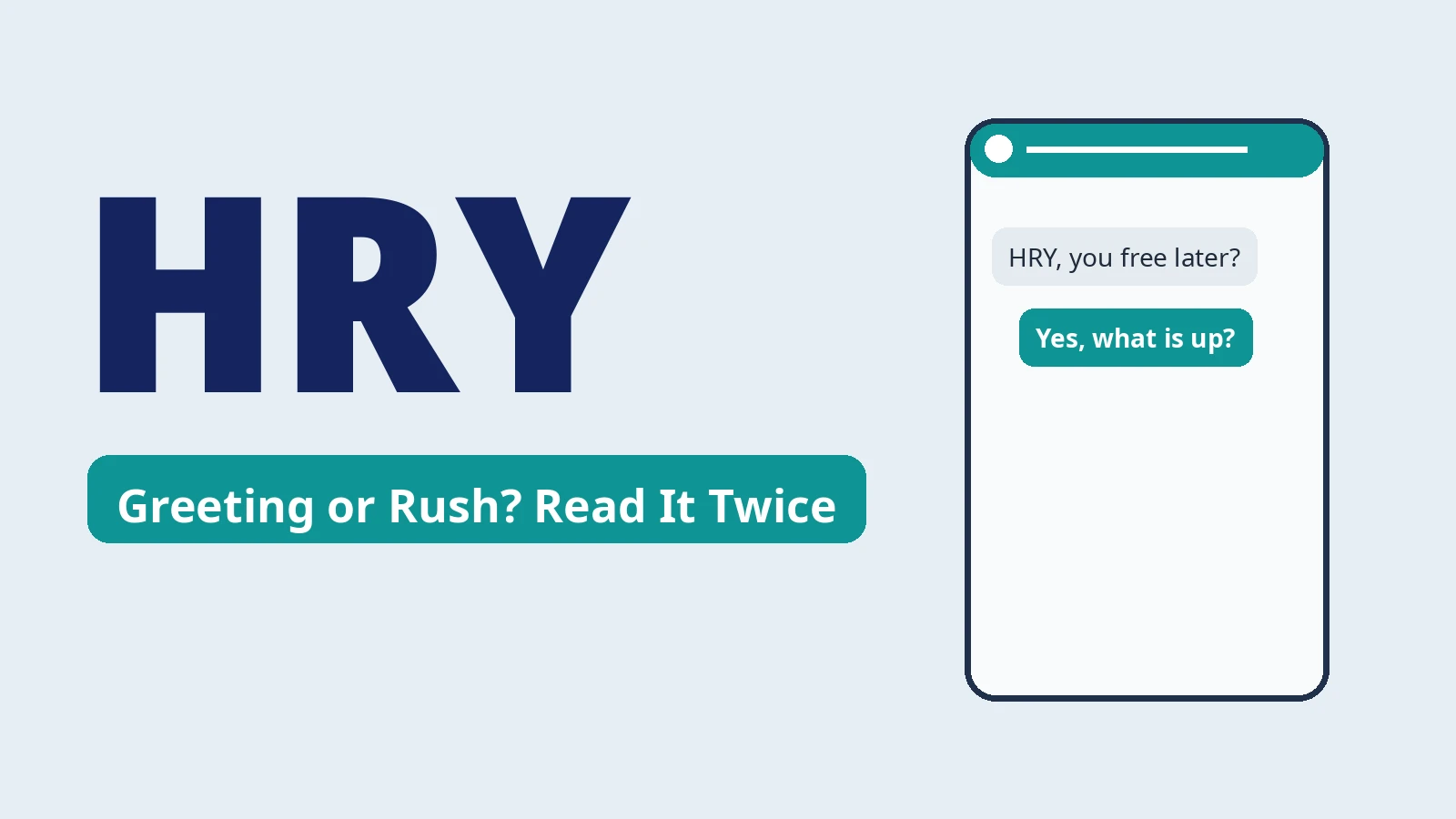
A chat opens with three letters that look familiar but feel slightly off: “hry?” You know HRU means “how are you?”, and this looks almost the same, but is it the same question, a greeting, or something else entirely?
Here is the honest short answer: HRY has no single settled meaning. Most often it works as a greeting question in the “how are you?” family, but it can also mean “hey, are you there?” and, with “up” after it, it can mean “hurry”. The sentence around it decides.
In this guide you will learn the hry meaning in text, how it relates to HRU without being HRU, when it means “hurry”, and how to reply without guessing wrong.
What Does HRY Mean in Text?
HRY is a contested abbreviation, and any guide that gives you one confident expansion for it is oversimplifying. The niche sources split, and the split itself is the most useful thing to understand.
Quick definition: HRY most often means “how are you?” or “hey, are you?”, used as a casual greeting question in chats. In urgent messages, “hry up” means “hurry up”. No single expansion wins in every chat, so context decides.
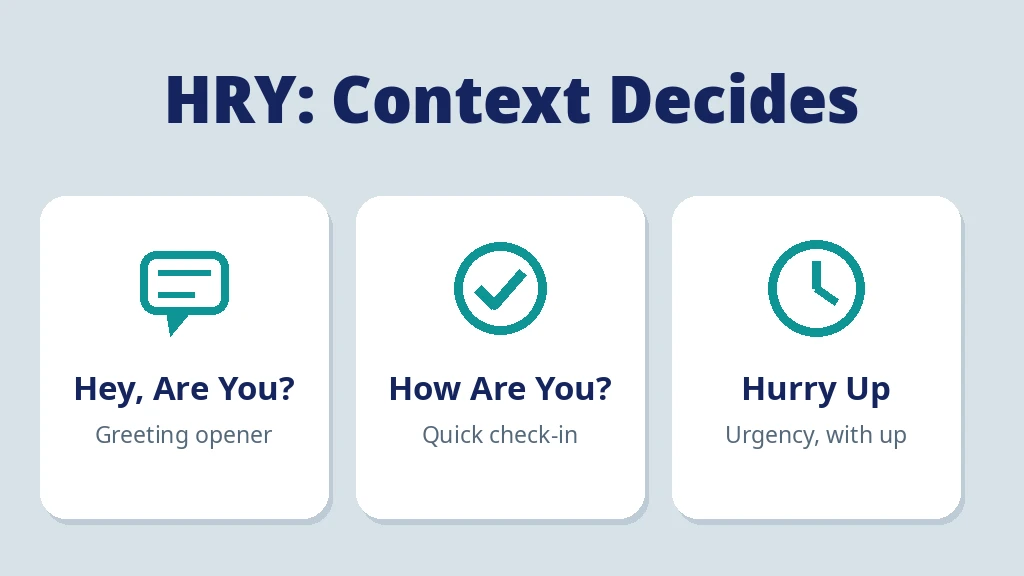
The Google top results show the disagreement clearly. Several niche guides lead with “How Are You?”, treating HRY as a shorter, looser cousin of HRU. One detailed guide leads with “Hey, are you?”, usually as “hey, are you there?” or “hey, are you okay?”, and treats “how are you?” as a close but less precise reading. A third group leads with “hurry”, but only for the “hry up” pattern. The Free Dictionary’s acronym listing also records “How Are You” as the chat sense of HRY, which supports the greeting-question family as the main reading, while the “hurry” sense stays tied to urgency and to the word “up” nearby.
There is no CyberDefinitions entry to settle the ranking: the Day 8 pre-check records its HRY page as a 404, and my own direct fetch of that page was rate-limited (429) during this writing pass, so I am not claiming a fresh CyberDefinitions check for HRY. That gap is exactly why this article does not force one lead. When the reference layer is missing and the niche guides disagree, the honest article is a multi-sense one, with each sense labelled by its evidence.
HRY Meaning in Easy Words
Think of HRY as a squeezed greeting.
Texting compresses phrases by dropping letters and sounds, and HRY is what happens when “how are you?” or “hey, are you?” gets squeezed too hard. The result is shorter, but it loses some of the clarity of HRU, which spells its question out more cleanly. That is why HRY feels familiar and confusing at the same time: your brain recognises the greeting family, but the exact words are blurred.
In the simplest words:
HRY = “Hey, how are you?” in a hurry, or just “hurry” when time matters.
Most senders are not trying to be cryptic. They typed fast, they assumed you would get it from context, and in most chats you will. The trouble only starts when HRY arrives with no context at all, such as a bare “hry” from someone you barely know. Then the safest reply is a general one that works for every reading, such as “Hey, good, what is up?”
Where Is HRY Used?
HRY is a private-chat term far more than a public-post term, and it clusters on fast, informal apps.
Common places:
- WhatsApp and Messenger chats, especially as an opener
- Snapchat and Instagram DMs, where short openers are the norm
- Text messages between friends who already text in shorthand
- Group chats, where it often opens a plan or a check-in
Typical situations:
- Opening a chat after a gap, as a looser version of “how are you?”
- Checking whether someone is there or free, as in “hry there?”
- Pushing someone along when time is short, as in “hry up”
- Softening a follow-up question, as in “hry, did you see my message?”
Why Do People Use HRY?
It is even shorter than HRU
HRU is already short, but HRY drops a letter and a sound, which appeals to fast typers and to people who treat every message as a race. The saving is tiny, but in shorthand culture, tiny savings are the whole point.
It feels softer than a full question
“How are you?” can feel formal or heavy, especially after a gap. HRY keeps the check-in but makes it casual, almost throwaway, which suits chats where nobody wants a serious answer.
It doubles as a nudge
The “hurry” reading gives HRY a second job that HRU cannot do. The same three letters can open a chat gently or push it along urgently, depending on the words around them, and fast typers like that flexibility.
Real-Life Examples of HRY
Here is how HRY actually shows up in daily chats, with the reading changing by context:

Example 1:
- Friend: “Hry?”
- You: “Hey, I am good. What is up?”
Meaning: Greeting question, in the “how are you?” family. A general, warm reply covers it whatever the exact expansion was.
Example 2:
- Friend: “Hry, you free later?”
- You: “Yes, after six. What did you have in mind?”
Meaning: “Hey, are you free?” The question after HRY reveals the reading: this is an availability check, not a wellbeing check.
Example 3:
- Friend: “Hry up, we are leaving in five.”
- You: “Coming, two minutes.”
Meaning: “Hurry up.” The word “up” and the time pressure make this reading certain, and a quick acknowledgement is the right reply.
Example 4:
- Friend: “Hry there? Did you see my last message?”
- You: “Yes, sorry, just saw it now.”
Meaning: “Hey, are you there?” The sender is checking presence, not wellbeing, and the follow-up question confirms it.
HRY vs Similar Terms
| Term | Meaning | How it differs from HRY |
|---|---|---|
| HRY | How are you? / Hey, are you? / Hurry | Contested, context decides |
| HRU | How Are You? | Settled, no hurry sense |
| HBU | How About You? | Returns a question, never opens one |
| HYB | How Have You Been? | Asks about a longer period |
| HMU | Hit Me Up | An invitation to contact, not a question |
Key difference: HRU is the safe, settled version of this greeting, while HRY is the loose version that sometimes means something else. If you want to be understood without fail, write HRU. HMU is the confusion risk in the other direction: it means “get in touch with me”, not “how are you?”
For the settled version of this greeting, here is what HBU means in text and how the bounce-back question works. And for the thinking pause that HRY is sometimes confused with in fast chats, here is what HM means in text.
Is HRY Its Own Term or a Compressed HRU?
This is the question the Day 8 watch-list asked, and the evidence points to a mixed answer: HRY started as a compressed greeting in the HRU family, but it has grown its own second job.
The “how are you?” reading is clearly a compressed HRU variant. The letters overlap, the use as an opener overlaps, and several guides describe it in exactly those terms. If HRY only ever meant that, it would be fair to call it a sloppy HRU and leave it there.
But two uses break away from HRU. The “hey, are you there?” reading is a presence check, not a wellbeing check, and HRU never does that job. The “hurry” reading is a command about speed, and HRU never does that job either. A term with two jobs its supposed parent cannot do is no longer just a variant: it is its own term with a messy history. That is why this article treats HRY as its own term, while warning readers that HRU is the clearer choice when they write it themselves.
One older guide gives “Hey, Really You?” as a surprise reading, but it has almost no support in the current top results. Treat it as unverified, not as a real sense.
How to Reply to HRY
Your reply should match the reading you are most confident about, and stay general when you are not sure.
If it is a greeting question: answer briefly and return the question. “Hey, good, you?” works for both the “how are you?” and the “hey, are you?” readings.
If it is a presence check: confirm you are there and answer the follow-up. “Yes, here. What is up?” is better than a bare “good”, which would miss the point.
If it is “hry up” or another urgent message: acknowledge fast and give a time. “Coming, two minutes” or “On it now” is what the sender needs, not a wellbeing update.
If you genuinely cannot tell: use a reply that covers every reading. “Hey, I am good, what is up?” answers a greeting, confirms presence, and invites the sender to say what they actually want.
If HRY keeps confusing you: ask once, lightly. “Do you mean hurry, or just hey?” clears it up without making a big deal of it, and most senders will switch to clearer wording next time.
When to Use HRY (and When to Avoid It)
Good situations:
- Chatting with close friends who already use loose shorthand
- A quick greeting where the exact expansion does not matter
- An urgent nudge among friends, as “hry up”
- A presence check when a reply has gone unanswered
Avoid using HRY when:
- You want to be understood without fail: write HRU instead
- The message is for work, a teacher, or anyone formal
- You are messaging someone new who may not know the shorthand
- The message is urgent and clarity matters more than speed
Common Misunderstandings About HRY
HRY is not just a typo of HRU. It often works like HRU, but the “hey, are you there?” and “hurry” readings are real uses, not typing errors, so correcting someone’s HRY to HRU can miss their point.
HRY does not always mean “hurry”. The hurry sense needs urgency around it, usually the word “up” or a time-pressured situation. A bare “hry?” at the start of a chat is a greeting, not a command.
HRY is not the same as HMU. HMU means “hit me up”, an invitation to make contact. HRY asks a question or pushes for speed. The two overlap as openers, but they ask for different things.
“Hey, Really You?” is not a reliable HRY meaning. It appears in one older guide as a surprise reading, but the current top results do not support it. Do not build a reply on it.
Frequently Asked Questions
What does HRY mean in text?
HRY most often means “how are you?” or “hey, are you?” as a casual greeting question. In urgent messages, especially “hry up”, it means “hurry”. Context decides which reading fits.
Is HRY the same as HRU?
Not exactly. HRY overlaps with HRU as a greeting question, but HRU is settled and always means “how are you?”, while HRY can also mean “hey, are you there?” or “hurry”. HRU is the clearer choice when you write it yourself.
What does “hry up” mean?
“Hry up” means “hurry up”. The word “up” and any time pressure in the message make the hurry reading clear, and a quick acknowledgement with a time is the right reply.
What does HRY mean on Snapchat and Instagram?
On Snapchat and Instagram DMs, HRY usually works as a short greeting opener, similar to “hey, how are you?” It does not have a separate platform meaning, and the hurry sense still needs urgency around it.
How do you reply to HRY?
If it reads as a greeting, answer “Hey, good, you?” If it reads as a presence check, confirm you are there. If it reads as hurry, acknowledge fast with a time. When unsure, “Hey, I am good, what is up?” covers every reading.
Should I use HRY or HRU?
Use HRU when you want to be understood without fail, since its meaning is settled. Use HRY only with close friends who already text in loose shorthand, where a little ambiguity is harmless.
Final Thoughts
HRY is a reminder that not every abbreviation has a clean answer, and pretending otherwise would mislead you. Most of the time it is a greeting question in the “how are you?” family, sometimes it is a presence check, and when urgency is in the air it is a hurry command. The three-way rule in this guide, greeting, presence, or hurry, will get the reading right in almost every real chat.
When you write it yourself, choose clarity over speed and use HRU for the greeting. When you receive HRY, read the sentence around it before you reply, and fall back on a general answer when the context gives you nothing to work with.
The dictionaries help with the hurry sense even though they do not settle the abbreviation itself. Wiktionary defines hurry as doing things quickly, often with “up”, which is exactly how the “hry up” reading works in real messages, and it is the one HRY sense that a standard dictionary can confirm outright.