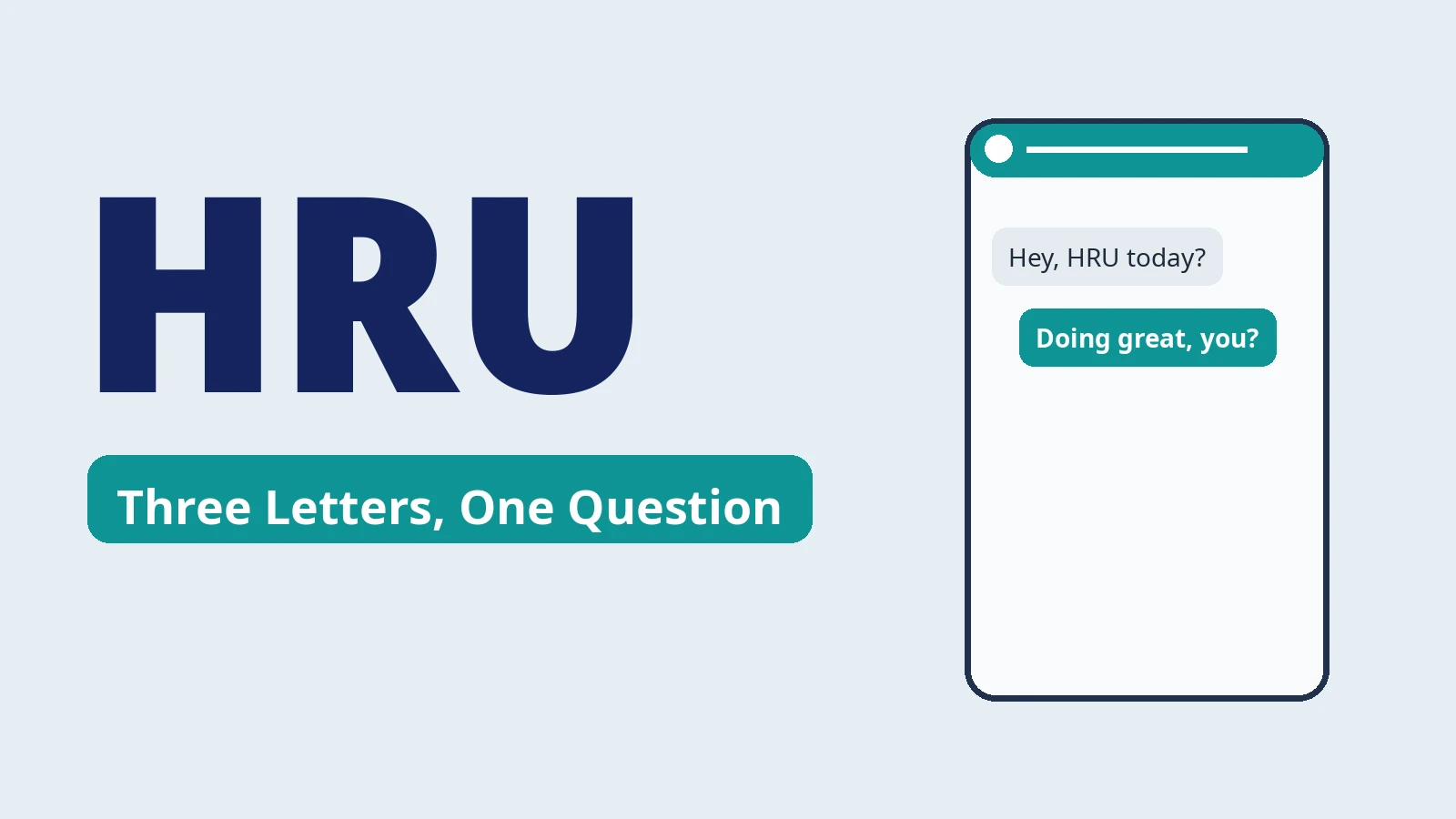
A message pops up from someone you have not talked to in a while, and it is only three letters long: “hru?” No hello, no name, no follow-up. Is it a real question, or just a lazy way to start talking?
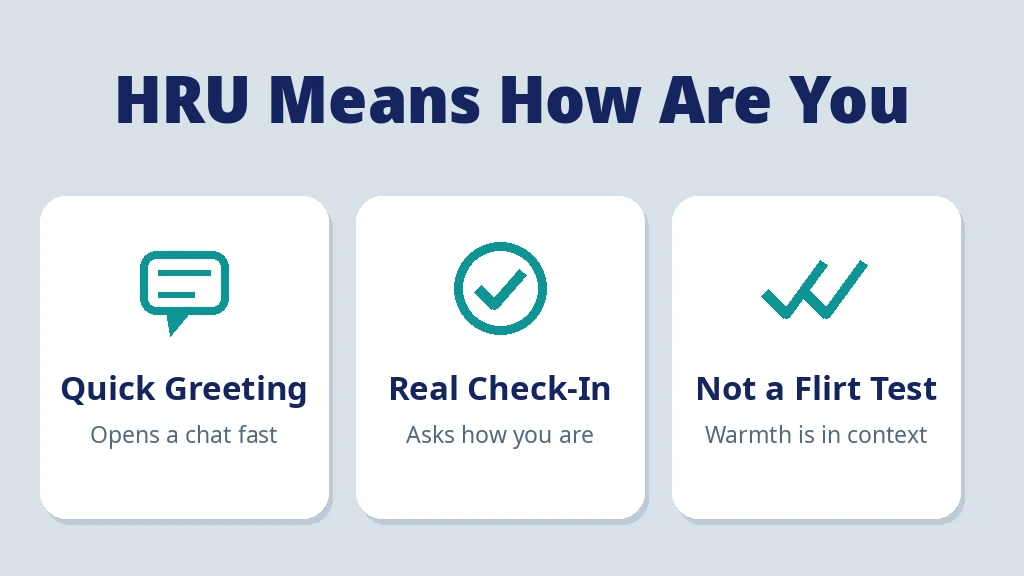
Here is the short answer: HRU means “how are you?” It is a quick, casual greeting and check-in, used at the start of a chat or to reopen one that has gone quiet.
In this guide you will learn the hru meaning in text, how it differs from a simple hello, when it sounds warm and when it sounds flat, and how to reply without overthinking a three letter question.
What Does HRU Mean in Text?
HRU stands for How Are You? The letters are a compressed version of the question: H for how, R for are, and U for you. It is the same trick behind many texting shortcuts, where “are” becomes “r” and “you” becomes “u” to save typing.
Quick definition: HRU means “how are you?” It is an informal greeting and check-in used in texts, DMs, and group chats to ask how someone is doing or to open a conversation.
The reference sources agree on this reading without any real dissent. CyberDefinitions gives “How Are You?” as the quick answer for HRU, and describes it as widely used in text messaging and on social media as a greeting. The top niche guides all lead with the same expansion, and none of them offers a competing texting sense. That makes HRU one of the cleanest terms in this whole family of greeting abbreviations: there is no second chat meaning waiting to trip you up.
HRU is almost always a question, even when the question mark is missing. People write “hru”, “HRU?”, and “hey hru” interchangeably, and the meaning does not change with the case. What changes is the energy: lowercase “hru” feels casual and relaxed, while capital “HRU?” can feel a little more direct, as if the sender really wants an answer rather than a polite “good, you?” in return.
HRU Meaning in Easy Words
Think of HRU as a tap on the shoulder in text form.
In real life, you would not walk up to a friend and launch straight into a story without first asking how they are. HRU does that small social job in three letters. It says “I am here, I am thinking of you, and I would like to talk.”
In the simplest words:
HRU = “Hey, how are you doing?”
That is the whole trick. HRU is not a deep question and it is not a test. Most of the time the sender expects a short, honest answer and then a return question, not a full life update. “Good, you?” is a complete and polite reply, and so is “Busy day, you?” The conversation that follows matters more than the three letters that started it.
Where Is HRU Used?
HRU lives wherever people chat casually, and it is most common in private messages rather than public posts.
Common places:
- WhatsApp and Messenger one to one chats
- Snapchat and Instagram DMs, often as an opener after a gap
- Text messages between friends, family, and classmates
- Group chats, where someone checks in on one person in front of everyone else
- Dating app messages, where it often opens a conversation with a match
Typical situations:
- Reopening a chat after days or weeks of silence
- Checking in on a friend you know has had a hard week
- Starting a conversation when you do not have a specific topic yet
- Softening a message that follows, such as a favour or a plan
- Replying to a story or a photo with a friendly follow-up
Why Do People Use HRU?
It is fast and low pressure
Typing “how are you?” takes a second, but HRU takes almost no effort at all, and it puts no pressure on the other person. A short question invites a short answer, which is exactly what most casual chats need.
It reopens a chat without awkwardness
After a long silence, a full message can feel like a big deal. HRU sidesteps that. It is light enough to send without overthinking, and it gives the other person an easy way back in.
It shows care without demanding depth
HRU asks about the other person before talking about yourself, which reads as polite even in a very short message. At the same time, nobody expects a long answer, so it works as care and as small talk at once.
It works as a greeting on its own
Many people use HRU the way they would use “hey” or “hi”, with the question built in. “Hey, hru?” is both a hello and a question, so the other person can answer the question and the conversation is already moving.
Real-Life Examples of HRU
Here is how HRU actually shows up in daily chats:

Example 1:
- Friend: “Hey, HRU today?”
- You: “Doing great, you?”
Meaning: A simple, friendly opener. Nothing is wrong, and the chat is just getting started.
Example 2:
- Friend: “Long time no talk. Hru?”
- You: “All good here, busy with work. You?”
Meaning: A reconnection check-in. The sender is bridging a gap, not asking for a detailed report.
Example 3:
- Friend: “Heard about your exam. HRU?”
- You: “A bit stressed, but managing. Thanks for asking.”
Meaning: A genuine check-in. The context shows real care, so a slightly fuller answer fits.
Example 4:
- Friend: “Hru? Want to grab coffee tomorrow?”
- You: “I am good, and yes, coffee sounds great.”
Meaning: HRU as a softener before a plan. The question warms up the message, and the plan is the real point.
Example 5:
- Friend: “hru” (sent at 2am, no context)
- You: “Good, just about to sleep. You okay?”
Meaning: A late-night check-in that could be casual or could mean something is on their mind. Answering with a question of your own is the safe move.
HRU vs Similar Terms
| Term | Meaning | When it fits |
|---|---|---|
| HRU | How Are You? | Opening a chat or checking in |
| HBU | How About You? | Returning a question you were just asked |
| HBY | How About You? | Same job as HBU, different spelling |
| WYD | What Are You Doing? | Asking about activity, not wellbeing |
| HYB | How Have You Been? | Asking about a longer stretch of time |
Key difference: HRU opens a conversation, while HBU and HBY continue one. If someone asks how your day went and you answer, then add HBU, you are handing the same question back. HRU at the start of a chat does the asking first. WYD is the one to watch: it asks what someone is doing right now, not how they feel, so answering it with “good” will confuse the sender.
For the closest cousin of HRU, the question that bounces back after you answer, here is what HBU means in text and how it differs from an opening HRU. And for the spelling that looks almost the same but works the same way, here is what HBY means in text.
HRU Variations You Should Know
hru vs HRU is about energy, not meaning. Lowercase “hru” feels relaxed and everyday, while capital “HRU” feels a little more deliberate. Neither version changes the question being asked.
HRU? with a question mark is the clearest form. Without it, HRU still reads as a question, because the phrase itself is a question, but adding the mark removes any doubt, especially with someone who does not text in shorthand often.
“Hey, hru?” is the most common full opener. The “hey” does the greeting work and HRU does the asking, so the pair covers both jobs in one short line.
“Hru today?” and “hru now?” narrow the question to the present moment. Instead of asking about life in general, the sender is asking about today, which usually invites a shorter, more specific answer.
HRU is not HRY. The two look almost identical, but HRY is a different, messier term that can mean “hey, are you?” or “hurry” depending on context. If you see HRU, read it as “how are you?” with confidence. If you see HRY, slow down and read the sentence around it.
How to Reply to HRU
Replying to HRU is easy, because the question is simple and the expected answer is short.
If it is a casual opener: answer briefly and return the question. “Good, you?” or “All good, hbu?” keeps the chat balanced and moving.
If it is a genuine check-in: give a slightly fuller answer. “A bit tired today, but okay. Thanks for asking” rewards the care behind the message without turning it into a long story.
If you do not want a long chat: answer warmly and close politely. “Good, just busy today. Catch up properly soon?” is friendly without inviting twenty more messages.
If it comes from a stranger or a match: match their energy and stay general. “Good, you?” is enough until you know whether the conversation is going anywhere.
If it arrives late at night: check whether they need something. “Good, about to sleep though. Everything okay?” covers both the casual reading and the worried one.
When to Use HRU (and When to Avoid It)
Good situations:
- Opening a chat with a friend or someone you know well
- Reconnecting after a gap in conversation
- Checking in on someone you know has had a tough time
- Softening a message before a request or a plan
- Replying to a story or a photo with a friendly follow-up
Avoid using HRU when:
- The message is for work, a teacher, or anyone formal
- Someone has shared serious news and needs a real response, not a shortcut
- You are opening a conversation with a stranger in a professional setting
- You actually need a detailed answer, where a full question works better
Common Misunderstandings About HRU
HRU does not mean “hello” on its own. It is close, because it often does the greeting job, but it is specifically a question about how you are. A plain “hey” greets without asking anything. HRU greets and asks.
HRU is not flirting by itself. People sometimes read a “hru?” from a match or a crush as a sign of special interest, but HRU is a standard opener for everyone. The interest, if any, shows in what follows, not in the three letters.
HRU does not require a long answer. Some people feel guilty giving a short reply to a question about their wellbeing. HRU is built for short replies, and “good, you?” is exactly what the sender expects most of the time.
HRU is not the same as HBU. HRU asks first, while HBU returns a question that was already asked. Using HBU as an opener, before anyone asked you anything, can read as odd, because there is nothing to bounce back yet.
Frequently Asked Questions
What does HRU mean in text?
HRU means “how are you?” It is a casual texting abbreviation used as a greeting and a check-in in texts, DMs, and group chats.
What is the full form of HRU?
The full form of HRU is “how are you?” The R stands for “are” and the U stands for “you”, following the same shortening pattern as many other texting abbreviations.
What does HRU mean on Snapchat and Instagram?
It means the same thing everywhere: “how are you?” On Snapchat and Instagram, HRU usually appears in DMs as an opener or a check-in, not in public comments.
Is HRU flirting?
Not on its own. HRU is a standard, friendly opener used with friends, family, and matches alike. Any romantic interest shows in the conversation that follows, not in the abbreviation itself.
How do you reply to HRU?
Answer briefly and return the question, such as “Good, you?” or “All good, hbu?” If the check-in feels genuine, a slightly fuller answer like “A bit tired, but okay” fits better.
What is the difference between HRU and HBU?
HRU opens a conversation by asking how someone is, while HBU returns a question you were just asked. HRU asks first, HBU bounces back.
Is HRU formal?
No. HRU is informal texting shorthand. In work messages, emails, or any formal setting, write “how are you?” in full instead.
Final Thoughts
HRU is one of the simplest terms in texting, and that is its strength. It means “how are you?”, it works as a greeting and a check-in at once, and it asks for nothing more than a short, honest answer in return.
Now you know how HRU differs from HBU and HBY, when it sounds warm and when it sounds flat, and how to reply in every common situation. The next time a three letter question opens your chat, you will not have to wonder what it wants. It wants to know how you are, and a simple answer is all it needs.
The reference guides settle the reading plainly. CyberDefinitions gives “How Are You?” as the quick answer for HRU and notes how widely it is used as a greeting in text messaging and on social media, which matches exactly how it shows up in real chats.