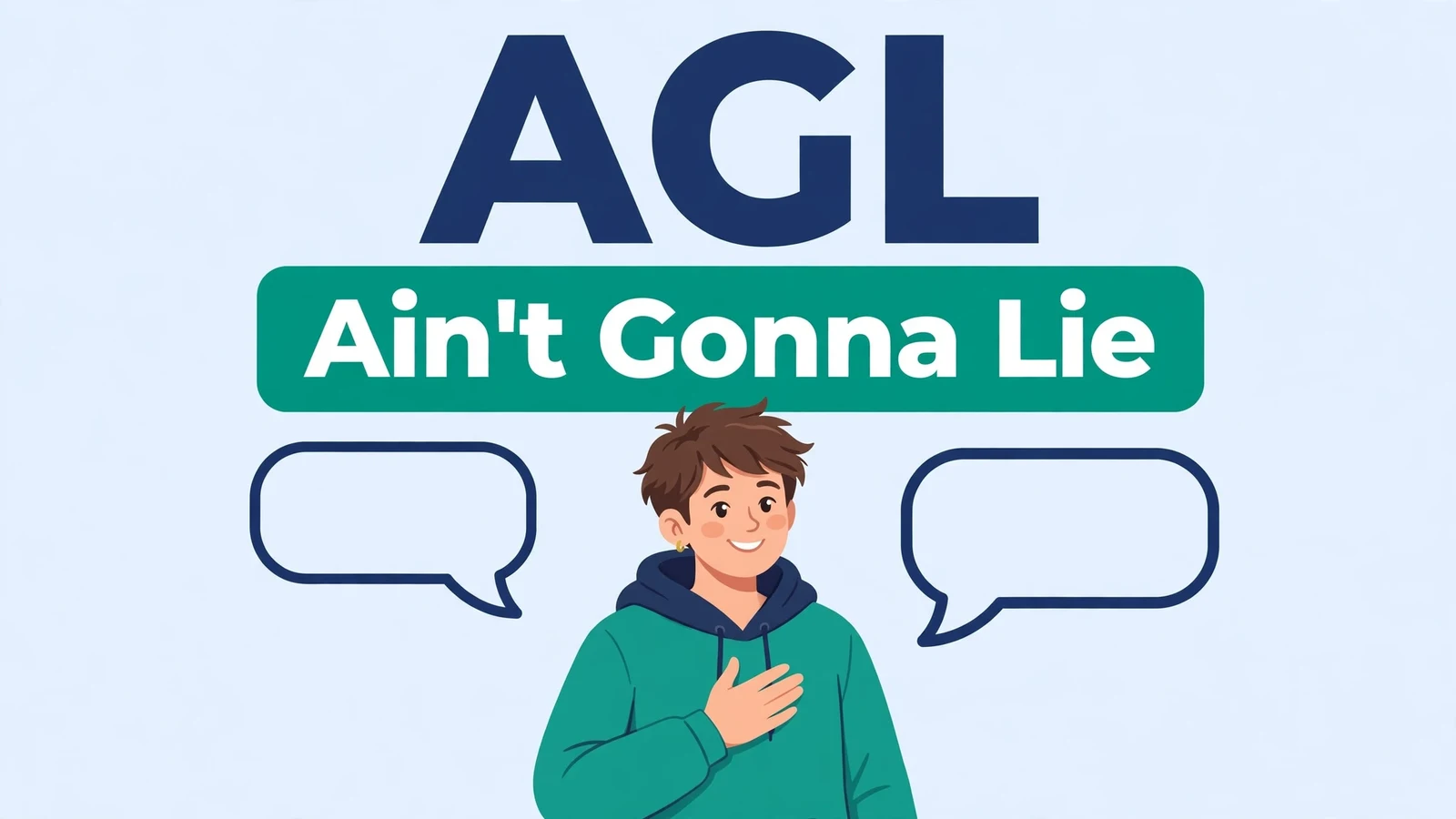
Your friend just texted you: “agl, I missed you today.” Sweet message, but what is that “agl” doing at the front of it? 😳
You’re not the only one pausing at it. Short slang like this lands in chats with zero explanation, and guessing it wrong can flip the meaning of the whole conversation.
Here’s the short answer: AGL means “ain’t gonna lie.” People type it right before saying something honest, bold, or a little bit embarrassing. Think of it as a small warning label that the truth is coming.
We decode texting slang like this every day at CodeTexting, and AGL trips people up because it looks like a typo. It isn’t one. It’s a whole honesty signal packed into three letters.
In this guide you’ll learn the agl meaning in text, where people use it, how to reply to it, and how it differs from its famous cousin, NGL.
📌 What Does AGL Mean in Text?
AGL stands for Ain’t Gonna Lie.
It’s not a word on its own. It’s an opener. When someone starts a message with AGL, they’re telling you: “Heads up, what comes next is my real, unfiltered thought.” Whatever follows it could be a compliment, a confession, a complaint, or a hot take.
✅ Quick definition: AGL means “ain’t gonna lie.” It is used in texts and chats to introduce an honest opinion, confession, or blunt truth, usually to soften it before it lands.
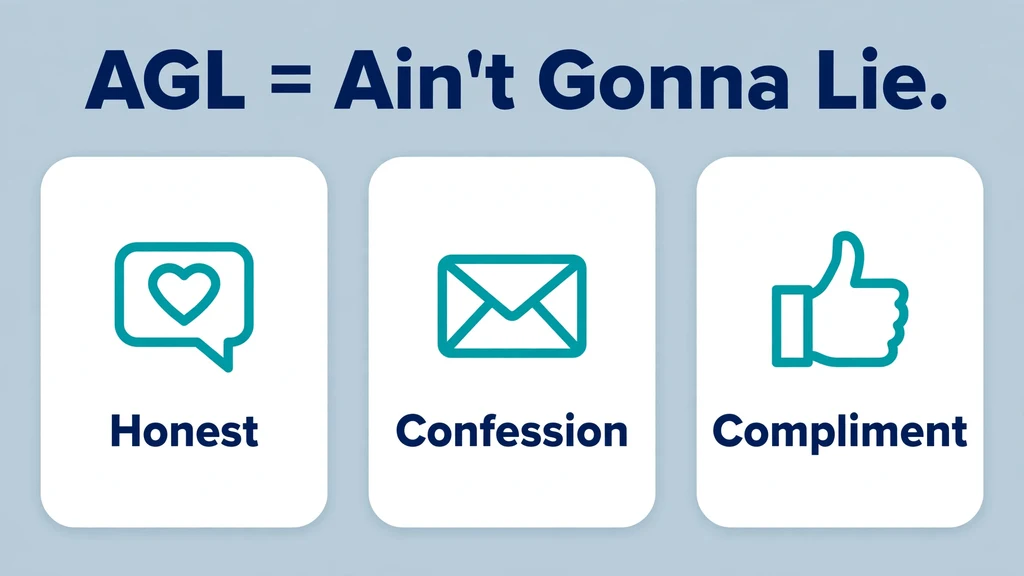
Break the phrase down and it explains itself. “Ain’t” is the casual way of saying “am not” or “is not.” “Gonna” is “going to” said fast. And “lie” means saying something untrue. Put together: “I am not going to lie to you.”
The tone of AGL is neutral on its own. The words after it decide everything. “agl, you did great today” is warm. “agl, that movie was boring” is a negative opinion. Same three letters, completely different feelings.
💡 AGL Meaning in Easy Words
Think of it like this:
👉 You have an honest thought
👉 Saying it plainly might sound too blunt
👉 So you drop AGL in front of it to warn and soften
So in the simplest words:
AGL = “Honestly…” or “To be real with you…” 🙂
It’s the texting version of a friend leaning in and saying “okay, real talk” before they tell you something true. Sometimes it’s sweet, sometimes it’s awkward, sometimes it’s a gentle complaint. The sentence after AGL always tells you which one.
🌍 Where Is AGL Used?
AGL shows up anywhere people type fast and talk casually. If a platform has chats or comments, AGL is already there.
📱 Common platforms:
- Text messages and iMessage chats
- Snapchat and Instagram DMs
- TikTok and Instagram comment sections
- WhatsApp and Messenger group chats
- X (Twitter) posts and replies
- Gaming chats and Discord servers
- Social media captions that open with a confession
🗣️ Example situations:
- Admitting a feeling to a crush
- Giving a friend an honest opinion
- Confessing a small mistake before it grows
- Posting a hot take in a comment section
- Owning a bad play in a gaming chat
🤔 Why Do People Use AGL?
⚡ It saves time
Three letters replace the whole phrase “ain’t gonna lie.” In a fast chat, nobody wants to type the full thing out every time they get honest.
🛡️ It makes honesty feel safer
Sharing a real feeling can feel risky. AGL works like a cushion. It prepares the other person first, so the honest part lands more softly.
😎 It adds personality
“To be honest” works, but it sounds plain. AGL feels more playful and modern, closer to how people actually talk with friends.
🤝 It builds trust
When someone warns you they’re about to be real, you tend to believe the next part more. AGL quietly tells the reader: this part is genuine.
💬 Real-Life Examples of AGL
Let’s see how people actually use AGL in daily conversations:
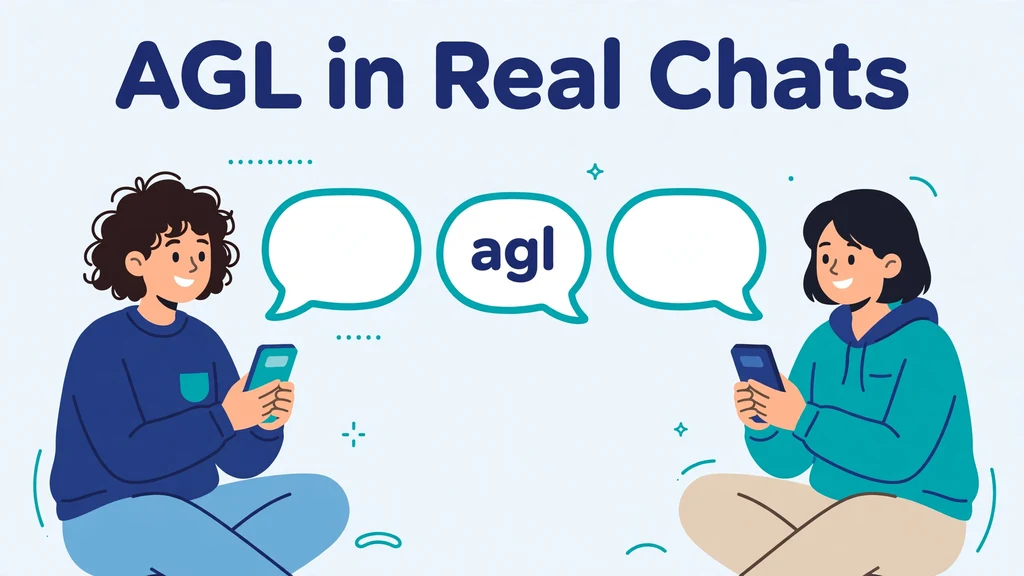
Example 1:
- Friend: “agl, I had so much fun last night”
- You: “Same, we need to do that again soon”
👉 Meaning: Friendly honesty. The sender truly enjoyed the evening, and AGL makes the message sound sincere instead of polite.
Example 2:
- Chat: “agl, that outfit looks amazing on you”
- Reply: “Stop it 😊 thank you”
👉 Meaning: A genuine compliment. AGL separates real praise from empty flattery, which is why compliments hit harder with it in front.
Example 3:
- Crush: “agl, I think about you more than I should”
- Reply: “Okay now I’m smiling, thanks for telling me”
👉 Meaning: A flirty confession. AGL adds a vulnerable tone here. If someone sends you this, they are almost certainly admitting a real feeling.
Example 4:
- Friend: “agl, I’m a little tired of waiting”
- You: “Fair, my bad. I’m leaving in five, promise”
👉 Meaning: A gentle complaint. The sender is frustrated but wants to stay polite, and AGL softens the edge of the message.
Example 5:
- Gaming chat: “agl, that last round was my fault”
- Teammate: “All good, we run it back”
👉 Meaning: Owning a mistake. This kind of honesty usually earns respect from teammates instead of blame.
⚖️ AGL vs Similar Internet Terms
| Term | Meaning | Feeling |
|---|---|---|
| AGL | Ain’t Gonna Lie | Honest, relaxed, personal |
| NGL | Not Gonna Lie | Honest, very common |
| TBH | To Be Honest | Neutral, softer, works with anyone |
| FR | For Real | Emphatic, “I mean it” |
| IMO | In My Opinion | Marks something as just your view |
🧠 Key differences:
- AGL and NGL mean exactly the same thing. NGL is more popular, but AGL sounds a touch more laid back because of the word “ain’t.”
- TBH is the neutral all rounder. AGL feels more personal, so it fits close friends better than strangers.
- FR confirms something is real. AGL introduces a truth that is about to arrive. One looks back, the other looks forward.
🔁 AGL Variations You Should Know
agl tho adds a small pushback, like “honestly though.” People use it when the truth slightly argues with what was just said: “He played well, agl tho, the other team carried that match.”
agl fr stacks AGL with FR (“for real”) for extra weight. It means “honestly, I seriously mean this.” Same core meaning, louder delivery.
agl vs AGL is about volume and mood. Lowercase “agl” in mid sentence feels calm and casual. A sentence that starts “Agl.” with a capital and a full stop, and no emoji anywhere, usually signals a heavier, more serious message. Read the punctuation before you panic.
↩️ How to Reply to AGL
Your reply depends on what kind of truth just landed.
If it’s a compliment: accept it warmly. “Thank you, that actually means a lot” beats a flat “ok,” because the sender made themselves a little vulnerable to say it.
If it’s a confession: respond with kindness first. “I appreciate you telling me” keeps the door open, even if you need a minute to think.
If it’s a gentle complaint: don’t get defensive. A quick “Fair point, I’ll fix it” ends the matter faster than an argument, the same way a well timed SMH reaction can say everything without a speech.
If your honest reply might land wrong: soften it before it sends. Adding a light JK at the end keeps a teasing truth from being read as a real attack.
⏰ When to Use AGL (and When to Avoid It)
✅ Good situations:
- Chatting with close friends or family
- Giving an honest opinion in a friendly way
- Admitting a feeling to someone you trust
- Posting casual comments or captions
- Joking around in a group chat
⚠️ Avoid using AGL when:
- The message is a work email or for your boss
- You’re writing to a teacher or anyone formal
- The conversation is serious and needs clear, full words
- The other person may not know slang at all
- You’re mid argument. AGL there can sharpen a harsh opinion instead of softening it
Need the same honesty in a formal setting? “To be honest,” “frankly,” and “candidly” all do the job without slang.
⚠️ Common Misunderstandings About AGL
Let’s clear up the confusion around AGL:
❌ AGL does not always mean bad news is coming. Plenty of AGL messages are compliments, happy confessions, or jokes. The sentence after it decides the mood, not the letters.
❌ It doesn’t mean the person was lying before. AGL marks the next sentence as extra honest. It says nothing about everything they said earlier.
❌ AGL is not always flirty. It can be, especially with a crush, but “agl, that test was hard” from a classmate is just honesty. Context first, conclusions second.
❌ In a chat, AGL is not “Above Ground Level.” That meaning is real, but it belongs to aviation and surveying, where it measures height above the ground. If the conversation is about feelings, it’s “ain’t gonna lie.” If it’s about a drone or a plane, it’s the altitude one.
Related Texting Slang
Keep exploring the dictionary: AII, explained with real examples, the meaning of ALR, the ASF meaning, in plain words, when someone texts you bet, the FR meaning, in plain words.
Frequently Asked Questions
What does AGL mean in text?
AGL means “ain’t gonna lie.” People type it before an honest opinion, confession, or blunt truth to signal that what comes next is genuine. It works like saying “honestly” or “to be real with you.”
What is the full form of AGL?
The full form of AGL is “ain’t gonna lie,” which means “I am not going to lie to you.” In aviation, the same letters stand for Above Ground Level, but in texting the honesty meaning is the one people use.
What is the difference between AGL and NGL?
Almost nothing. AGL means “ain’t gonna lie” and NGL means “not gonna lie,” and both introduce an honest statement. NGL is more common, while AGL sounds slightly more relaxed because of the word “ain’t.”
Is AGL rude or flirty?
Neither by default. AGL itself is neutral; the message after it sets the tone. It reads flirty when the honest statement is a feeling or a compliment, and it can sound sharp only if the opinion after it is harsh.
What does AGL mean on Snapchat and TikTok?
It means the same thing everywhere: “ain’t gonna lie.” On Snapchat people use it in chats before confessions or real opinions, and on TikTok it opens comments and captions that share an honest reaction.
How do you reply when someone sends AGL?
Match the message, not the letters. Thank them for a compliment, answer a confession kindly, and take a gentle complaint on the chin with a quick “fair point.” If the message looks serious, with a full stop and no emoji, reply carefully and listen first.
🧾 Final Thoughts
AGL is a tiny warning label for the truth. It means “ain’t gonna lie,” and everything after it is the sender being real with you, whether that’s a compliment, a confession, or a complaint they softened first.
Now you know what AGL means, how it differs from NGL and TBH, and how to reply to each flavor of it. Use it with friends, follow it with kind words, and save it for moments when the honesty actually matters.
The dictionaries back this reading up for its famous twin: the Free Dictionary defines NGL as an initialism of “not gonna lie,” used in texts and online chats to flag an honest opinion, especially one that might be unexpected. AGL works in exactly the same way, with a slightly more laid back sound.