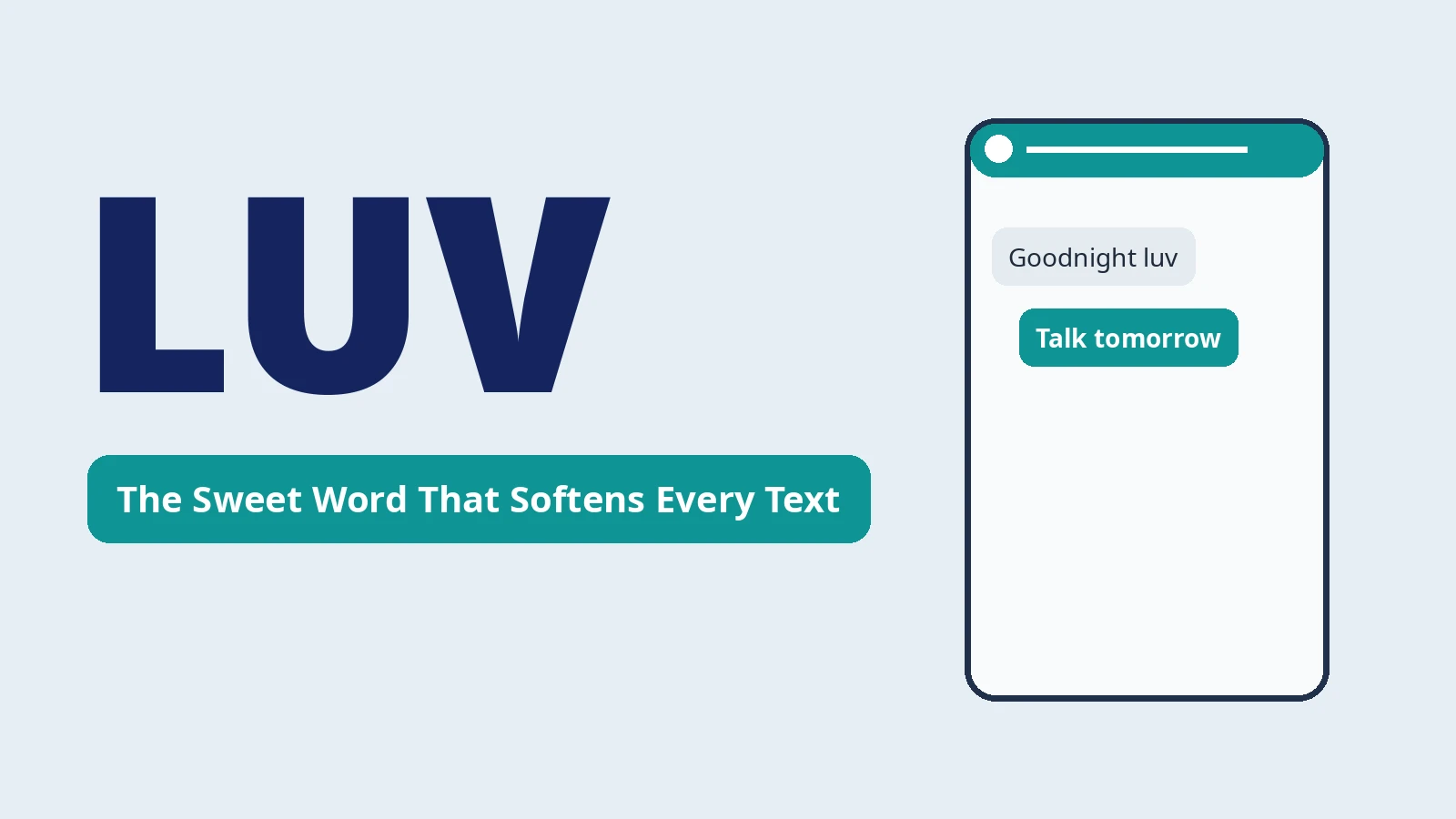
Your crush texts back at midnight. Not “love you”. Just two words: “night, luv”. Your heart jumps, and then your brain catches up. Wait. What did that actually mean?
Here is the short answer: LUV means “love”. It is the same word, spelled the way it sounds, and it carries the same warmth with the pressure turned down. It says “I care about you” without making the moment heavy, serious, or hard to answer.
In this guide you will learn the luv meaning in text, why people choose it over the full word love, where it shows up on TikTok and Instagram, and what to send back when someone sends it to you.
What Does LUV Mean in Text?
LUV is love with the weight taken off. It is not a different word, and it is not a code. It is the word love written the way it sounds when someone says it softly, and that softer spelling changes how the message feels.
When a friend texts “thanks, luv” after you help them, they are not confessing deep feelings. They are saying thank you with warmth. When a partner texts “miss you, luv”, the same three letters carry real affection. The spelling stays the same. The relationship and the sentence around it decide how much feeling is inside.
Quick definition: LUV means “love”. In texting and social media it is a casual, phonetic spelling of love, used to show warmth, care, or closeness without sounding serious or intense.
The sources agree on the spelling and on the softening, and they agree on how old the habit is. CyberDefinitions says LUV means “Love” in a text, and calls it a slang word that is easy to guess. Dictionary.com lists LUV as an abbreviation for love, and Wiktionary calls luv a deliberate misspelling of love and an Internet slang and text messaging form of the word. Collins gives the same reading for messaging and social media, and the Oxford Advanced Learner’s Dictionary defines luv as an informal way of spelling love, used as a friendly way of addressing somebody. Grammarly adds the history: luv has been in use since at least 1825, and today it is mostly used to express affection of a lesser magnitude than love. The niche guides that rank for this term say the same thing in different words: a casual spelling that softens the word and sits somewhere between like and love on the scale of feeling. Every layer gives the same lead, and that is why the article leads with it.
LUV Meaning in Easy Words
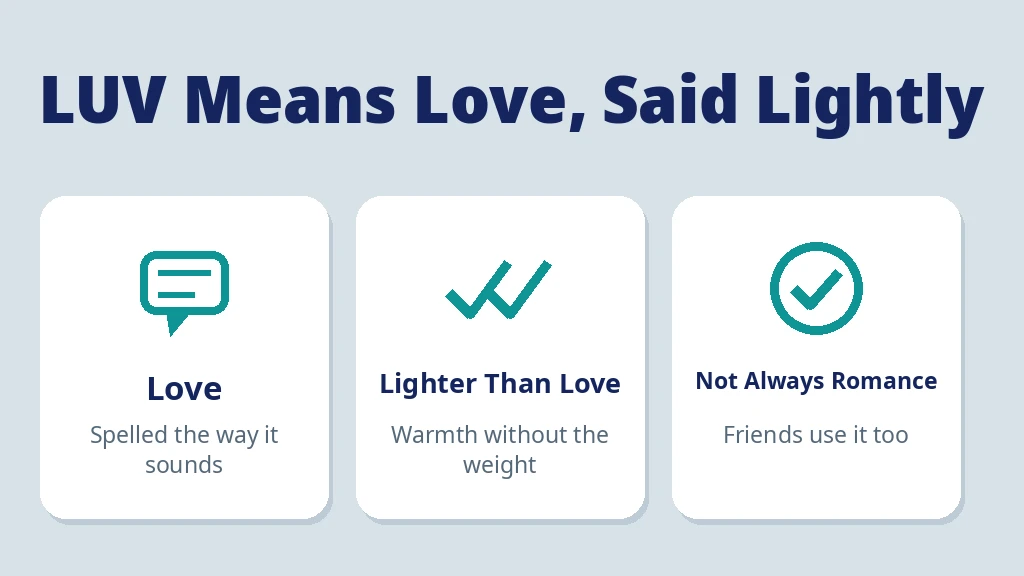
Think of LUV as love in a soft voice. That is the luv meaning in one image.
When someone says “I love you” in a serious voice, the room goes quiet. When they say it in a soft voice, with a smile, it feels warm instead of heavy. LUV is the typed version of that soft voice.
In the simplest words:
LUV = “Love, said lightly.”
Where Is LUV Used?
As luv slang, LUV lives in fast, warm chats and on social media, wherever affection needs to sound light instead of formal.
Common places:
- Private texts and DMs, as a warm sign off or a soft thank you
- WhatsApp and Messenger chats between friends, family, and partners
- Instagram captions and comments, where it adds a cute and supportive tone
- TikTok comments and captions, where it shows excitement or admiration
- Snapchat chats and stories, answering a snap with a quick warm word
Typical situations:
- Saying goodnight to a friend or a partner without making it a big moment
- Thanking someone warmly after a favour or a kind message
- Cheering on a friend’s photo, outfit, or video in a comment
- Greeting someone in British English, as in “Alright, luv?”
Why Do People Use LUV?
It softens a heavy word
Love is a big word. Saying it in full can feel like a confession, even when the sender only means “I like you a lot” or “thanks, you are great”. LUV keeps the warmth and drops the weight, so the message lands gently.
It sounds like the way people talk
LUV is written the way love sounds in casual speech, with the middle sound dropped out. That is why it feels natural in a chat. It reads like a voice, not like a dictionary entry.
It fits the mood of social media
On Instagram and TikTok, affection is often public and quick. A comment has to be warm in a few words, and “luv this” does that job better than a long sentence. It is cute, it is fast, and it does not ask for a serious reply.
LUV on Social Media and in Captions
On social media, LUV is often not a private message at all. It is a public one, and the meaning stays the same: love, made light and cute. On Instagram, “Luv this look!” and “Luv u bestie” cheer a post on. On TikTok, “Luv this vibe!” shows excitement for a video. On Snapchat, it answers a snap with a quick warm word.
It also lives in usernames and bios, where people want a sweeter voice. Names built from “luv”, like “luvlyday” or “bbyluv”, and soft-aesthetic bios use it to set a gentle tone before a single post is read. In stan culture, fans use it to show love for a singer, an actor, or a creator, and there it reads as admiration, not romance.
Real-Life Examples of LUV
Here is how LUV actually shows up in chats, comments, and captions:

Example 1:
- Chat: “Goodnight luv, talk tomorrow.”
Meaning: A warm goodnight, affectionate but light, from a friend or a partner.
Example 2:
- Chat: “Thanks for the help, luv, you saved me.”
Meaning: A friendly thank you, warm and casual, not romantic.
Example 3:
- Chat: “Miss you, luv, come home soon.”
Meaning: Real affection, likely from a partner, missing the other person.
Example 4:
- Comment: “Luv this look, where did you get that jacket?”
Meaning: Supportive admiration in a comment, cheering the post on, not a confession.
Example 5:
- Chat: “Alright luv, see you at work.”
Meaning: A British friendly greeting, using luv as a term of address, like “mate” or “dear”.
LUV vs Similar Terms
| Term | Meaning | When to use it |
|---|---|---|
| LUV | Love, said lightly | Warm affection that stays casual |
| LOVE | Love, full weight | Serious affection or a real confession |
| ILY | I Love You | Telling someone directly that you love them |
| ILYSM | I Love You So Much | The strongest version, for deep feeling |
| LIKE | Fondness | Lighter than luv, for something you enjoy |
| LV | Love, two letter form | The shortest abbreviation, same meaning |
Key difference: LUV sits in the middle of the affection scale. Like is lighter, it says you enjoy something or someone. Love is heavier, it says you feel deeply. LUV is the step between them: warmer than like, softer than love. ILY and ILYSM are full phrases, not spellings, and they say the feeling out loud to a person. LV is the same idea as LUV, just shorter. For the direct version, here is what ILY means in text, the plain “I love you” that says the feeling in full instead of softening it.
The Other LUV Meanings You Should Know
“Love” is the only texting and social media meaning. In chats, DMs, comments, and captions, LUV means love, spelled softly, and nothing else. Every dictionary and slang source that covers it agrees on that.
In British English, luv is also a term of address. In the UK, people have used “luv” for decades as a friendly way of addressing someone, the way others say “mate”, “dear”, or “hun”. “Alright, luv?” and “Thanks, luv” are greetings and thanks, not confessions. This is the same word doing a different job: it names the person, warmly, instead of describing a feeling.
Outside texting, LUV has a finance meaning. LUV is the stock ticker symbol of Southwest Airlines, whose logo is shaped like a heart. A market report about LUV is talking about the airline, not about affection.
Two rare claims, labelled as rare. One slang list mentions an adult backronym for LUV and the rapper nickname “Lil Uzi Vert” as other readings. Neither is backed by a second source, and neither appears in dictionaries, so treat them as rare curiosities, not as meanings you will meet in a normal chat.
How to Reply to LUV
Your reply depends on who sent it and what they meant.
If it was friendly: answer in kind. “Thanks, luv, you too” or “You are the best” keeps the warmth going without making it bigger than it is.
If it was affectionate: match the warmth. “Miss you too” or “Goodnight, luv” tells the sender the feeling is shared.
If it was a comment on your post: a simple thank you is enough. “Thank you, that means a lot” fits a supportive comment, and you do not need to send the word back.
When to Use LUV (and When to Avoid It)
Good situations:
- Saying goodnight or thank you to a friend, family member, or partner
- Cheering on a friend’s photo, video, or outfit in a comment
- Adding warmth to a casual message without making it serious
Avoid using LUV when:
- You are writing to a teacher, a boss, or anyone formal
- You are confessing real feelings for the first time, since the soft spelling can hide what you mean
- The message is serious or sad, since a cute spelling can sound careless
Common Misunderstandings About LUV
LUV does not always mean romance. This is the biggest misunderstanding, and it comes from reading the word “love” without the room. Friends, family, and even strangers in comments use LUV every day, and most of the time it is friendly warmth, not a crush.
LUV is not a typo. It is not a misspelling of love by accident. It is a deliberate phonetic spelling, used on purpose because it sounds softer and friendlier than the full word. Dictionaries record it as a real form, not as a mistake.
LUV is not a separate word from love. It does not have its own definition apart from love. It is the same word, written differently, and the difference is in tone, not in meaning.
LUV is not always from a girl. Anyone can send it, and the meaning does not change with the gender of the sender.
Frequently Asked Questions
What does LUV mean in text?
LUV means “love”. It is a casual, phonetic spelling of love, used to show warmth, care, or closeness without sounding serious or intense.
Is LUV romantic or friendly?
It depends on the context. Between friends it is usually friendly warmth, between partners it is real affection, and in a comment it is support for a post. The sentence around it tells you which one it is.
What does LUV mean from a girl?
It means the same as from anyone else: a casual, softer way of writing love. “Thanks, luv!” from a girl is usually sweet and friendly, not romantic.
What is the difference between LUV and LOVE?
They mean the same thing, but they feel different. LOVE carries the full weight of the word and can sound serious or like a confession. LUV is lighter and more playful, so it fits casual chats, thanks, and goodnights.
What does LUV mean on TikTok and Instagram?
On TikTok and Instagram, LUV means love used lightly in captions, comments, and usernames. “Luv this look!” or “Luv this vibe!” shows support, excitement, or admiration for a post, not a romantic confession.
Is LUV rude or inappropriate?
No. It is warm and friendly, not rude. It can sound too familiar in a formal message, so skip it with a teacher or a boss, but in a casual chat it is a kind word.
Should I use LUV at work?
No. It is informal and affectionate, and it can sound too personal in a work chat. Write “thanks so much” or “appreciate it” in full instead.
Final Thoughts
LUV is love in a soft voice. It means “love”, spelled the way it sounds, and it does the work of a warm tone: I care about you, and I am saying it lightly so you can answer lightly too.
Now you can read it at a glance: a thank you or a goodnight means friendly warmth, “miss you, luv” from a partner means real affection, and a comment under a photo means support for the post. Save the full word love for the moments that deserve its weight, and let LUV carry the everyday warmth. For the strongest version of the same feeling, here is what ILYSM means in text, the “I love you so much” that leaves no doubt about how much someone means it.
The lead is documented by CyberDefinitions, which says LUV means “Love” in a text and lists it as a slang word that is easy to guess. The history behind the spelling is covered by Grammarly, which notes luv has been in use since at least 1825 and is mostly used today to express affection of a lesser magnitude than love, falling somewhere between like and love.