Your phone lights up late at night. It is a short message from someone far away, a friend who moved to another city or a partner in another time zone, and it ends with three letters: “LMY”.
Here is the short answer: LMY means “Love and Miss You”. It is a warm sign-off that packs two feelings into three letters, “I love you” and “I miss you” at the same time. It usually closes a message the way a hug closes a visit, and it tells the other person they matter and their absence is felt.
In this guide you will learn the lmy meaning in text, its playful reply and typo readings, where LMY shows up, and what to send back when someone sends it to you.
What Does LMY Mean in Text?
LMY is a sign-off, not a sentence. It does not ask a question or start a new topic. It ends a message with affection, and it works because the reader already knows the feelings behind it.
When a friend you have not seen in months texts “Goodnight, LMY”, they are saying two things at once: I love you, and I wish you were here.
Quick definition: LMY means “Love and Miss You”. In texting and social media it is a warm, affectionate sign-off sent to a partner, a close friend, or a family member when you are apart.
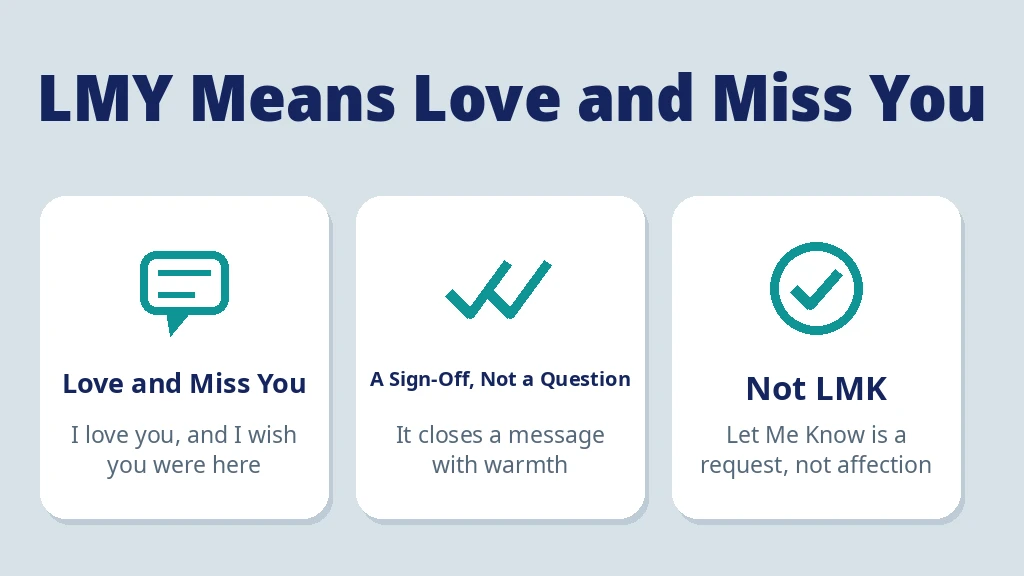
The sources agree on the lead, and the agreement starts with a dictionary. Dictionary.com says plainly that LMY is a textspeak acronym standing for “love and miss you”, backed by real usage examples from 2016 and 2017, and notes that its entry is an informal word summary rather than a formal definition. The niche guides say the same thing, calling it the most common reading in texting and social media slang. CyberDefinitions has no LMY entry at all, its page returns a clean 404, so the lead rests on the dictionary plus the unanimous niche guides. That is a gap, not a disagreement.
LMY Meaning in Easy Words
Think of LMY as a hug and a “wish you were here” postcard folded into one line. That is the lmy meaning in one image.
When someone waves goodbye at an airport, they do not give a speech. They hug, and the hug says everything the speech would have said. LMY is the typed version of that hug, sent at the end of a message.
In the simplest words:
LMY = “I love you, and I miss you.”
Where Is LMY Used?
As lmy slang, LMY lives in close, personal chats where affection is already understood.
Common places:
- Private texts and DMs, as a sign-off at the end of a sweet chat
- WhatsApp chats with a partner, a best friend, or family far away
- Snapchat chats and stories, answering a snap from someone you miss
- Instagram comments and captions, under a throwback photo or a post about distance
- Facebook Messenger, in long chats with siblings, parents, and old friends
Typical situations:
- Saying goodnight to a partner in a long distance relationship
- Ending a catch-up chat with a friend who moved away
- Answering a photo from home while travelling or living abroad
- Closing a birthday or holiday message to a sibling or a parent
- Replying to a friend who says they miss you
Why Do People Use LMY?
It says two feelings in one breath
“I love you” is one feeling, and “I miss you” is another. LMY says both at once, in three letters, and the short form keeps the goodbye light.
It closes a message softly
Some messages need a gentle ending, not a new question. A plain “bye” can feel cold after a warm conversation, and LMY fills that gap.
It is safer than a long confession
Typing out “I love you and I miss you so much” can feel too heavy in a casual chat. LMY carries the same warmth in a smaller package.
LMY on Social Media and in Captions
On social media, LMY keeps the same meaning it has in private chats, which is worth knowing, because many slang terms change their sense from one app to another. LMY does not.
On Snapchat, LMY answers a funny or sweet snap from someone you miss. On Instagram, it appears in comments under throwback photos and posts about distance. On TikTok, it shows up in comments on videos about long distance relationships and friends who live far apart. On WhatsApp and Messenger, it closes the same kind of close, personal chats where it started.
The hashtag family around the phrase is part of the same picture: Instagram posts about missing someone carry tags like #loveandmissyou and #missyousomuch, and LMY is the shorthand version of that same feeling. In a caption, read it the way you would read it in a text, a warm sign-off, not a request and not a joke.
Real-Life Examples of LMY
Here is how LMY actually shows up in chats, comments, and captions:
Example 1:
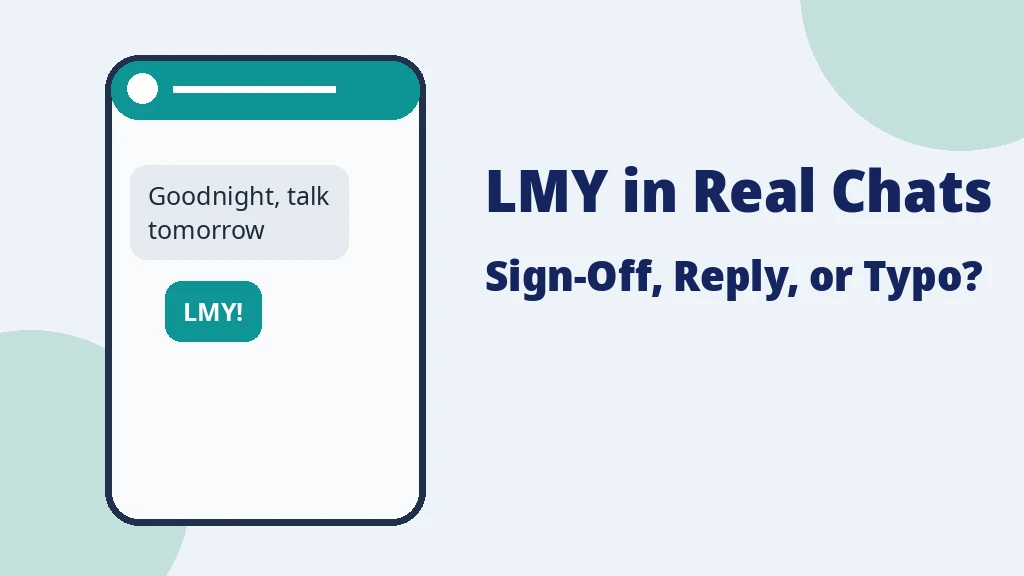
- Chat: “Goodnight, talk tomorrow. LMY!”
Meaning: A warm sign-off: the sender loves and misses the other person, and the chat is ending for the night.
Example 2:
- Chat: “I love you.” “LMY!”
Meaning: A playful reply, here LMY means “Love You More”, a loving comeback that returns the affection.
Example 3:
- Chat: “Are you free Friday? LMY.”
Meaning: Probably a typo: the sender almost certainly meant LMK, “Let Me Know”, and is asking for an answer.
Example 4:
- Comment: “Throwback to last summer with my best friend. LMY, come visit soon.”
Meaning: A caption sign-off: the sender loves and misses the friend in the photo.
Example 5:
- Chat: “I miss you so much.” “LMY too, we need to fix this.”
Meaning: Returned affection, the sender feels the same way and agrees they should meet soon.
LMY vs Similar Terms
| Term | Meaning | When to use it |
|---|---|---|
| LMY | Love and Miss You | A warm sign-off that says both feelings at once |
| ILY | I Love You | Love only, no mention of missing |
| IMY | I Miss You | Missing only, no mention of love |
| LMK | Let Me Know | A request for information, not affection |
| LAMY | Love And Miss You | The same phrase, spelled out in full |
Key difference: LMY is the only term in this list that says two feelings at once. ILY says love only, IMY says missing only, and LMK is not affection at all, it is a request for an answer. LAMY is the same phrase with the A written out. For the plain “I love you” on its own, here is what ILY means in text.
Keep LMY apart from LMK as well. The two look alike, and the Y and K keys sit close together on a phone keyboard, so one is often typed when the other was meant. The position gives it away: LMY at the end of a heartfelt message is affection, while LMY in a planning question is almost certainly a mistyped LMK.
The Other LMY Meanings You Should Know
“Love and Miss You” is the lead texting meaning. In chats and comments, LMY means “Love and Miss You”, and every source that covers it agrees on that. The other readings below are secondary.
“Love You More” is a reply variant, not a second lead. When someone says “I love you” and the other person fires back “LMY”, the letters can mean “Love You More”, a playful comeback between couples and close friends. Three niche guides document it as second, behind the sign-off.
“Let Me Know” is a typo, not a meaning. Inside a planning question, LMY is probably a mistyped LMK. This is not a second dictionary meaning, it is a keyboard error to recognise, so answer the question.
“Love Me Yet?” is a minority reading. One guide leads with it as a playful, flirty question in romantic chats. No dictionary backs it as the lead, so treat it as a rare claim, not the standard meaning.
Position test in one line: at the end of a heartfelt message, LMY means love and miss you; as a reply to “I love you”, it can mean love you more; in the middle of a planning question, it is probably a mistyped LMK.
How to Reply to LMY
Your reply depends on which LMY you received.
If it was the sign-off: answer the feeling, not the letters. “LMY too” returns it exactly, and “Miss you too, talk soon” says the same thing in full words.
If it was the “Love You More” reply: play along. “No way, I love you more” keeps the game going. For the strongest version of that same feeling, here is what ILYSM means in text, the “I love you so much” that raises the stakes instead of matching them.
If it was a typo for LMK: ignore the letters and answer the question. If they asked whether you are free on Friday, say yes or no and suggest a time.
When to Use LMY (and When to Avoid It)
Good situations:
- Ending a goodnight message to a partner in a long distance relationship
- Signing off a chat with a close friend or family member far away
- Commenting on a throwback photo or a post about someone you miss
- Answering “I love you” with the playful “Love You More” reading
- Closing a birthday, holiday, or homecoming message with warmth
Avoid using LMY when:
- Writing to a teacher, a boss, or anyone in a formal setting
- The other person may not know the slang and could read the words literally
- You are planning something, since it can be read as a mistyped LMK
- The relationship is new or professional, since the affection may feel too strong
- You mean “let me know”, since LMK is the term that says that clearly
Common Misunderstandings About LMY
LMY is not only romantic. It comes from hearing the word “love” and stopping there. LMY is sent to friends, siblings, and parents just as often as to partners.
LMY is not always a typo for LMK. Some readers see LMY in a planning message and decide the whole term is a mistake. It is not: the typo reading only applies inside a planning question.
LMY does not mean “Love Me Yet?” as its standard reading. That flirty question is a minority reading from a single guide, and no dictionary backs it as the lead.
LMY is not formal language. It is casual textspeak for chats between people who are close. In a work email or any formal writing, write the feelings out in full instead, or leave them out.
Frequently Asked Questions
What does LMY mean in text?
LMY means “Love and Miss You”. It is a warm, affectionate sign-off sent to a partner, a close friend, or a family member when you are apart.
What does LMY mean on Snapchat?
On Snapchat, LMY means “Love and Miss You” as a reply to a funny or sweet snap from someone you miss. It is the same sign-off meaning as in any other chat.
What does LMY mean when someone replies to “I love you”?
As a direct reply to “I love you”, LMY can mean “Love You More”, a playful comeback between couples and close friends. Anywhere else, read it as the sign-off.
Is LMY the same as LMK?
No. LMY means “Love and Miss You” and is affection, while LMK means “Let Me Know” and is a request for information. If LMY shows up in the middle of a planning question, it is probably a mistyped LMK.
Is LMY romantic?
Not only. LMY is sent to partners, but also to close friends, siblings, and parents. The love in it is affection, and the missing in it is about distance, so it fits any close relationship.
What is the difference between LMY and ILY?
ILY means “I Love You” and says love only, while LMY means “Love and Miss You” and adds the longing of being apart.
Should I use LMY at work?
No. It is informal textspeak for close, personal chats. In a work message, write a plain goodbye instead, so nobody has to guess at your meaning.
Final Thoughts
LMY is two feelings folded into three letters. It means “Love and Miss You”, and it does the work of a hug at the end of a message.
Now you can read it at a glance: at the end of a heartfelt message it is the sign-off, as a reply to “I love you” it can be “Love You More”, and in a planning question it is probably a mistyped LMK.
The lead is documented by Dictionary.com, which says LMY is a textspeak acronym standing for “love and miss you”, backed by real usage examples from 2016 and 2017. CyberDefinitions simply has no entry for the term, a gap in its coverage, not a rival reading.