Your friend opens the fridge, finds the last slice of cake gone, and types a single word: “LAWD.” Nobody asks what it means. Everyone in the chat knows exactly how she feels.
Here is the short answer: LAWD means “Lord”. It is a slang spelling of “Lord”, used as an exclamation when something is surprising, funny, shocking, or just too much. It is the typed version of throwing your hands up and saying “oh my Lord” in a thick Southern drawl.
In this guide you will learn the lawd meaning in text, where the spelling comes from, how it shows up in chats, captions, and memes, what “Oh Lawd He Comin” means, and what to send back when someone sends it to you.
What Does LAWD Mean in Text?
LAWD is a reaction, not a sentence. It does not add a new idea to the chat. It tells the other person how big the feeling was, and it does it with a spelling that sounds like the word is being said out loud.
When a friend sends a video of a cat knocking a whole shelf over and you reply “LAWD”, you are saying the moment was too funny, too shocking, or too dramatic for a plain “wow”. The extra letters carry the drawl, and the drawl carries the feeling.
Quick definition: LAWD means “Lord”. In texting and social media it is an exclamation, an alternative spelling of “Lord” used to express surprise, disbelief, excitement, frustration, or laughter, usually in phrases like “Oh my Lawd” or “Lawd have mercy”.
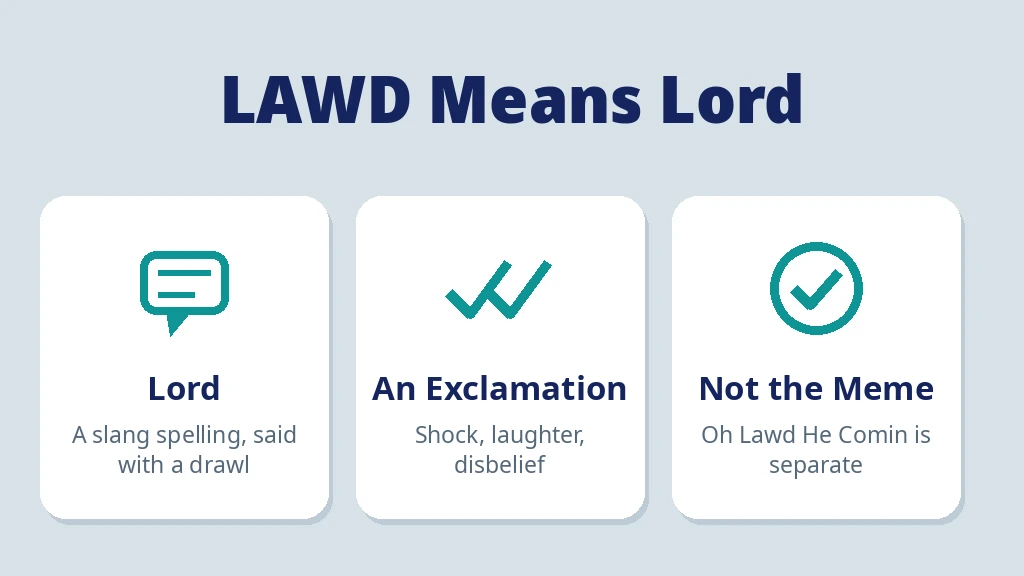
The sources agree on the expansion, and they agree on the job it does. CyberDefinitions says LAWD means “Lord”, and calls it an alternative spelling of the word “Lord”, often typed in phrases such as “Oh my Lawd”, “Dear Lawd”, and “Lawd be praised”, and typically used as an interjection. The niche guides that rank for this term say the same thing in different words: meaningboost calls it an informal, exaggerated spelling of “lord”, commonly used online to express strong emotions such as surprise, disbelief, excitement, or frustration, and notes that it comes from dialect pronunciations of “Lord” in Southern American and Caribbean speech. Two independent sources plus CyberDefinitions all give the same lead.
LAWD Meaning in Easy Words
Think of LAWD as a gasp in writing. That is the lawd meaning in one image.
When someone gasps, they are not starting a conversation. They are letting a feeling out in one sound. LAWD does the same job in a chat: the typed version of a sharp breath, a laugh, or a hand on the chest.
In the simplest words:
LAWD = “Oh my Lord, I cannot believe what I just saw.”
The spelling is the whole trick. “Lord” on its own sounds formal, almost like a prayer. “Lawd” sounds like someone saying it out loud, with feeling, and that is why it fits a meme comment better than the dictionary spelling does.
Where Is LAWD Used?
As lawd slang, LAWD lives in casual, expressive spaces where a reaction matters more than a reply.
Common places:
- Private texts and DMs, reacting to gossip, a surprise, or a funny story
- Group chats, where one “LAWD” tells the whole group the news landed hard
- TikTok and Instagram comments, reacting to a dramatic or ridiculous video
- Twitter posts and replies, where the exclamation punctuates a hot take
- Facebook posts and captions, often in the longer phrase “Lawd have mercy”
- Meme captions, where “Oh Lawd He Comin” has a life of its own
Why Do People Use LAWD?
It sounds like a real voice
Most slang is typed to be read silently, but LAWD is typed to be heard. The spelling copies the way “Lord” sounds in a Southern American or Caribbean accent, so the reader hears a voice instead of reading a word. That voice carries the feeling, and the feeling is the message.
It is warmer than “Lord”
Saying “Lord” in a chat can sound stiff or even religious. CyberDefinitions notes the spelling may have started as a way for some Christians to avoid taking the Lord’s name in vain. Whatever the origin, “Lawd” reads as playful and dramatic, not formal.
It works alone or in a phrase
LAWD is flexible. On its own it is a full reaction: “LAWD.” At the start of a sentence it sets the tone: “Lawd, she did not just say that.” Inside the classic phrases “Oh my Lawd” and “Lawd have mercy” it carries a whole tradition of dramatic reactions.
Real-Life Examples of LAWD
Here is how LAWD actually shows up in chats, comments, and captions:
Example 1:
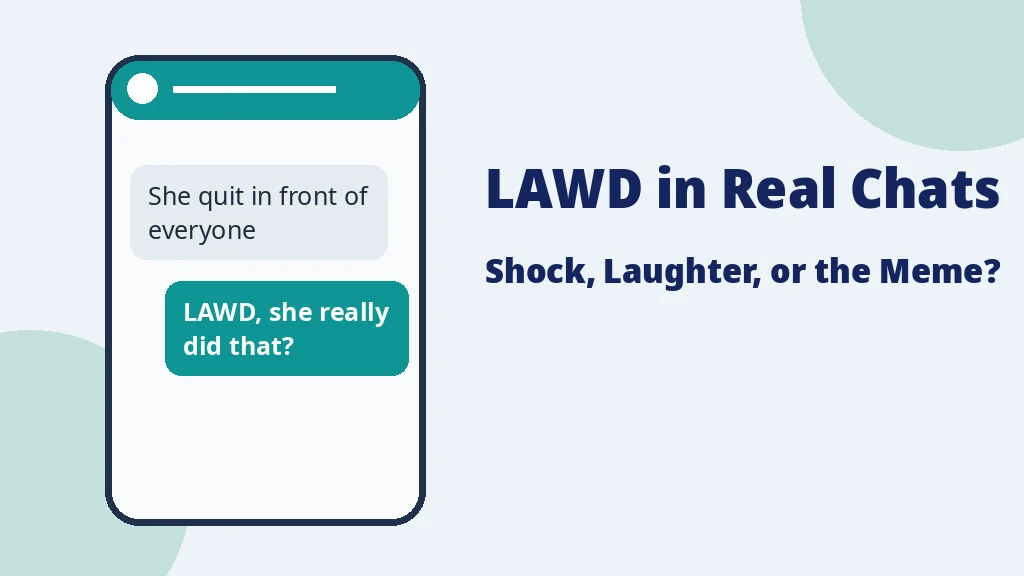
- Chat: “She just told her boss she quits, in front of everyone.” “LAWD, she really did that?”
Meaning: Shock and disbelief, the sender cannot believe the story.
Example 2:
- Comment: “Me trying to explain to my mum why I need a new phone for the fifth time.” “Lawd have mercy, same energy.”
Meaning: Relatable laughter, the sender recognises the situation and finds it funny.
Example 3:
- Chat: “The power went out right in the middle of my exam.” “Oh my Lawd, are you serious?”
Meaning: Sympathetic shock, the sender is reacting to bad luck, not laughing at it.
Example 4:
- Caption: “Oh Lawd He Comin” under a photo of a very large cat waddling toward the camera.
Meaning: The meme sense, a playful warning that something big is on its way.
Example 5:
- Chat: “He ate the whole pizza by himself.” “LAWD, that man has no shame.”
Meaning: Playful judgment, amused and a little horrified at the same time.
LAWD vs Similar Terms
| Term | Meaning | When to use it |
|---|---|---|
| LAWD | Lord | Dramatic surprise, shock, or laughter |
| GAWD | God | The same trick applied to “God”, for shock or boredom |
| OMG | Oh My God | Quick surprise, the most common reaction of all |
| OML | Oh My Lord | Surprise with the Lord spelling kept plain |
| Lord | Lord | Formal or religious use, or a plain exclamation |
| Wow | Wow | Simple surprise, with no drawl or drama |
Key difference: LAWD is the only term in this list that changes the spelling to change the sound. OMG and OML say the same feeling in initials, and “wow” says it in one plain word. GAWD is its closest cousin, the same spelling trick applied to “God”. For a warm agreement in any chat, here is what IKR means in text, the “I know, right?” that agrees with feeling instead of gasping at it.
Keep LAWD apart from “loud” as well. The two sound alike when spoken fast, but “loud” describes volume, while LAWD is a reaction.
The Other LAWD Meanings You Should Know
“Lord” is the only texting meaning. In chats, DMs, comments, and captions, LAWD means “Lord” and nothing else. Every source that covers the slang agrees on that.
“Oh Lawd He Comin” is a meme sense, not a second meaning. The phrase comes from the Chonk Chart, a photoshopped cat body fat chart posted to the Facebook group THIS CAT IS C H O N K Y on August 2, 2018. The chart ranked cats from “A fine boi” to “OH LAWD HE COMIN”, the largest level, and the phrase became a caption and catchphrase for images of large animals, objects, and people. Know Your Meme records that it was adopted to describe large objects, animals, or people, and it spread through Twitter, Reddit, TikTok, and Instagram. When you see it under a photo of a chonky cat, it is the meme doing the talking. When you see LAWD on its own in a chat, it is the exclamation.
Do not mix it up with “Lauds”. Lauds is the morning prayer of the Catholic Church, from the Latin word for praises. It belongs in a prayer book, not in a comment thread.
Context rule in one line: if the message is a reaction to news, a video, or a story, LAWD means “Lord” as an exclamation; if it is a caption under a photo of something huge, it is probably the “Oh Lawd He Comin” meme; and if it is in a church book, it is Lauds. When in doubt, read the sentence around it before you decide which one you are looking at.
How to Reply to LAWD
Your reply depends on which feeling the LAWD carried, because the same word can mean shock, laughter, or sympathy.
If it was shock: confirm the news. “I know, right? I could not believe it either” keeps the story going.
If it was laughter: laugh along. “I know, I watched it three times” is the warm answer.
If it was sympathy: answer the feeling, not the word. “Tell me about it, that is rough” shows you heard the trouble behind the exclamation. For the calmest acknowledgement in texting, here is what IK means in text, the plain “I know” that nods instead of gasping.
If you want to use LAWD yourself: use it when a reaction is the whole reply. Save it for the moments that deserve a gasp, because using it on every small surprise wears it out.
When to Use LAWD (and When to Avoid It)
Good situations:
- Reacting to gossip, a twist, or a surprise in a casual chat
- Commenting on a funny or dramatic video on TikTok or Instagram
- Captioning a photo of something huge, dramatic, or over the top
- Letting a friend know their story landed hard
Avoid using LAWD when:
- You are talking to a teacher, a boss, or anyone formal
- You are in a religious conversation where the plain word “Lord” fits better
- Someone is sharing something serious and a dramatic gasp would hurt them
- The other person does not know the slang and may read it as a typo
Common Misunderstandings About LAWD
LAWD is not a typo. This is the biggest misunderstanding, and it comes from reading the letters without hearing the sound. It is a deliberate spelling that copies a Southern American and Caribbean pronunciation of “Lord”, and people type it that way on purpose so the reader hears the drawl.
LAWD does not always mean the meme. “Oh Lawd He Comin” is famous, but it is only one phrase. Most of the time LAWD appears on its own, as a simple exclamation, and it has nothing to do with cats.
LAWD is not the same as “loud”. The two sound alike when spoken fast, but they do different jobs. Loud describes volume, while LAWD expresses a feeling. A loud party is not a lawd party.
LAWD is not disrespectful by default. Some people avoid the plain word “Lord” in casual talk for religious reasons, and the slang spelling grew partly from that care. In a casual chat it reads as playful, not rude, but in a formal or religious setting the plain spelling is the safer choice.
Frequently Asked Questions
What does LAWD mean in text?
LAWD means “Lord”. It is a slang spelling of “Lord”, used as an exclamation to express surprise, disbelief, excitement, frustration, or laughter in texts and comments.
What does Oh Lawd He Comin mean?
It is a meme catchphrase from the 2018 Chonk Chart, where “OH LAWD HE COMIN” was the largest level for very round cats. It is now used as a playful caption for photos of large animals, objects, or people heading toward the camera.
Is LAWD a typo for Lord?
No. It is a deliberate spelling that copies how “Lord” sounds in Southern American and Caribbean accents. People type it that way on purpose so the reader hears the drawl.
What does LAWD mean on TikTok?
On TikTok, LAWD means “Lord” as a dramatic reaction in comments and captions, usually to something surprising, funny, or shocking. It also appears in the “Oh Lawd He Comin” meme caption on videos of large animals.
What is the difference between LAWD and GAWD?
LAWD is a slang spelling of “Lord” and GAWD is a slang spelling of “God”. Both use the same spelling trick to make a formal word sound casual and dramatic, and both work as exclamations.
Should I use LAWD at work?
No. It is informal and dramatic, and it reads as slang in a work chat. Write “that is surprising” or “I cannot believe it” in full instead.
Final Thoughts
LAWD is a small word with a big voice. It means “Lord”, spelled the way it sounds in a Southern drawl, and it does the work of a gasp: that was shocking, that was funny, that was too much.
Now you can read it at a glance: on its own in a chat it is an exclamation, in the phrase “Oh Lawd He Comin” it is the chonky cat meme, and in a prayer book it is Lauds. Save LAWD for the moments that deserve a gasp, and let the plain word “Lord” do the formal work.
The lead is documented by CyberDefinitions, which says LAWD means “Lord”, an alternative spelling of “Lord” typically used as an interjection. The meme sense is documented by Know Your Meme, which traces “Oh Lawd He Comin” to the 2018 Chonk Chart and its adoption as a catchphrase for large animals and objects.