Your friend is waiting to hear whether the concert tickets went on sale. You have no news yet, and you do not want to keep checking in every hour. You type three letters back: “KMP”. They know what you want.
Here is the short answer: KMP means “Keep Me Posted”. It is a short way to ask someone to tell you what happens next, as soon as they hear anything. It says you care about the news, and you trust them to pass it on.
In this guide you will learn the kmp meaning in text, how it differs from LMK and LYK, where KMP shows up, why people reach for it, and what to send back.
What Does KMP Mean in Text?
KMP is a request with a promise built into it. It asks for future news and trusts the other person to deliver it without being chased: the texting version of “let me know how it goes”, folded into three letters.
When a friend says “I have an interview on Friday” and you reply “KMP”, you are saying three things at once: I want to hear how it goes, I do not need the news right now, and I will wait for you to tell me.
Quick definition: KMP means “Keep Me Posted”. In texting and social media it asks someone to share updates with you when news arrives, instead of leaving you to keep asking. It is polite, low pressure, and patient.
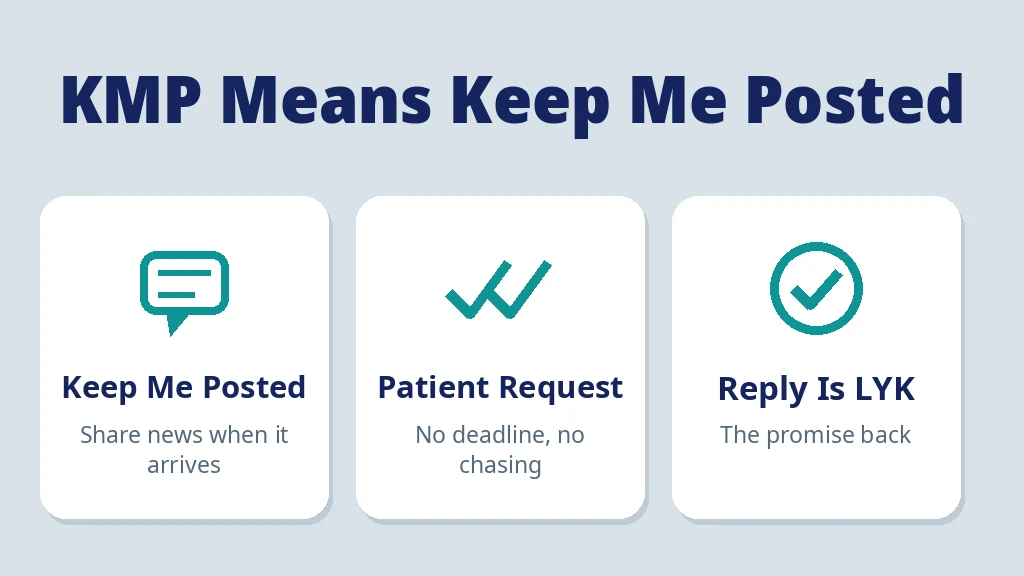
The sources agree on the expansion, and they agree that it is rare. CyberDefinitions says KMP means “Keep Me Posted” and notes that it is a rare term, so the context matters more than usual. The niche guide that ranks for this term leads with the same reading: slangify lists “Keep Me Posted” first as a request to keep you updated, ahead of a dramatic second reading. The wider agreement is broad: a texting acronyms reference, a large abbreviations guide, Computer Weekly’s IM slang glossary, a 2024 study of WhatsApp abbreviations, and the FBI Guide to Internet Slang all list “KMP, keep me posted”. The phrase behind it is ordinary English too: Cambridge documents “keep sb posted” as making sure that someone always knows what is happening, with the example “Keep me posted on anything that happens while I am away.”
KMP Meaning in Easy Words
Think of KMP as a mailbox flag. That is the kmp meaning in one image.
When you put the flag up on a mailbox, you are telling the postman there is something to collect, without standing by the door waiting. KMP is the typed version of that flag: “when there is news, send it my way”.
In the simplest words:
KMP = “Tell me what happens when you hear anything.”
Where Is KMP Used?
As kmp slang, KMP lives in casual chats between people who already share some context, and it almost never leaves that world. It is rare, so it shows up less often than LMK.
Common places:
- Private texts and DMs, asking a friend for updates on a job, a trip, or a result
- Group chats, where one “KMP” asks the whole group to share news when it arrives
- Snapchat chats, as a short reply when a friend is waiting on an answer
- Instagram and TikTok DMs, asking for updates on a plan or an event
- WhatsApp chats, where students and friends use it to track shared plans
Typical situations:
- A friend is waiting for exam results and you want to hear how it went
- Someone is going to a doctor, an interview, or a meeting with news attached
- A plan depends on a reply from someone else, and you want the outcome
- A friend is travelling and you want to know they arrived safely
- A group is waiting on tickets, a booking, or a decision from a third person
Why Do People Use KMP?
It saves time and typing
KMP is three letters instead of fourteen, and in a fast chat that difference matters. The full phrase adds nothing, so they cut it, and the request survives the cut.
It is polite without being pushy
Asking “tell me the second you hear anything” can sound demanding, but KMP says the same thing softly. It asks for news without setting a deadline, and it leaves the timing to the other person.
It closes a loop without closing the chat
Some requests end a conversation, but KMP leaves a small door open. The chat can pause, the news can arrive hours later, and the other person knows exactly what to send when it does.
Real-Life Examples of KMP
Here is how KMP actually shows up in chats and comments:
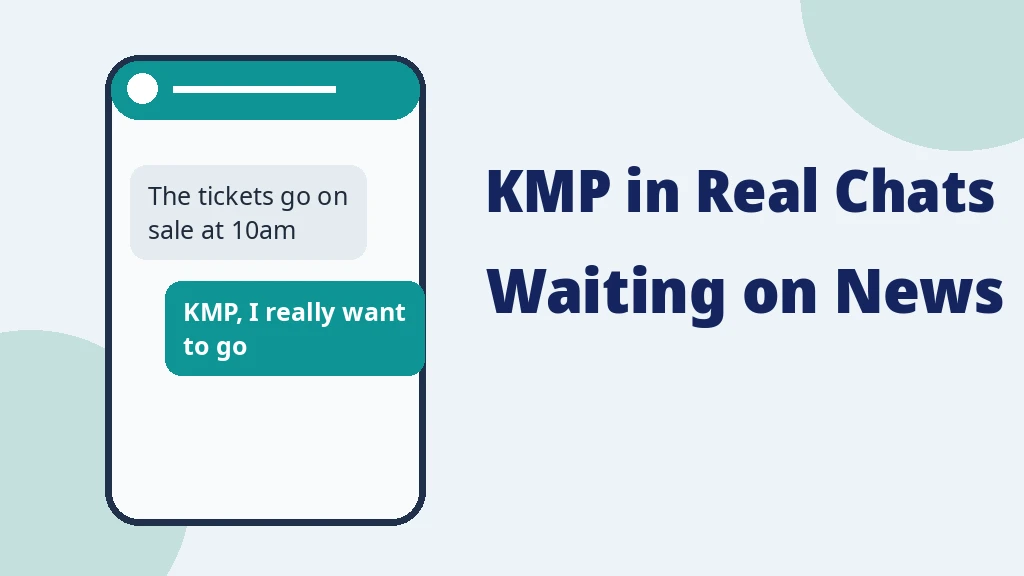
Example 1:
- Chat: “My interview is on Friday, wish me luck.” “Good luck! KMP.”
Meaning: Warm request, the sender wants to hear how the interview went.
Example 2:
- Chat: “The tickets go on sale at 10am, I will try to get two.” “KMP, I really want to go.”
Meaning: Eager request, the sender wants the result as soon as it is known.
Example 3:
- Chat: “Mum is at the doctor, I will know more by evening.” “Okay, KMP. Hope she is fine.”
Meaning: Gentle request, the sender wants news but knows the timing is uncertain.
Example 4:
- Chat: “Did the landlord reply about the flat?” “Not yet. KMP when he does?”
Meaning: Plain request for an update, the sender is waiting on a third person.
Example 5:
- Chat: “Flight lands at 9, I will text when I am through.” “Safe trip, KMP.”
Meaning: Caring request, the sender wants to know the friend arrived safely.
KMP vs Similar Terms
| Term | Meaning | When to use it |
|---|---|---|
| KMP | Keep Me Posted | Asking for future updates as news arrives |
| LMK | Let Me Know | Asking to be told something, now or later |
| LYK | Let You Know | The reply to KMP, a promise to update |
| KYP | Keep You Posted | Promising to send updates yourself |
| FYI | For Your Information | Sharing news, not asking for it |
Key difference: KMP asks for updates over time, while LMK asks to be told something and works for a single fact too. If you want one answer, LMK fits better. If you want every update as it arrives, KMP is the right request. LYK is the natural reply to KMP, and KYP is the same promise in the other direction. FYI is the opposite job: it shares news instead of asking for it. For the plainest way to say you already know something, here is what IK means in text, the short “I know” that answers without asking for anything.
Keep KMP apart from LMK as well. LMK is common and flexible, and it works when you want a single piece of information. KMP is rare and specific, and it works when the news will arrive in stages. Match the request to the news.
The Other KMP Meanings You Should Know
“Keep Me Posted” is the only common texting meaning. In chats, DMs, and comments, KMP means “Keep Me Posted” and almost nothing else. One niche guide lists a second texting reading, “Kill Me Please”, as a dramatic or joking way to say something is frustrating, but it is a minor secondary sense, and the context makes it obvious: a KMP after good news is a request for updates.
Outside texting, KMP has formal meanings. In computer science, KMP stands for the Knuth-Morris-Pratt algorithm, a string-searching method from 1977. In Indian company law, it stands for Key Managerial Personnel, the senior officers a company must appoint. In networking, it can mean Key Management Protocol. None of these will appear in a chat about concert tickets.
Tone rule in one line: a warm sentence around it means a caring request, a bare KMP after a plan means a plain request, and the news being waited on tells you which one you are looking at.
How to Reply to KMP
Your reply depends on what news you have, because KMP is a request that waits for an answer.
If you have news already: share it. “Got the tickets, we are going!” is exactly what the sender wanted, so do not make them ask twice.
If you have no news yet: promise it. “Will do” or “LYK as soon as I hear anything” is the natural reply. For a reply that is warm in any chat, here is what IDM means in text, the friendly “I don’t mind” that keeps any choice easy.
If you want to use KMP yourself: use it when you genuinely want updates on something that is still open. Add a few words when the news matters, so it does not read as a demand. “KMP, I am really hoping it goes well” is warm, while a bare “KMP” after serious news can sound cold.
When to Use KMP (and When to Avoid It)
Good situations:
- Asking a friend for updates on a result, a decision, or a trip
- Following a plan that depends on news from someone else
- Checking in gently on a friend who is waiting for an answer
- Leaving a chat open so news can arrive later without a new request
Avoid using KMP when:
- You are talking to a teacher, a boss, or anyone formal
- You need one quick fact, since LMK fits that job better
- The other person has already promised to update you, since asking again sounds pushy
- The news is sensitive and a short request would sound cold
Common Misunderstandings About KMP
KMP is not a demand. This is the biggest misunderstanding, and it comes from reading three capital letters as a command. KMP is a soft request, not an order: it asks for news, leaves the timing to the other person, and a warm sentence around it keeps it friendly.
KMP does not mean “kill me please”. That is a minor second reading, and it only fits chats where someone is venting about something frustrating. In an ordinary chat about plans, results, or trips, KMP means “Keep Me Posted”.
KMP is not the same as LMK. LMK asks to be told something and works for a single fact, while KMP asks for updates as they arrive. Mixing the two up is harmless, but using the right one makes the request clearer.
KMP is not a full answer to a real question. If someone asks you a genuine question, “KMP” does not answer it. When a question needs an answer now, give the answer, and save KMP for when the news has not arrived yet.
Frequently Asked Questions
What does KMP mean in text?
KMP means “Keep Me Posted”. It is a short way to ask someone to share updates with you when news arrives.
Is KMP rude?
No, it is polite and low pressure. It asks for news without setting a deadline. Add a few warm words when the news matters, so a bare KMP does not read as cold.
What does KMP mean on Snapchat?
On Snapchat, KMP means “Keep Me Posted” as a short reply when a friend is waiting on an answer. It is the same update request as in any other chat.
What is the difference between KMP and LMK?
KMP asks for updates over time as news arrives, while LMK asks to be told something and works for a single fact too. Use KMP for ongoing news and LMK for one answer.
What should I reply when someone says KMP?
Share the news if you have it, or promise it with “Will do” or “LYK as soon as I hear anything”. That promise is the natural reply to KMP.
What does KMP mean in computing?
In computing, KMP stands for the Knuth-Morris-Pratt algorithm, a string-searching method from 1977. That is a technical meaning, not a texting meaning.
Should I use KMP at work?
No. It is informal and rare, so many people will not know it. Write “please keep me posted” in full instead.
Final Thoughts
KMP is the smallest update request in texting, and one of the most polite. It means “Keep Me Posted”, and it does the work of a mailbox flag: tell me what happens when you hear anything. The feeling comes from everything around it, the warmth of the sentence, the news being waited on, and the trust between the two people.
Now you can read it at a glance: a warm sentence means a caring request, a bare KMP after a plan means a plain request, and the promise back is LYK, the “let you know” that closes the loop. The next time a friend is waiting on news you want to hear, ask in three letters, and add a little warmth.
The lead is documented by CyberDefinitions, which says KMP means “Keep Me Posted” and notes that it is a rare term. The phrase behind it is ordinary English too: Cambridge Dictionary documents “keep sb posted” as making sure that someone always knows what is happening. For a reply that is warm in any chat, here is what IDM means in text, the friendly “I don’t mind” that keeps any choice easy.