
You are scrolling through a British group chat when someone drops a blunt little reply: “CBA.” No explanation, no emoji, just three letters and a full stop.
Here is the short answer: in British texting, CBA means the sender cannot be bothered to do something. It is the casual, slightly fed up way of saying “I do not have the energy or the interest for this,” and it is far more common in the UK than anywhere else.
That sounds simple, but the tone matters as much as the meaning. CBA can be funny, lazy, rude, or honest depending on who says it and where, so let us unpack it properly: what it means, where it comes from, and when to use it without offending anyone.
What Does CBA Mean in Text?
CBA stands for Can’t Be Arsed.
That is the full British expansion, and from here on we will mostly use the softer paraphrase “can’t be bothered,” because that is what the phrase means in everyday language, and it is the version most Americans will recognise instantly. The bluntness is part of the point, though: CBA is not polite, and it is not meant to be.
Quick definition: CBA means “can’t be bothered.” In British texts and chats, people type it when they lack the energy, motivation, or interest to do something, from going out in the rain to replying to a long email.

The phrase comes from British slang, where the original wording is a coarse way of saying someone cannot summon the effort for a task. Over time, the three letters travelled on their own, and today many younger Brits type CBA without thinking about the literal wording at all. They just mean “nah, not doing that.”
There is also a completely different, formal meaning: in business and economics, CBA stands for Cost-Benefit Analysis, the process of weighing the costs of a decision against its benefits. If you see CBA in a work report or a finance email, that is almost certainly the meaning, not the slang one.
CBA Meaning in Easy Words
Think of it like this:
You are warm on the sofa, it is raining outside, and a friend asks if you want to walk to the shop. You could go, but honestly, you just do not want to. That feeling, in three letters, is CBA.
So in the simplest words:
CBA = “I could do it, but I really do not want to right now.”
It is not the same as “I can’t,” which means you are unable. CBA means you are able, but unwilling, tired, or uninterested. That small difference is the whole joke, and also the whole risk: telling someone you cannot be bothered can sound dismissive if they were counting on you.
Where Is CBA Used?
CBA lives mostly in British casual chat. It is far less common in American texts, where people are more likely to type “can’t be bothered” in full, or use a different shrug entirely.
Common platforms:
- WhatsApp and Messenger chats between British friends
- Instagram and TikTok comments from UK users
- X (Twitter) replies, especially about chores, weather, and work
- Discord and gaming chats, usually about grinding, queuing, or practice
- Workplace chats, but only between close colleagues, never with a boss
Example situations:
- A friend suggests a night out and you are already in pyjamas
- Someone sends a long video and you do not have the patience to watch it
- A game asks you to repeat a boring level for the tenth time
- A colleague suggests a meeting that could have been an email
- You look at a pile of washing and decide it can wait until tomorrow
Why Do People Use CBA?
It is brutally honest
Most polite excuses take a whole sentence: “Sorry, I am a bit tied up at the moment.” CBA skips the performance and says the quiet part out loud, which is why friends find it funny.
It is fast
Three letters replace a full explanation of your mood, your energy level, and your decision. In a fast group chat, that speed matters.
It signals closeness
You would not tell your manager you cannot be bothered. Typing CBA to a friend says “we are close enough that I can be honest with you,” which is part of its charm.
It is very British
Real-Life Examples of CBA
Let us see how people actually use CBA in daily conversations:
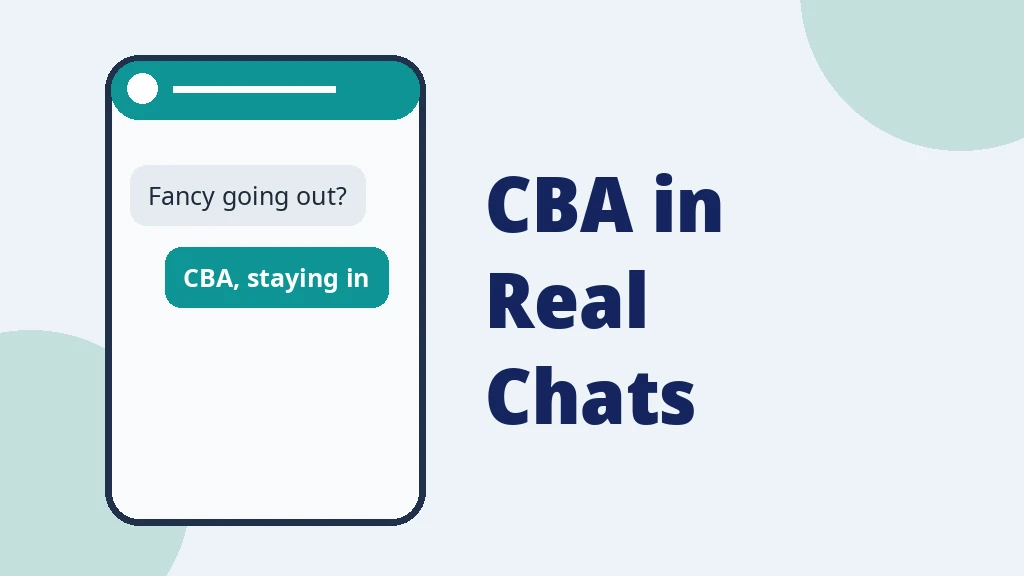
Example 1:
- Friend: “Fancy going for a run this morning?”
- You: “CBA, it is freezing out there”
Meaning: You are not injured or busy, you just do not want to run in the cold. Playful and honest between friends.
Example 2:
- Friend: “Did you watch that 40 minute video I sent?”
- You: “CBA to watch the whole thing, give me the short version”
Meaning: You lack the patience for the full video, not the interest in the topic. Asking for a summary softens it.
Example 3:
- Group chat: “Who is cooking tonight?”
- Reply: “CBA, let us just order something”
Meaning: A group decision disguised as laziness. Everyone was probably thinking the same thing.
Example 4:
- Friend: “You should really sort out your inbox, it has 3,000 emails.”
- You: “I know, I know. CBA though”
Meaning: Self aware laziness. You agree it needs doing, and you are admitting you still will not do it today.
CBA vs Similar Terms
| Term | Meaning | Tone |
|---|---|---|
| CBA | Can’t be bothered | Blunt, British, funny |
| IDK | I don’t know | Neutral, no opinion |
| IDC | I don’t care | Colder, more dismissive |
| TLDR | Too long, didn’t read | About length, not effort |
| NVM | Never mind | Withdrawing a request |
Key difference:
- CBA is about effort: you could do it, but you will not, at least not now.
- IDC is about caring, and it lands much colder. Saying you do not care hurts more than saying you cannot be bothered.
- TLDR is about a specific long message, while CBA can cover anything, from chores to nights out.
And if someone replies to your plan with a flat “nah” and nothing else, you may be dealing with a different kind of shrug. Here is what a single B can mean in text and how context decides it.
CBA Variations You Should Know
Cost-Benefit Analysis is the formal twin. In a business document, “the CBA shows a net gain” has nothing to do with laziness. The topic, not the letters, tells you which one you are reading.
How to Reply to CBA
Your reply depends on whether the CBA was aimed at you or just a general grumble.
If a friend CBA’d your plan: do not take it personally. “Fair enough, another time?” or “Lazy, but I respect it” keeps things light.
If it was about something important: say so plainly. “I get it, but this one actually matters, can you help for ten minutes?” works better than guilt tripping.
If you are the one who said CBA: soften it with an alternative when you can. “CBA tonight, but tomorrow I am in” shows you care, even when your energy does not.
When to Use CBA (and When to Avoid It)
Good situations:
- Chatting with close British friends who know the slang
- Joking about your own laziness, which is always safe
- Group chats where everyone is equally unmotivated
- Gaming chats about boring grinds and repeated tasks
Avoid using CBA when:
- Talking to your boss, a teacher, or anyone formal
- Someone is asking for real help, not a casual favour
- The topic is serious, such as health, money, or family trouble
- You are chatting with Americans or others who may not know the British slang
- You actually need to say no clearly. CBA sounds vague, so use a direct “no” instead
Common Misunderstandings About CBA
It does not mean “I can’t.” CBA means you will not, not that you cannot. That is why it can sting: it admits the choice.
It is not American slang. Americans understand “can’t be bothered” perfectly, but the three letter CBA form is overwhelmingly British. An American reader may guess it means something else entirely.
It is not always rude. Between friends it is a joke, and often a shared one. It only turns rude when it dismisses someone who genuinely needed help.
It is not the business term. Cost-Benefit Analysis shares the letters and nothing else. If the message is about budgets and decisions, you are reading the formal CBA, not the slang one.
Pro Tips for CBA
Use CBA on yourself before you use it on others. “CBA to cook, ordering in” is funny. “CBA to help you” is a rejection, and it reads very differently.
Pair it with an alternative whenever you can. A CBA plus a plan (“CBA tonight, how about Saturday?”) keeps friendships warm while still being honest.
Frequently Asked Questions
What does CBA mean in text?
In British texting, CBA means the sender cannot be bothered to do something. It is a casual, slightly blunt way of saying they lack the energy, motivation, or interest for a task right now.
Is CBA rude?
It can be, but usually it is not meant that way between friends. CBA is blunt by design, so it feels funny among close friends and dismissive when it is aimed at someone who genuinely needed help, or used in a formal setting.
Do Americans use CBA?
Rarely in this slang sense. Americans say “can’t be bothered” in full, but the three letter CBA form is overwhelmingly British, so an American reader may not recognise it at first.
What does CBA mean in business?
In business and economics, CBA means Cost-Benefit Analysis, the process of weighing the costs of a decision against its benefits. The topic of the message tells you whether you are reading the slang or the formal meaning.
What is the difference between CBA and IDC?
CBA is about effort: you could do something but you do not want to right now. IDC is about caring, and it lands colder, because it says the thing itself does not matter to you.
How do you reply when someone says CBA?
Keep it light if it was a joke: “Fair enough, another time?” If it was about something important, say so plainly and ask for a short burst of help instead of arguing about the slang.
Related Texting Slang
Keep exploring the dictionary: what CHEESING means in a text, what chile means in a text, FR in chats and texts, FYP in chats and texts, how people actually use HBU, JK, explained with real examples, the meaning of SMH.
Final Thoughts
CBA is three letters of very British honesty. In a casual chat it means the sender cannot be bothered, and everyone involved usually knows it is half a joke and half the truth. That is exactly why it works between friends and fails at work.
Now you know the slang meaning, the softer paraphrase to use with people who do not know the term, and the formal business twin to watch for in reports and emails. Next time a British friend replies “CBA,” you will know they are not confused or busy. They are just, very honestly, not doing that today.
The British slang use is well documented in general dictionaries. Collins lists CBA as British slang for the blunt phrase behind “can’t be bothered,” and CyberDefinitions gives the same quick answer for texting, which matches how UK chats actually use it.