You saw “BBC” in a chat and froze, because you know those letters, but the conversation did not feel like it was about the news at all.
That confusion is normal, because BBC genuinely lives two lives online. Here is the short answer: in news, general, and everyday chats, BBC means the British Broadcasting Corporation. In flirty, dating app, or adult oriented chats, the same three letters are also used as adult slang, and that sense is usually what people mean when they ask about BBC “in text” after seeing it in a private chat.
Context is the decoder. This guide explains the bbc meaning in text, both meanings factually, how to tell them apart in seconds, and the mix ups that catch people out.
What Does BBC Mean in Text?
Quick definition: BBC most widely means the British Broadcasting Corporation, the UK public service broadcaster founded in 1922. In flirty or adult chat contexts, BBC is also used as adult slang with a sexual meaning, and in identity contexts it can mean British Born Chinese.
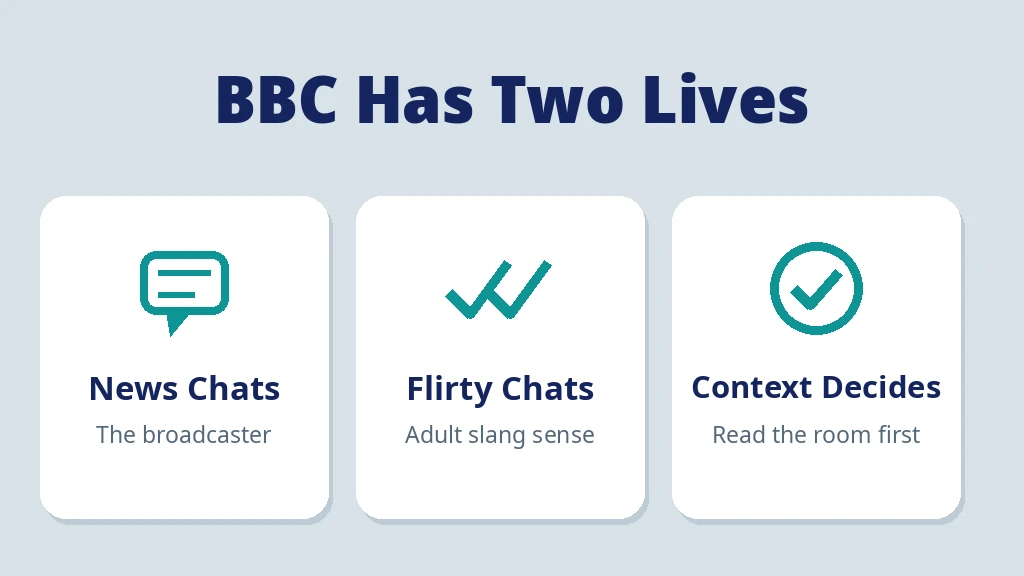
CyberDefinitions puts it plainly: BBC means “British Broadcasting Corporation” and “British Born Chinese”, but if you met it in a text message or online chat and did not know what it meant, the chances are that it stood for the adult slang sense, especially on dating sites and adult chat forums. Other current guides agree that the broadcaster is still the most common meaning overall, while the adult sense dominates in flirty and dating contexts.
Neither side of that split is a mistake. The letters are the same, the worlds are different, and the chat around the letters tells you which world you are in. A message about a documentary, a match, or a news report is using the broadcaster sense. A flirty message on a dating app is almost certainly not talking about television.
BBC Meaning in Easy Words
Think of BBC like a name that two different groups borrowed.
The first group is the whole English speaking world, which has used BBC for the British Broadcasting Corporation for more than a century. When someone says “I saw it on the BBC”, everyone in that group hears “news and TV”.
The second group is adult and dating chat culture, which reused the same letters as shorthand for an adult slang phrase. People inside that group hear the second meaning instantly, and people outside it are left confused.
So the easy rule is: news context means the broadcaster, flirty private context means the adult slang sense. If neither context fits, ask, because guessing wrong here is more awkward than asking.
Where Is BBC Used?
The broadcaster sense shows up in:
- News chats, group chats about current events, and social media posts about TV, sport, and documentaries
- School, university, and work messages that cite a BBC report, show, or podcast
- Everyday recommendations: “The BBC has a great series on this”
The adult slang sense shows up in:
- Dating app profiles, flirty DMs, and adult oriented forums and comment threads
- Memes and jokes that play on the double meaning, often by pairing a BBC news logo with a cheeky caption
- Private chats where the tone is already flirty and both people understand the reference
The identity sense, British Born Chinese, shows up in community and identity discussions, alongside similar terms like ABC for American Born Chinese and CBC for Canadian Born Chinese. It is much less common than the other two in general chats, but it is a real use worth knowing.
Why Do People Use BBC?
It is a famous name, already short
Three letters stand for one of the best known media brands in the world. Nobody spells out “British Broadcasting Corporation” in a fast chat when BBC does the job.
The double meaning makes jokes easy
Memes love a word with two meanings, and BBC is a perfect case. A joke that works in both the news sense and the adult sense gets shared precisely because readers have to pause and pick the right one.
It is discreet in adult contexts
On dating apps, shorthand lets people hint at an adult topic without spelling it out in full. That discretion is part of why the slang sense spread, and also why it can surprise someone who only knows the broadcaster.
It marks identity in community chats
British Born Chinese uses BBC as a compact identity label, the same way other “born” labels work. In those conversations it is about background and belonging, not about media or slang.
Real-Life Examples of BBC
The examples below stay clean. For the adult sense, only the context is shown, not explicit example dialogue, because the point is recognition, not repetition:
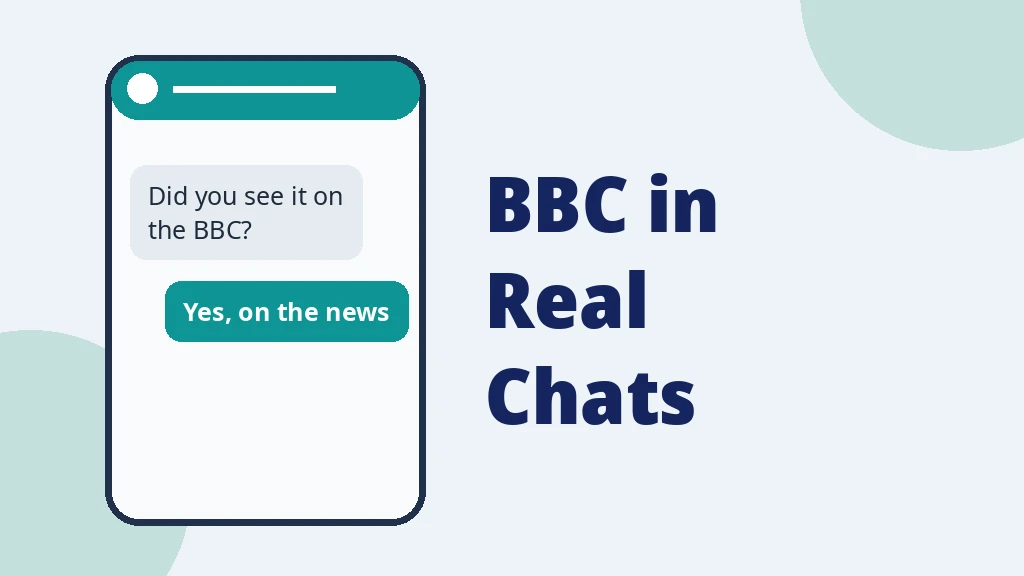
Example 1 (broadcaster):
- Friend: “Did you watch that BBC documentary last night?”
- You: “Yes, the photography was incredible”
Meaning: The British Broadcasting Corporation, plain and simple.
Example 2 (broadcaster):
- Group chat: “BBC News just reported the score, we won”
- Reply: “Finally, what a game”
Meaning: A news report from the broadcaster, used as a trusted source.
Example 3 (broadcaster):
- Classmate: “Use the BBC article for your essay, it is well sourced”
- You: “Good idea, I will cite that one”
Meaning: The broadcaster as a reference for school work.
Example 4 (adult slang sense, context only):
- Setting: A flirty dating app profile or private DM with a clearly adult tone
- Reading: BBC here is not about news or TV
Meaning: The adult slang sense. The flirty setting, not the letters alone, gives it away, and that is why this sense surprises people who meet it outside that setting.
Example 5 (identity sense):
- Community post: “As a BBC, I grew up between two cultures”
- Reply: “Same here, it shapes how you see both sides”
Meaning: British Born Chinese, an identity label in a community discussion.
BBC vs Similar Terms
| Term | Meaning | Where you see it |
|---|---|---|
| BBC | British Broadcasting Corporation, or adult slang in flirty chats | News chats, TV talk, dating apps |
| BCC | Blind Carbon Copy | Email, when hiding recipients |
| ABC | American Born Chinese, or a TV network | Identity chats, US media talk |
| CBC | Canadian Born Chinese, or Canadian Broadcasting Corporation | Identity chats, Canadian media talk |
| NBC | National Broadcasting Company | US TV and news talk |
The most common mix up is BBC vs BCC. They look alike, but they are unrelated. BCC is an email function that hides other recipients, while BBC is a broadcaster or, in adult chats, slang. If someone says “I BBCed you on that email”, they almost certainly meant BCC and just typed the wrong letters. Like other acronyms with several lives, ASP works the same way: the context, not the letters, picks the meaning.
BBC Variations You Should Know
“The BBC” vs “BBC”: Adding “the” usually points to the broadcaster. People say “on the BBC” for a show or report, while the slang sense rarely takes “the” in the same way.
“BBC News”, “BBC Sport”, “BBC iPlayer”: These are broadcaster brands, and they always mean the corporation. If a longer BBC name follows, the adult reading disappears.
Lowercase “bbc”: Case does not settle the meaning. Lowercase is common in fast chats for both senses, so read the conversation, not the capitalization.
Joke uses and memes: Many memes deliberately sit on the fence between the two meanings. If a meme pairs a news logo with a winking caption, it is playing on the double meaning on purpose, and laughing at the joke does not require using the slang sense yourself.
How to Reply to BBC
Your reply depends on which BBC you just met.
If it was the broadcaster: Reply to the show, news, or topic itself. “I loved that documentary too” or “Send me the link to that report” keeps the chat moving.
If it was the adult slang sense and you are comfortable: You can steer the chat or set a boundary in your own words. You do not owe anyone a matching reply just because they used slang.
If it was the adult sense and you are not comfortable: Change the subject, keep your reply neutral, or end the chat. A simple “Not my thing, lets talk about something else” is clear without turning it into an argument.
If you genuinely cannot tell: Ask a light clarifying question. “Do you mean the broadcaster or something else?” is far less awkward than answering the wrong meaning.
When to Use BBC (and When to Avoid It)
Good situations for the broadcaster sense:
- Talking about news, TV, sport, documentaries, or podcasts from the BBC
- Citing a BBC report in school, work, or a serious discussion
- Recommending a BBC show to friends or family
Avoid the slang sense when:
- Chatting with colleagues, teachers, family, or anyone in a formal setting
- Messaging someone you do not know well, where the adult reading can shock or offend
- Posting publicly, where the joke can be read by people outside the intended audience
- Talking about a person, where the slang sense reduces them to a stereotype
Common Misunderstandings About BBC
BBC does not always mean the broadcaster. That is the most common and most widely recognized meaning, but in flirty and dating chats the adult slang sense is the live one. Assuming the broadcaster sense everywhere is how people get caught out.
BBC is not always sexual slang either. Most everyday uses, in news, school, work, and family chats, are about the broadcaster. The adult sense needs an adult context to activate.
BBC is not the same as BCC. BCC is Blind Carbon Copy in email. The two terms share letters, not meanings.
BBC is not a new internet invention. The broadcaster dates to 1922, first as the British Broadcasting Company and from 1927 as the British Broadcasting Corporation. The slang sense is the newer borrower, not the original owner of the letters.
Frequently Asked Questions
What does BBC mean in text?
In news and everyday chats, BBC means the British Broadcasting Corporation. In flirty, dating app, or adult chats, the same letters are used as adult slang, so the context of the chat decides which meaning fits.
Is BBC always sexual slang online?
No. The broadcaster meaning is still the most common overall, in news, school, work, and family chats. The adult slang sense appears mainly in flirty, dating, and adult oriented contexts.
What does BBC mean on Snapchat and dating apps?
On dating apps and in flirty DMs, BBC usually carries the adult slang sense rather than the broadcaster sense. If the tone is flirty and private, read it that way, and set a boundary if you are not comfortable.
What does BBC stand for?
BBC stands for the British Broadcasting Corporation, founded in 1922 as the British Broadcasting Company and renamed as a corporation in 1927. It can also stand for British Born Chinese in identity discussions.
What is the difference between BBC and BCC?
BBC is the British Broadcasting Corporation, or adult slang in flirty chats. BCC is Blind Carbon Copy, an email feature that hides other recipients. They look similar but mean unrelated things.
How do you reply when someone uses BBC as slang?
If you are comfortable, steer or set a boundary in your own words. If you are not comfortable, change the subject or end the chat with a neutral line. If you cannot tell which meaning was meant, ask directly.
Related Texting Slang
Keep exploring the dictionary: B, explained with real examples, how people actually use bricked up, when someone texts you BWC, what DTF means in a text, FWB, UNC, explained with real examples.
Final Thoughts
BBC is a small test of reading the room. In a news chat it is one of the oldest names in broadcasting, and in a flirty chat it is adult shorthand wearing the same letters. The letters never change, but the room around them changes everything.
That is the skill to take away: check the setting, the sender, and the topic before you answer. Do that, and BBC stops being confusing, even when it shows up in the last place you expected it.
The reference points line up with that reading. CyberDefinitions lists the broadcaster, British Born Chinese, and the adult slang sense side by side, and the Science Museum Group records the broadcaster’s 1922 founding as the British Broadcasting Company and its change to a corporation in 1927.