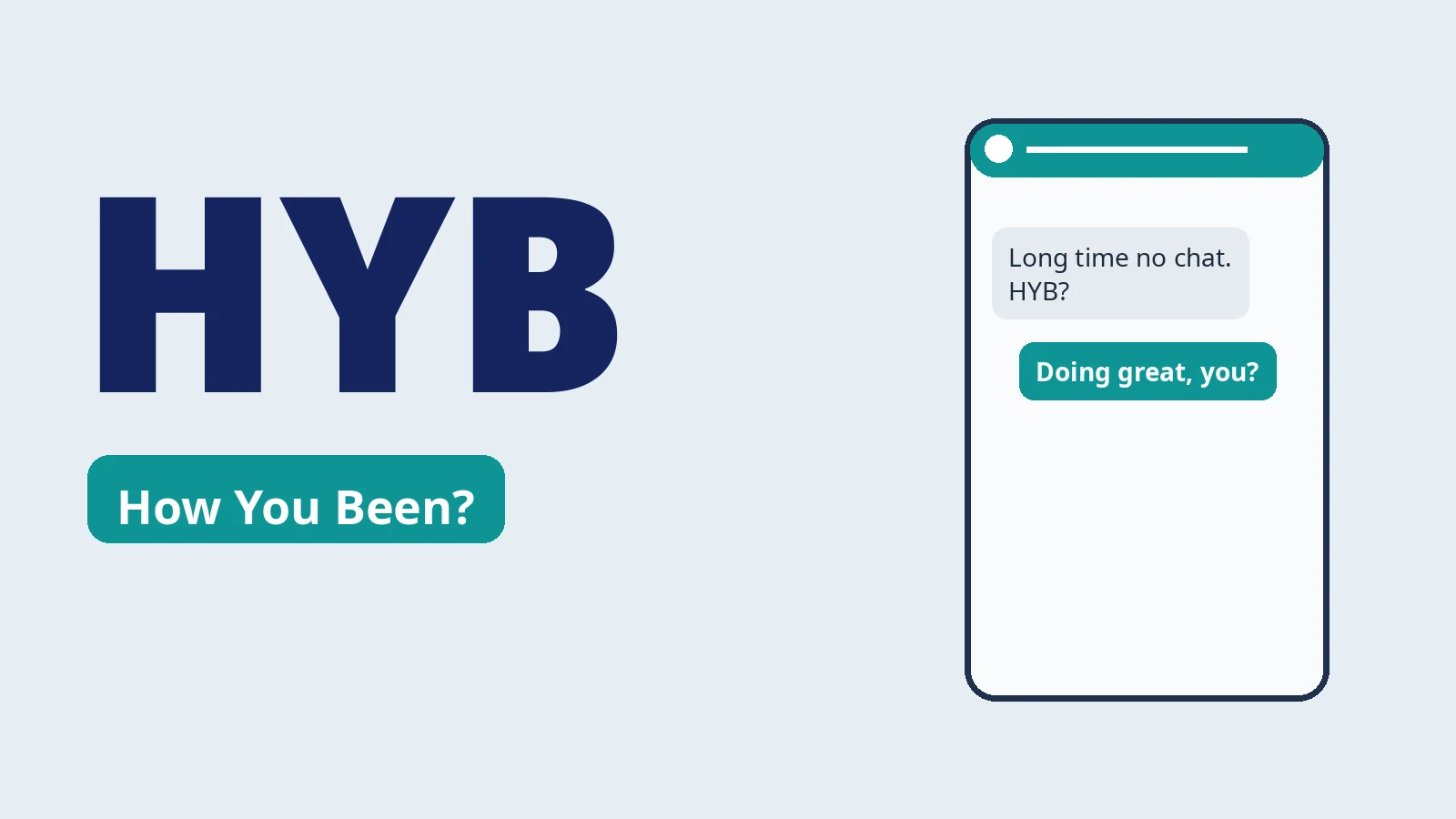
A friend you have not spoken to in months sends one short message: “HYB?” No name, no greeting, no context. Are they asking about your life, telling you to sort yourself out, or promising to message you later?
Here is the short answer: HYB usually means “How You Been?” It is a casual check-in, a squeezed down version of “How have you been?”, sent when someone wants to reopen a conversation after a gap. That reading fits most private chats, but HYB is a crowded abbreviation, and the same three letters can mean something quite different in the right sentence.
In this guide you will learn the hyb meaning in text, how to tell the check-in from the other readings, how HYB differs from its close neighbours HBY and HBU, and how to reply without guessing wrong.
What Does HYB Mean in Text?
In everyday chats, HYB is a greeting that looks backwards before it looks forwards.
Most abbreviations describe the present moment: LOL reacts to a joke, BRB announces a short absence. HYB is different. It reaches back over the time since you last spoke and asks how that time treated you. That is why it appears at the start of a conversation, not in the middle of one.
Quick definition: HYB means “How You Been?”, a casual way of asking someone how they have been doing since you last spoke, usually after a gap in conversation.

The reference sources agree on this lead. CyberDefinitions gives “How You Been?” as the texting definition of HYB, and the majority of the top niche guides lead with the same reading, describing it as a relaxed check-in used on Instagram, Snapchat, WhatsApp, and plain SMS. One guide leads with “Hit Your Boy” instead, which is a real secondary reading covered below, but it is outnumbered: the check-in reading is the one most readers will meet first.
CyberDefinitions also flags HYB as a rare term with a difficulty rating of 4 out of 5 for guessing, which is honest. The letters do not spell out their meaning the way BRB does, and that is exactly why HYB causes confusion when it lands without context.
HYB Meaning in Easy Words
Think of HYB as a door opening, not a full conversation.
When someone types “HYB?”, they are not asking for your life story. They are testing whether the door is open: are you around, are you willing to talk, and is there anything new worth catching up on? A good reply matches that energy, short, warm, and open, rather than a long essay.
In the simplest words:
HYB = “How have you been since we last talked?”
Notice the time element. HYB is not the same as “How are you?”, which asks about right now. HYB asks about the gap.
Where Is HYB Used?
HYB is platform neutral, because reconnecting happens everywhere.
Common places:
- Instagram and Snapchat DMs, often as the first message after weeks of silence
- WhatsApp and Messenger one to one chats with old friends
- Group chats, when someone returns after being quiet for a while
- Comments and replies, where a quick check-in keeps a friendship warm
- Song lyrics and captions, where the check-in energy fits a nostalgic mood
Typical situations:
- Reopening a conversation after a break, a move, or a busy period
- Checking in on a friend you have not seen since school, work, or a trip
- Starting a chat without a specific reason, just to see how someone is doing
- Softening a request, by warming up the chat before asking a favour
Why Do People Use HYB?
It is faster than the full question
Typing “How have you been?” takes effort and feels formal. HYB keeps the warmth and drops the weight, which suits a quick DM far better.
It admits the gap without awkwardness
After months of silence, a plain “Hi” can feel thin, and a long apology can feel heavy. HYB sits in between: it acknowledges the gap in three letters and moves straight to the person.
It invites a real answer
Unlike a plain greeting, HYB is a question, and questions get replies. It gives the other person a clear next move: a short update, and then the same question back.
Real-Life Examples of HYB
Here is how HYB actually shows up in daily chats, with the check-in reading doing most of the work:
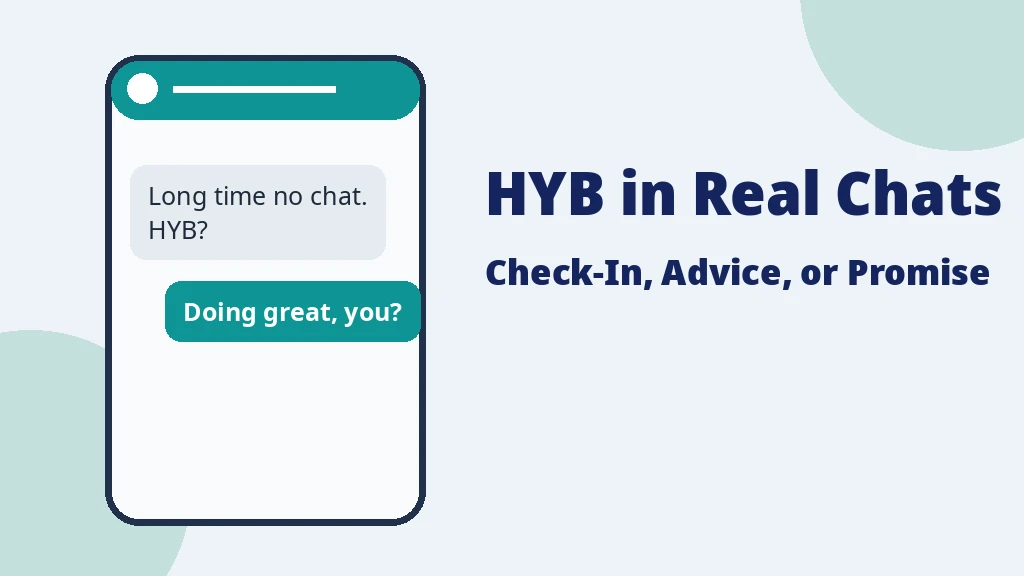
Example 1:
- Friend: “Long time no chat. HYB?”
- You: “Doing great, you?”
Meaning: Classic check-in. The gap is named first, then HYB asks about it.
Example 2:
- Friend: “HYB? Missed you at the reunion.”
- You: “I know, work kept me away. How was it?”
Meaning: Warm reconnection with a specific missed event behind it.
Example 3:
- Friend: “HYB, still at the same job?”
- You: “Yes, same job, new team though.”
Meaning: Check-in plus a pointed follow-up. The question after the comma shows what the sender actually wants to know.
Example 4:
- Friend: “You need to stop waiting around. HYB.”
- You: “Fair point, I will handle it this week.”
Meaning: Not a check-in at all. Here HYB means “Handle Your Business”, a firm push to take care of responsibilities. The advice tone gives it away.
Example 5:
- Friend: “Busy right now, HYB later.”
- You: “No rush, talk then.”
Meaning: “Hit You Back” reading. The sender is promising a later reply, not asking a question, and the word “later” confirms it.
HYB vs Similar Terms
| Term | Meaning | Key difference from HYB |
|---|---|---|
| HYB | How You Been? | Asks about the gap since you last spoke |
| HBY | How About You? | Returns a question already asked, needs a question first |
| HBU | How About You? | Same return question as HBY, different letters |
| HRU | How Are You? | Asks about right now, not about the gap |
| WYD | What You Doing? | Asks about this moment, not about your life lately |
Key difference: HYB opens a conversation, while HBY and HBU continue one. HYB works as the first message after silence. HBY only makes sense after someone has already told you how they are, because it hands their question back to them. For the closest cousin of HYB, here is what HBY means in text and how it keeps chats going once they have started.
HYB vs HBY: The Mix-Up to Avoid
HYB and HBY share the same three letters in a different order, and readers mix them up constantly. The difference is direction. HYB points backwards over time: how have you been since we last talked? HBY points sideways across the conversation: you told me your news, now what about me?
A quick test settles most cases. If HYB or HBY arrives as the first message after silence, it is almost certainly HYB, the check-in. If it arrives right after someone answered a “how are you” question, it is HBY, the bounce back. Letter order is the clue, but position in the conversation is the proof.
The Other Meanings of HYB
Handle Your Business is the motivational reading. In advice, encouragement, or tough love messages, HYB tells someone to take care of their responsibilities, deal with a problem, or stop waiting around. It shows up in captions and pep talks more than in private check-ins, and its tone is firm, not warm. Slang.org actually leads with this reading, which is why it deserves second place here even though the check-in reading wins overall.
Hit You Back is the promise reading. “HYB later” or “HYB tonight” means “I will get back to you”. The direction flips here: the sender, not the reader, will do the contacting. A time word nearby, like later or tonight, is the giveaway.
Hit Your Boy is the contact reading, as in “HYB if you are free later”, meaning “contact me”. One niche guide leads with this sense, and it shares the contact idea with Hit You Back, except the direction is reversed: the reader is asked to reach out. The sentence around it decides which way the contact flows.
Hell Yeah, B*tch is a rare playful profane reading among close friends, used as hype rather than as a question. It is documented but uncommon, and it only fits inside jokes between people who already talk that way. Never assume this reading from a stranger, and never use it in a formal or first message context.
How to Reply to HYB
The best reply depends on which HYB you received, and the wrong reply to the wrong reading causes real confusion.
If it was a check-in: answer briefly, then bounce the question back. “Doing well, busy with work. HYB?” keeps the rhythm and shows equal interest. A one word answer with no return question can read as cold after a long gap.
If it was “Handle Your Business”: reply to the advice, not to a question. Agreement, a plan, or a light pushback all fit: “Fair point, I will handle it this week” works better than “I am good, you?”
If it was “Hit You Back”: do not answer a question nobody asked. A short acknowledgement fits: “No rush, talk later” or a thumbs up.
If it was “Hit Your Boy”: reply with contact, not an update. “Will do, free after six” matches the invitation.
If you are unsure: answer the check-in reading, the most common one, and add a light question that lets the sender correct you.
When to Use HYB (and When to Avoid It)
Good situations:
- Reopening a chat after weeks or months of silence
- Checking in on a friend after a big event, a move, or a hard time
- Starting a casual DM when you have no specific news to share
- Warming up a chat before a favour or a plan
Avoid using HYB when:
- The message is formal, where the full “How have you been?” reads warmer and clearer
- You already spoke today, because HYB asks about a gap that does not exist yet
- You mean “Hit You Back” and the reader may take it as a check-in question
- You mean “Handle Your Business” and the reader may take it as friendly, not firm
Common Misunderstandings About HYB
HYB does not mean “How About You”. That is HBY and HBU. HYB asks about the gap since you last spoke, which is a different question with a different answer.
HYB is not always a question. The check-in reading ends with a question mark, but “Handle Your Business” and “Hit You Back” are statements. Punctuation and the sentence around HYB decide whether an answer is expected.
HYB is not the same as HRU. HRU asks about right now. HYB asks about the time since you last talked. Answering HYB with “fine” is correct but thin; a short update about what changed fits the question better.
HYB has no “HYBB” variant. No doubled form was found in the sources checked for this guide. If you see HYBB, it is almost certainly a typo for HYB or HBB, not a separate term.
Frequently Asked Questions
What does HYB mean in text?
HYB usually means “How You Been?”, a casual check-in asking how someone has been doing since you last spoke, typically after a gap in conversation.
What does HYB mean on Instagram?
On Instagram, HYB most often means “How You Been?” in DMs, used to reopen a conversation after silence. In captions, the motivational “Handle Your Business” reading appears more often.
What is the difference between HYB and HBY?
HYB asks about the gap since you last spoke and opens a conversation. HBY means “How About You?” and returns a question someone already asked you, so it needs a question first.
Can HYB mean “Handle Your Business”?
Yes, in motivational or tough love contexts HYB means “Handle Your Business”, telling someone to take care of their responsibilities. The firm, advice tone gives this reading away.
Can HYB mean “Hit You Back”?
Yes, especially with a time word nearby, as in “HYB later”. There HYB is a promise that the sender will reply later, not a question.
Is HYB rude?
No, the check-in reading is warm and friendly. The “Handle Your Business” reading can sound blunt, but that is the tone of the advice, not rudeness in the letters themselves.
How do you reply to HYB?
For a check-in, answer briefly and bounce the question back: “Doing well, busy with work. HYB?” For “Hit You Back”, just acknowledge it. For “Handle Your Business”, reply to the advice itself.
Final Thoughts
HYB is a small message with a warm job. Most of the time it means “How You Been?”, a check-in that admits time passed and asks how that time treated you, and it deserves a short, warm update plus the same question back.
Now you know the other readings too: “Handle Your Business” when the tone turns firm, “Hit You Back” when a time word promises a later reply, and “Hit Your Boy” when the sender asks you to reach out. Read the sentence around HYB first, and you will rarely pick the wrong one.
The reference definition backs the lead reading. CyberDefinitions defines HYB in texting as “How You Been?”, while noting that it is a rare term that can mean something else in other contexts, which is exactly why the sentence around it matters.