
Someone writes “HMW” in a chat, and every search result seems to point somewhere else. Is it homework, a design question, or just a typo for something shorter?
Here is the honest short answer: HMW has no settled texting meaning, and the homework reading behind it rests on very thin evidence. A couple of slang listings give “Homework” for HMW, but the major references do not, and the dominant meaning of HMW anywhere else is the design phrase “How Might We”, which is not a texting sense at all.
In this guide you will learn the hmw meaning in text as far as the evidence actually goes, why HMW is so easily confused with HW, and how to check a stray HMW before you act on it.
What Does HMW Mean in Text?
Start with what is solid, then with what is claimed.
The solid fact: HMW is the standard short form of “How Might We” in design thinking and product work. A “How Might We” question reframes a problem as an open opportunity, as in “How might we help new users finish signup without getting stuck?” That sense is documented by design schools, professional guides, and the Interaction Design Foundation, and it dominates general search results for HMW. It is a workshop tool, not a chat abbreviation, and it should never be read into a friend’s text.
The thin claim: two slang listings, NoSlang and UrduPoint, give “Homework” as the HMW meaning in texting. No other layer confirms it. CyberDefinitions has no HMW entry: its HMW page returns a clean 404. No Dictionary.com or Wiktionary texting entry for HMW surfaced. Google’s top results for “hmw meaning in text” are dominated by the design sense, not by homework, which means the homework claim has no majority support in the niche results either.
Quick definition: HMW has no settled texting lead. “Homework” is a claimed but thinly supported reading, “How Might We” is a real but non texting professional sense, and in most chats HMW is best treated as a probable variant or typo of HW until the sender’s context proves otherwise.

That verdict may feel unsatisfying, but it is the only one the evidence supports. The program’s hard gate requires a lead to have the agreement of at least two independent layers, and HMW’s homework claim has only the slang listing layer. One slang listing layer, or even two low authority listings, cannot set a lead when the dictionary layer, the CyberDefinitions layer, and the Google majority all point elsewhere or stay silent. An article that led confidently with “Homework” would repeat the exact kind of error this program was built to stop.
HMW Meaning in Easy Words
Think of HMW as a code with a famous professional life and a rumoured chat life.
In a design workshop, HMW is a question starter. It turns a complaint into a challenge: instead of “users abandon signup”, a team writes “How might we make signup feel effortless?” That question opens brainstorming instead of closing it, which is why the phrase spread from Procter and Gamble workshops through IDEO and Stanford’s d.school into product teams everywhere.
In a school chat, HMW is rumoured to mean homework, as in “got so much HMW tonight”. If that is what your friend meant, the sentence will usually make it obvious, because homework talk comes with classes, deadlines, and assignments attached. Without that school context, do not assume it.
In the simplest words:
HMW = “How Might We” at work, a thin “Homework” claim in chats, and most often a longer form of HW. Context is the only decoder.
Where Is HMW Used?
Because HMW has no settled chat home, its appearances split sharply by setting:
- Design and product workshops, sprint docs, and sticky notes, where it always means “How Might We”
- School group chats, where the claimed homework reading would appear, if it appears at all
- Study and revision channels, where HW dominates and HMW may be a slip for HW
- General web search, where HMW means the design phrase, high molecular weight in science, or half mini wireless in hardware, none of which are texting senses
Typical situations for “How Might We”:
- Opening a brainstorming session with a reframed problem
- Labelling a sticky note or a sprint board section
- Writing a design challenge statement for a team
Typical situations for the claimed homework reading:
- A student complaining about assignments in a group chat
- A quick note about work due tomorrow
- A study reminder typed in a hurry, where an extra letter easily slips in
Why Would Anyone Write HMW for Homework?
HW already owns the homework slot
HW is the settled, widely used short form of homework in school chats, and the Day 8 batch itself contains HW with that settled lead. A writer who types HMW in a school chat may simply have added a letter to HW by habit, by autocorrect, or by copying a longer form they saw once. That makes HMW look like a variant of HW rather than a term in its own right.
The longer form feels more complete
Some writers stretch abbreviations to make them clearer, the way “btw” sometimes becomes “by the way” in full. HMW could be a stretched HW in the same spirit: homework with an extra letter that adds nothing but length. Stretched forms like this appear in slang all the time, and they rarely earn their own dictionary entry.
Two listings are enough to keep a rumour alive
Once two slang listings record a reading, later guides can copy it without checking, and a thin claim starts to look established. That copying chain is visible across slang sites generally, and it is why this program checks CyberDefinitions, dictionaries, and Google together instead of trusting a listing count. For HMW, the chain stops at those two listings, and the stronger layers never pick it up.
Real-Life Examples of HMW
Here is how HMW actually shows up, with each example labelled by how much trust it deserves:
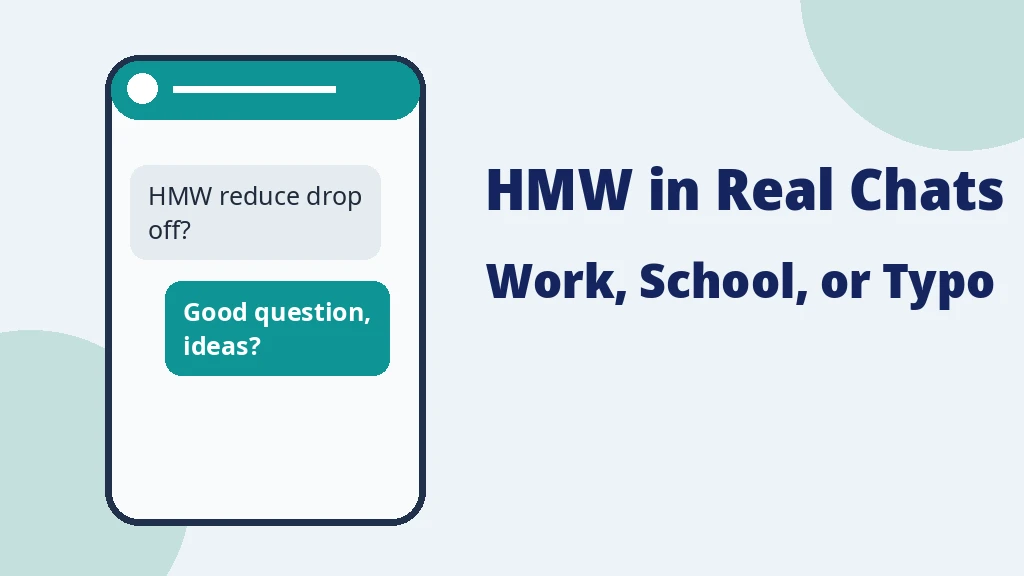
Example 1 (How Might We, professional, settled):
- Colleague: “HMW reduce drop off on the payment page?”
- You: “Good question, let us list three ideas”
Meaning: A design question starter. This is the only HMW reading with strong documentation, and it belongs at work, not in a casual chat.
Example 2 (Claimed homework, thin evidence):
- Friend: “Ugh, so much HMW tonight”
- You: “Same, which subject is worst?”
Meaning: Probably homework, if the school context confirms it. Treat this as a reasonable guess from context, not as a dictionary settled reading.
Example 3 (Probable HW typo):
- Friend: “brb, HMW due lol”
- You: “Good luck with it”
Meaning: Almost certainly HW, homework, with an extra letter. The sentence pattern matches HW usage exactly, and the extra W adds no meaning.
Example 4 (Science, not texting):
- Classmate: “The HMW fraction separated first”
- You: “That is the chemistry sense, not slang”
Meaning: High molecular weight. A technical sense that should never be carried into a chat reading.
Example 5 (Ask, do not guess):
- Friend: “HMW?”
- You: “Do you mean homework, or something else?”
Meaning: Unknown. A bare HMW with no context is the one case where asking is clearly better than guessing, because every candidate reading is weak in a chat.
HMW vs Similar Terms
| Term | Meaning | Status |
|---|---|---|
| HMW | How Might We, or claimed homework | Professional sense settled, chat sense thin |
| HW | Homework | Settled chat lead, use this instead |
| HMWK | Homework | Documented by CyberDefinitions as homework |
| HM | Thinking pause | Unrelated, but easily confused in fast typing |
| BTW | By The Way | Settled chat abbreviation, no HMW overlap |
Key difference: HW and HMWK both have real support as homework forms, while HMW does not. That contrast is the strongest reason to treat a chat HMW as a variant of HW: the homework job already has two better documented forms, so HMW adds nothing except confusion. For the shortest member of the family, here is what HM means in text and how a thinking pause differs from every homework form.
A note on HMWK: CyberDefinitions does document HMWK as “Homework”, describing it as a rare term. That entry helps HMW only slightly: it shows that homework abbreviations with extra letters exist, but it documents HMWK, not HMW, and borrowing its authority for HMW would be exactly the kind of layer confusion the hard gate forbids.
How to Reply to HMW
If it arrived in a work or design setting: answer it as a question. “How might we” invites ideas, so offer one, or ask what problem sits behind the question.
If it arrived in a school chat with homework context: reply as if it means homework, but keep the reply flexible. “Which subject?” works whether HMW meant homework or HW, because it follows the context rather than the letters.
If it arrived with no context at all: ask lightly. “HMW as in homework?” takes one second and avoids a reply built on a thin reading.
If you are the one writing: do not write HMW for homework. Write HW, which everyone in a school chat understands, or write homework in full. Using a thin, contested form when a settled form exists only creates work for your reader.
When to Use HMW (and When to Avoid It)
Good situations:
- In a design workshop, sprint doc, or brainstorming board, where “How Might We” is the standard reading
- When quoting a design question that already uses the HMW form
- Nowhere else as a deliberate choice, because the chat sense is not settled
Avoid using HMW when:
- You mean homework in a chat, because HW is clearer and settled
- The reader may be a designer and will read it as “How Might We”
- The message matters and a misread could change the reply
- You are writing for the first time to someone with no shared slang
Common Misunderstandings About HMW
HMW does not certainly mean homework in chats. That reading comes from two slang listings only, with no CyberDefinitions entry, no dictionary texting entry, and no Google niche majority behind it. Presenting it as certain would overstate the evidence.
HMW does not mean “How Might We” in a casual chat. The design sense is real, but it belongs to workshops and product teams. Carrying it into a friend’s text would be a setting error, not a clever reading.
HMW is not just HW with better spelling. HW is the settled form. HMW is longer, rarer, and less documented, so it is a worse homework abbreviation, not a better one.
HMW is not proven by HMWK. CyberDefinitions documents HMWK as homework, but that is a different string. Similar letters are not the same term, and the hard gate requires evidence for the exact term being written about.
Frequently Asked Questions
What does HMW mean in text?
HMW has no settled texting meaning. A thin slang claim gives “Homework”, but the major references do not confirm it, so treat any chat HMW as a probable HW variant until context proves otherwise.
Does HMW mean homework?
Only according to two slang listings, NoSlang and UrduPoint. CyberDefinitions has no HMW entry, no dictionary texting entry surfaced, and Google results are dominated by the design sense, so the homework reading stays unverified.
What does HMW mean in design?
In design thinking, HMW means “How Might We”, a question format that reframes a problem as an opportunity for brainstorming, as in “How might we make signup easier?”
Is HMW a typo for HW?
Often, yes. In a school chat, HMW usually behaves exactly like HW, homework, with an extra letter, and HW is the settled form you should use and expect.
What is HMWK?
HMWK is a separate, longer homework form that CyberDefinitions does document as “Homework”. It is not the same term as HMW, and its entry does not settle HMW.
Should I use HMW?
Use it only for “How Might We” in design work. For homework in a chat, use HW instead, which is settled, shorter, and understood.
Final Thoughts
HMW is the batch’s cautionary tale. It looks like a normal abbreviation, it has a famous professional meaning, and it has a chat claim that sounds plausible, but those three facts do not add up to a settled texting lead.
Now you know how to handle it: recognise “How Might We” at work, treat a school chat HMW as a probable HW variant, and ask when there is no context at all. That discipline, checking the exact term instead of trusting a familiar pattern, is what keeps a thin rumour from becoming a published fact.
The design sense is documented by the Interaction Design Foundation, whose “How Might We” guide describes it as a design thinking method that reframes problem statements for targeted ideation, which is a world away from a school chat abbreviation.