
You are mid chat when a friend ends a message with two plain letters: “CM.” No phone emoji, no explanation, just CM and silence.
Here is the short answer: in texting, CM usually means “Call Me.” It is a quick nudge that says “stop typing, pick up the phone, this is easier by voice,” and it is one of the oldest shortcuts in mobile messaging.
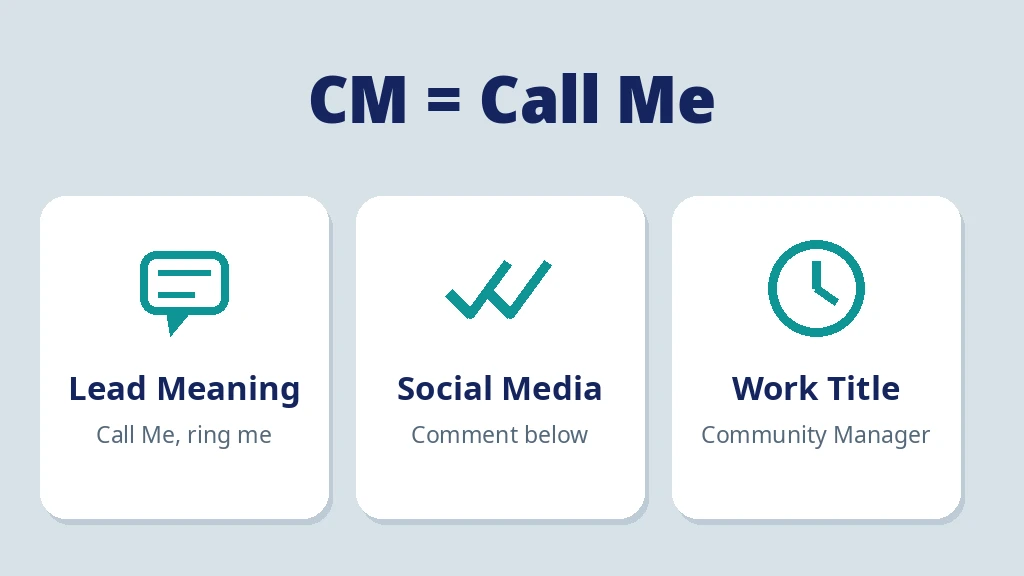
That is the lead meaning, but CM has a few side jobs too, from social media comments to office titles to plain measurements. This guide covers the lead first, then the rest, so you never mix them up.
What Does CM Mean in Text?
CM stands for Call Me.
It comes from the early days of mobile phones, when typing was slow and every character cost effort. Instead of writing “please call me when you get this,” people typed CM, and the habit stuck around long after keyboards improved.
Quick definition: CM means “Call Me.” People type it at the end of a text when they want a voice call instead of more typing, usually because the topic is urgent, complicated, or too personal for messages.
The call request is almost always friendly and practical. A friend who types CM is not ordering you around, they are saying the conversation has outgrown text. It could be good news they want to share properly, a plan that keeps getting tangled in messages, or something they would rather explain than type.
CM also has secondary meanings that depend on the platform. On social media, CM can mean Comment, as in “CM for the link” or “CM your answer below.” At work, CM can mean Community Manager or Content Manager, a job title. And in measurements, cm is the symbol for centimeter, which is a unit of length, not a texting term at all. A related chat reading is Check Message, as in “CM, I sent you the details,” though Call Me remains the dominant texting sense.
CM Meaning in Easy Words
Think of it like this:
You and a friend are texting back and forth about weekend plans, and the messages keep crossing over each other. One of them finally writes “CM.” That is the moment the typing stops and the talking starts.
So in the simplest words:
CM = “Ring me, this is quicker by phone.”
It is not a question and it is not a command in a bossy sense. It is a shortcut for a polite request: “I would rather talk about this than type about it.” If you see CM and you cannot call right away, a quick “Can’t call now, text me the short version” is a perfectly good answer.
Where Is CM Used?
CM as “Call Me” lives in private chats, while its other meanings live in public or professional places. Keeping those worlds separate makes decoding easy.
Call Me contexts:
- Text messages and WhatsApp chats between friends and family
- Messages after a missed call: “Saw your call, CM”
- Chats where plans get complicated and typing slows everything down
- Urgent messages where tone matters more than words
Other CM contexts:
- Social media captions asking followers to comment: “CM your favourite below”
- Work chats and emails about a Community Manager or Content Manager
- School, DIY, and shopping messages giving a length in centimeters
- Group chats where someone writes “CM” to mean “check the message I just sent”
Why Do People Use CM?
Typing has limits
Some news is better spoken. Tone, laughter, and hesitation all disappear in text, and CM is the fastest way to switch to a channel that keeps them.
It is faster than explaining
Writing “please call me when you have a minute because this is complicated” takes time and sounds formal. CM does the same job in two letters.
It signals urgency without panic
CM says “this matters” without using caps lock, exclamation marks, or a string of worried emojis. It is calm urgency, which is why friends trust it.
It ends texting loops
Long back and forth chats about times, places, and plans often go in circles. CM breaks the loop by moving the conversation to a call, where it can be settled in a minute.
Real-Life Examples of CM
Let us see how people actually use CM in daily conversations:
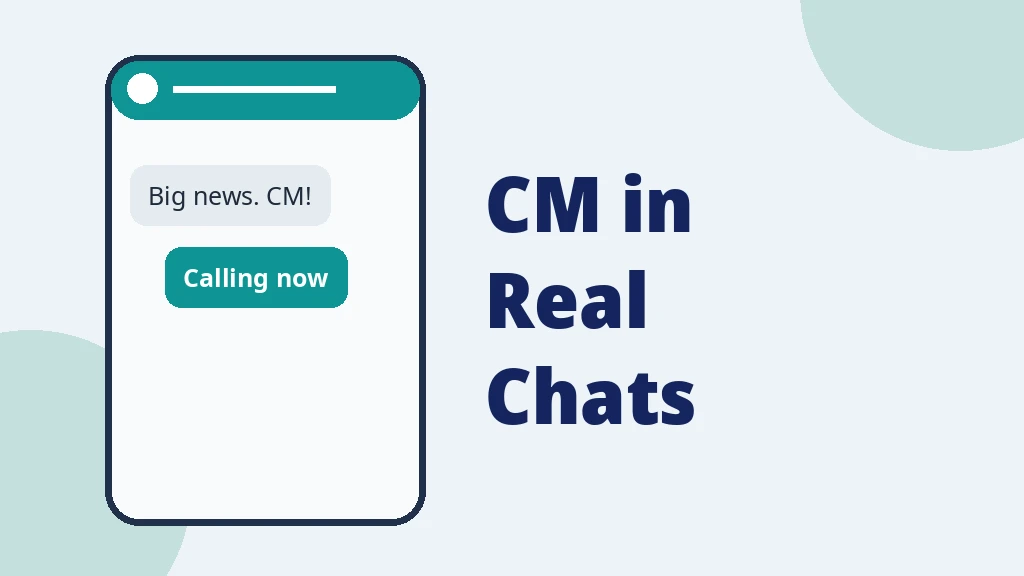
Example 1:
- Friend: “Big news about the trip. CM!”
- You: “Calling now, do not spoil it in text!”
Meaning: Call Me. The news is too good, or too complicated, for a text message.
Example 2:
- Friend: “We need to sort the tickets, it is getting messy. CM when you are free.”
- You: “Free in ten, I will call you then”
Meaning: Call Me, with a polite time window. The plans need a real conversation.
Example 3:
- Caption: “CM your favourite song below and I will make a playlist!”
- Follower: “My pick is in the comments!”
Meaning: Comment, not Call Me. A public caption asking for comments is a different world from a private chat.
Example 4:
- Friend: “CM, I sent the address in the group.”
- You: “Got it, thanks!”
Meaning: Check Message. The sender is pointing you to a message they already sent, not asking for a call.
CM vs Similar Terms
| Term | Meaning | What it asks for |
|---|---|---|
| CM | Call Me | A phone call |
| BRB | Be Right Back | A short wait |
| DM | Direct Message | A private message |
| TTYL | Talk To You Later | Ending the chat |
| HMU | Hit Me Up | Contact me somehow |
Key difference:
- CM asks for a voice call specifically. HMU is vaguer: a text, a call, or a message would all satisfy it.
- DM moves a conversation to private messages, while CM moves it off text entirely, onto a call.
- BRB and TTYL are about pausing or ending a chat, while CM is about changing how you talk.
And if someone says they will be right back before they call you, the two shortcuts work as a pair. Here is what BRB means in text and how it fits with a call request.
CM Variations You Should Know
“CM ASAP” adds urgency. It means “call me as soon as possible,” and it should only be used when the matter really is urgent, or it loses its power fast.
Lowercase “cm” usually means centimeter in a measurement context (“the box is 20 cm long”), while uppercase “CM” in a chat usually means Call Me. Case is a useful clue here, unlike with many other abbreviations.
cm as “come on.” In casual chats, a bare “cm” is sometimes used to hurry someone up or cheer them on, short for “come on,” as in “cm, we are leaving.” This reading is minor and easy to misread, which is why most people write CMON when they mean come on. If a “cm” arrives with no call being discussed and the chat is about leaving or hurrying, come on is the likely sense. A few lists also give CM as “checkmate” in chess talk.
How to Reply to CM
Your reply depends on whether you can call, and whether you know which CM you received.
If you can call: just call, or confirm first. “Calling now” or “Give me two minutes” are both perfect replies.
If you cannot call: say so and offer text instead. “Can’t call right now, but I can text, what is up?” respects the request without ignoring it.
If it was a comment request: comment, do not call. A creator asking followers to “CM below” wants engagement on the post, not a phone call from every follower.
If it was a work title: treat it as a role, not a request. “Ask our CM” means find the person with that job, not pick up the phone.
If you are the one sending CM: add a time hint when you can. “CM when you are free” is kinder than a bare “CM,” and it gets you a faster callback.
When to Use CM (and When to Avoid It)
Good situations:
- Texting friends and family when a call would settle things faster
- After a missed call, to say “call me back”
- When news is good, complicated, or needs tone of voice
- When a text thread is going in circles about plans
Avoid using CM when:
- The message is for work or anyone formal. Write “please call me” in full
- You are posting publicly, where followers may read it as “comment”
- The matter is simple enough for one short text. Do not demand a call for a yes or no answer
- You know the other person cannot take calls, such as during work or class
Common Misunderstandings About CM
It does not always mean Call Me. In a public caption it usually means Comment, and at work it can be a job title. Private chats are where Call Me rules.
It is not a demand. CM sounds abrupt because it is short, but between friends it is a friendly request, not an order. Tone comes from your relationship, not the letters.
It is not the same as HMU. HMU leaves the channel open: text, call, or message. CM picks one channel, a voice call, and that specificity is the point.
It is not a measurement in chats. Lowercase cm for centimeters belongs in DIY, shopping, and school messages. If a friend texts “CM” in caps at the end of a chat, they are not measuring anything.
Pro Tips for CM
Respect a CM the same way you would a missed call. If a friend asks you to call, a quick reply, even “can’t call, text me,” beats silence.
Frequently Asked Questions
What does CM mean in text?
In texting, CM usually means “Call Me.” It is a short request to switch from typing to a voice call, usually because the topic is urgent, complicated, or easier to explain by talking.
What does CM mean on Instagram or TikTok?
On social media captions, CM often means Comment, as in “CM your favourite below.” A public caption is asking for comments, not phone calls, so the platform changes the meaning.
What does CM mean at work?
At work, CM can mean Community Manager or Content Manager, a job title for someone who runs social media or content. The work topic points to the professional meaning.
Does CM ever mean Check Message?
Yes, sometimes. In chats, “CM” can mean “check the message I just sent.” This reading only fits when the sender has just sent another message for you to read.
Is CM rude?
Usually not. Between friends it is a friendly, practical request. It only feels abrupt if it arrives with no context, or if it demands a call for something a short text could have settled.
How do you reply to CM?
If you can call, call or say “calling now.” If you cannot, reply honestly: “Can’t call right now, but I can text, what is up?” That respects the request without ignoring it.
Can CM mean come on?
Sometimes. In casual chats a bare “cm” can mean “come on,” used to hurry someone or cheer them on. It is a minor reading, and CMON is the clearer spelling, so if no phone call fits the chat, come on may be the sense.
Related Texting Slang
Keep exploring the dictionary: when someone texts you CMP, the meaning of dm me, HBU, SMH in chats and texts, WYN, explained with real examples.
Final Thoughts
CM is one of the simplest shortcuts in texting, and that simplicity is its strength. In a private chat it means “Call Me,” a two letter bridge from typing to talking, and it still works because some conversations really are better spoken than typed.
Just remember the side meanings before you act: Comment on a public post, a job title at work, centimeters in a measurement, and occasionally Check Message in a chat. The setting tells you which one you are reading, and the private chat setting is where Call Me wins.
The call meaning is the one texting glossaries document first. CyberDefinitions lists CM as “Call Me” for texting, and Dictionary.com also records CM as an abbreviation used in messages, which matches how private chats actually use it.