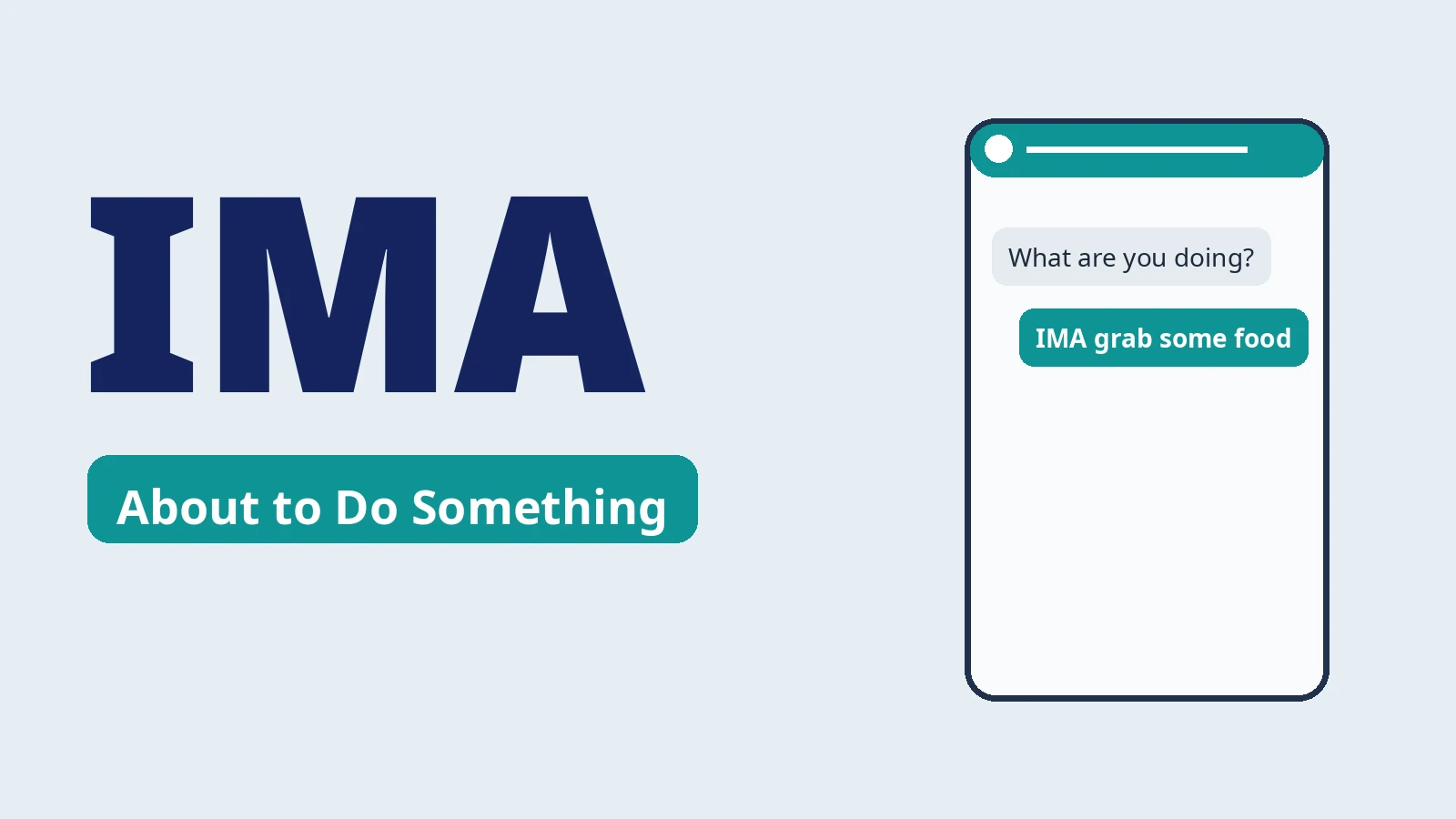
Your friend texts you at noon: “ima grab some food, want anything?” You read it in half a second and you already know the plan. Nobody spelled it out in full, and nobody needed to.
Here is the short answer: IMA means “I’m going to.” It is a contraction of the slang phrase “I’m gonna,” and it announces what the writer is about to do. It is fast, casual, and almost always followed by a verb, as in “IMA call you back” or “IMA head out now.”
In this guide you will learn the ima meaning in text, the second sense that changes the whole sentence, the spellings IMMA and I’MA, and the mistakes that mislead readers.
What Does IMA Mean in Text?
IMA is a shortcut for a plan. It takes the three words “I am going to,” squeezes out the spaces and the extra letters, and leaves three letters that do the same job in half the time. The path is simple: “I am going to” becomes “I’m gonna,” which becomes the typed “IMA.”
Quick definition: IMA means “I’m going to.” In most texting and social media use it announces an intention or a plan, and it is usually followed by a verb, as in “IMA eat first” or “IMA talk to him tomorrow.”
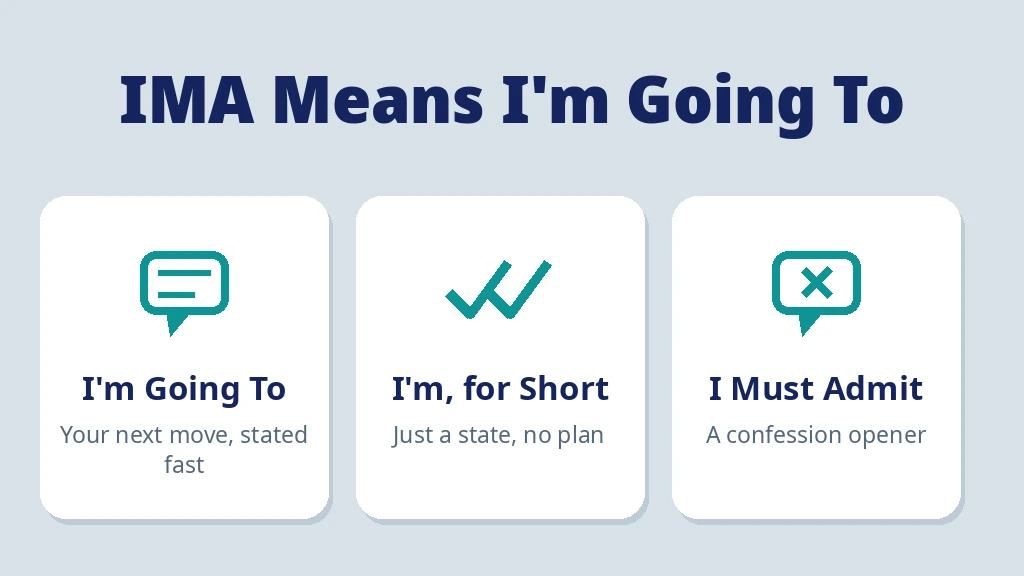
The sources agree on the lead. CyberDefinitions says IMA is most often used online and in text speak to indicate that the sender is about to do something, and it calls IMA a contraction of the slang phrase “I’m gonna.” The niche guides that rank for this term say the same thing in different words: texting.io calls “I’m going to” the most common meaning of IMA, bookmakingblog says IMA mainly stands for “I’m going to” or “I’m gonna,” and 7ESL lists “I Am (Going To)” as the most common meaning.
IMA also has a second, smaller job. When IMA opens an opinion instead of a plan, it can mean “I Must Admit,” as in “IMA, that film was better than I expected.” CyberDefinitions lists this as a second definition, and 7ESL and texting.io confirm it. The sentence around IMA tells you which job it is doing: a verb after IMA means a plan, an opinion after IMA means a confession.
IMA Meaning in Easy Words
Think of IMA as a raised hand that says “here is what I am about to do.” That is the ima meaning in one image.
When someone raises a hand in a classroom, you do not need a speech to know what comes next. IMA works the same way in a chat. It points forward. The words after it are the plan, and IMA itself is just the signal that a plan is coming.
In the simplest words:
IMA = “Here is what I am about to do next.”
Where Is IMA Used?
As ima slang, IMA lives in fast, informal writing.
Common places:
- Private texts and DMs, when someone announces a plan or a next step
- Group chats, where short plan announcements keep the conversation moving
- Snapchat chats and comments, where short messages are the norm
- Instagram and TikTok comments and captions, often announcing what the writer will do next
- Rap lyrics and hip-hop, where “IMA” is the spoken “I’m gonna” written down
Why Do People Use IMA?
It is faster than the full phrase
“I am going to” is five syllables and a lot of keystrokes for a message whose only job is to announce a plan. IMA is three letters.
It sounds like the way people talk
Nobody says “I am going to” out loud in a casual chat with a friend. They say “I’m gonna.” IMA is that spoken sound written down, so a text that uses it reads like a voice message in text form.
It keeps the plan in one breath
A plan announcement works best when it arrives whole: who, what, when. “IMA call you back in five minutes” is one thought in one line. For a quick note that you are leaving, here is what BRB means in text, the classic “be right back” that pairs naturally with an IMA plan.
Real-Life Examples of IMA
Here is how IMA actually shows up in chats and comments:
Example 1:
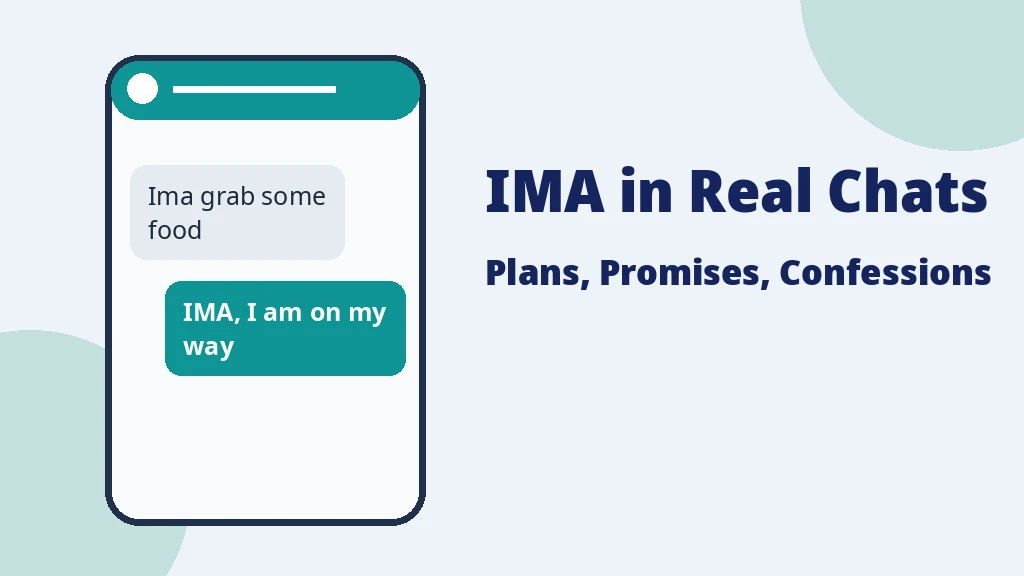
- Chat: “Ima grab some food, want anything?”
Meaning: “I’m going to grab some food.” A plan announcement, and an offer in the same breath.
Example 2:
- Chat: “IMA head out now, the bus is here.”
Meaning: “I’m going to head out now.” The plan plus the reason.
Example 3:
- Chat: “IMA, that film was better than I expected.”
Meaning: “I must admit, that film was better than I expected.” The second sense, opening a confession.
Example 4:
- Chat: “Ima call you back in five minutes, I am in the middle of something.”
Meaning: “I’m going to call you back.” A promise with a time attached.
Example 5:
- Comment: “IMA try this recipe tonight, it looks too good to skip.”
Meaning: “I’m going to try this recipe tonight.” A public plan under a cooking video.
IMA vs Similar Terms
| Term | Meaning | When to use it |
|---|---|---|
| IMA | I’m going to | Announcing a plan or next step in a casual chat |
| IMMA | I’m going to | The same meaning, a different spelling of IMA |
| I’m gonna | I am going to | The full spoken form IMA comes from |
| I Must Admit | A confession opener | When IMA opens an opinion, not a plan |
| BRB | Be right back | Announcing a short absence, not a future plan |
| IG | I guess | A reluctant guess, not a firm plan |
Key difference: IMA and IMMA are the same word in two spellings, and “I’m gonna” is the full spoken form they both come from, so there is nothing to choose between them except habit. The real choice is between IMA and its neighbours: BRB announces a short absence and a quick return, while IMA announces whatever comes next. IG is the opposite energy from IMA: IMA states a plan firmly, while IG hedges with “I guess.” If you are not sure about the plan at all, here is what IG means in text, the shrug that fits a maybe better than a plan.
Keep IMA apart from “I might add” too. That is a real minor sense of IMA, but it sits at the end of a sentence, as in “The food was great, IMA,” while the plan sense sits at the start, as in “IMA cook tonight.” Position is the clue.
The Other IMA Meanings You Should Know
“I Must Admit” is the real second sense. CyberDefinitions lists it as a second definition, and 7ESL and texting.io both confirm it. It appears when IMA opens an opinion or a confession, as in “IMA, I was wrong about him.” It is rarer than the plan sense, but the sentence around it makes it obvious: an opinion follows, not a verb of action.
“I Might Add” is a minor sense with real support. Texting.io lists it as a meaning of IMA when it comes at the end of a statement, and Disabled World’s texting abbreviations list gives “IMA – I Might Add.” It is a small afterthought sense, as in “The food was great, IMA.” Check the position: end of a sentence means an afterthought, start of a sentence means a plan.
“In My Arms” is an unverified claim. One guide (slangify) lists it as a romantic reading of IMA, but no other independent source agrees, and it does not match how the term is used in real examples, where IMA starts a sentence about doing something. Treat it as unproven, and do not use IMA to mean “in my arms” yourself: almost nobody will read it that way.
Outside texting, IMA has formal meanings. In business, IMA stands for the Institute of Management Accountants. In India, it can stand for the Indian Military Academy or the Indian Medical Association. None of these is a texting meaning, and none of them will appear in a chat about grabbing food.
Spelling rule in one line: IMA, IMMA, and I’MA are the same contraction; the spelling changes nothing about the meaning.
How to Reply to IMA
Your reply depends on which IMA you just received: a plan and a confession need different answers.
If it was a plan: answer the plan. “Okay, see you soon” or “Grab me one too” is enough. If it was a promise with a time, like “IMA call you back in five minutes,” a short “sounds good” confirms you heard it.
If it was a confession: answer the opinion. “IMA, that film was better than I expected” deserves a real reply, like “I told you!” or “Okay, I will give it another try.”
If you want to use IMA yourself: put it at the start of the sentence and follow it with a verb, as in “IMA eat first, then I will come over.” Do not use it in a work email, and do not leave it standing alone with nothing after it, because the reader will be left waiting for the plan that never arrives.
When to Use IMA (and When to Avoid It)
Good situations:
- Announcing a plan to a friend in a private text or group chat
- Promising a reply or a call with a time attached
- Opening a light confession with “IMA” before an opinion
Avoid using IMA when:
- You are writing a work email, a school assignment, or any formal message
- You are talking to someone who does not text in slang and may misread it
- You mean “I am a…” as in “IMA student”, since most readers will read “I’m going to student” instead
- You want the romantic “in my arms” reading, since almost nobody will read it that way
Common Misunderstandings About IMA
IMA does not mean “I am a…” This is the most common mistake. “IMA student” looks like “I am a student,” but IMA is a contraction of “I’m gonna,” not a fragment of “I am a.” If you write “IMA student” expecting people to read “I am a student,” most of them will read “I’m going to student” instead. Write “I am a student” in full.
IMA is not a formal acronym. In a casual chat, IMA is never the Institute of Management Accountants, the Indian Military Academy, or any other organisation. Those expansions belong to business and official writing.
IMA does not always mean a plan. The “I must admit” sense is real, and it flips the sentence from a plan to a confession. “IMA, I liked it” is not a plan to like something later. It is an admission right now. Read the words after IMA before you decide what it means.
IMA is not the same as IMMA in meaning. Actually, that is false: some readers treat IMMA as a different word, but it is not. IMMA and I’MA are the same contraction in different spellings, and they mean exactly what IMA means.
Frequently Asked Questions
What does IMA mean in text?
IMA means “I’m going to.” It is a contraction of “I’m gonna” and announces what the writer is about to do, as in “IMA call you back.”
Does IMA mean the same thing from a girl or a guy?
Yes. IMA means “I’m going to” no matter who sends it, and it carries no romantic hint on its own.
What is the difference between IMA and IMMA?
There is no difference in meaning. IMMA and I’MA are alternate spellings of the same contraction of “I’m gonna,” and they are used interchangeably.
Does IMA mean “I must admit”?
Yes, as a second sense. When IMA opens an opinion instead of a plan, as in “IMA, that film was better than I expected,” it means “I must admit.” CyberDefinitions lists this as a second definition.
What does IMA mean on TikTok?
On TikTok, IMA usually means “I’m going to” in comments and captions, often announcing a plan like “IMA try this tonight” under a video.
Should I use IMA at work?
No. It is informal slang, and in a work email it will look careless. Write “I am going to” in full instead.
Final Thoughts
IMA is a small word with one clear job: it tells you what someone is about to do. It means “I’m going to,” it comes from “I’m gonna,” and in most chats it is followed by a verb and a plan. The second sense, “I must admit,” is real too, and it turns the same three letters into a confession instead of a plan. That is the ima meaning in text in one line.
Now you can read it at a glance: a verb after IMA means a plan, an opinion after IMA means a confession, and a bare “IMA” with nothing after it means the writer stopped halfway.
The lead is documented by CyberDefinitions, which says IMA is most often used to indicate that the sender is about to do something, as a contraction of the slang phrase “I’m gonna.” For the short absence that often follows an IMA plan, here is what BRB means in text, the “be right back” that fits the same fast chat.